Precision reduces equipment cost of ownership through AI-driven component life optimization
First applied to mud pump components, the solution predicts up to 88% of fluid end failures, reducing mud pump Code-8 NPT by 75%
By Andy Wang, Prescient Devices, and Russell Whitney, Precision Drilling
The drilling industry has been on a continuous trajectory to drill faster while supporting increasingly complex wellbores. This pursuit is pushing rig equipment to their limits. At the 2026 IADC/SPE International Drilling Conference and Exhibition, Helmerich & Payne demonstrated the increasing workload on top drive systems, and Precision Drilling showed the trend of increasing mud pump Code 8 downtime. These not only create downtime risks but also increase maintenance demand and costs, and have been a concern for the industry.
Modern technology helps to mitigate these issues. Calendar-based maintenance is moving to condition-based maintenance, and preventative maintenance is moving to predictive maintenance. However, the drilling industry faces a technical challenge that many other industries do not have. Unlike industries such as manufacturing, where most of the equipment operates in a steady, constant-load state, drilling equipment operates dynamically with variable load due to well conditions. In other words, the conditions in which drilling equipment operates are much more complex and dynamic than equipment in many other industries. Because of this, traditional condition-based maintenance solutions that worked for other industries have not been as effective for the drilling industry.
Prescient Devices and Precision Drilling have been building an asset health solution specifically for drilling equipment since January 2023. This solution now monitors mud pumps, top drives, engines, mud systems, catwalks and batteries on 120+ rigs in the US, Canada and the Middle East. It has reduced nonproductive time (NPT) by 50-70% across Precision’s fleet while also achieving significant maintenance cost savings. This article discusses the technologies that were specifically built to solve drilling equipment maintenance challenges, reduce both downtime and maintenance costs, and serve as an enabler for field ops, remote ops and even the supply chain.
High impact, low-hanging fruit
The journey started with mud pumps. Why mud pumps instead of another equipment class such as the top drive? This was chosen deliberately. First, the mud pump components – in particular, the fluid end consumables – have a lot more failures than top drive components. For a land contractor, there may be a top drive failure every six months, but the mud pump could see a fluid end replacement every week. This makes it easier to validate the solution and enable it to improve based on failure data.
Second, while the mud pump is not the top NPT contributor, it is often the top cost contributor. Large drilling contractors spend millions of dollars a year replacing mud pump fluid end consumables, so there is an opportunity for business impact.
Third, because of the relatively high component replacement frequency, the field uses the solution on a daily basis to monitor pump health. Once they develop trust in the solution, it becomes a part of their daily routine. In contrast, if they started with the top drive solution, they would not pay as much attention to the solution since failures happen so rarely. This would reduce the chance of successful adoption. But if they started with and built trust in the mud pump solution, the top drive could be added to it later as part of the same solution. This is exactly what happened.
This methodology points out a couple of important considerations for digital solution adoption. First, choose problems that are high impact and low-hanging fruit. High impact alone is not a sufficient criterion if the problem is too difficult to solve. Second, user adoption is always difficult in the age of technology overload. Therefore, both technical risk and adoption risk need to be considered from the beginning of the project.
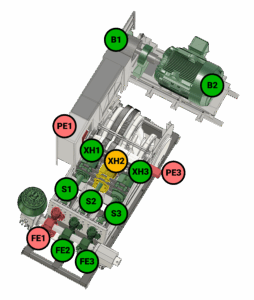
Precision Drilling installed vibration sensors at key locations on both the fluid end and the power end of the mud pumps. However, what the team found was that the failure predictions were only sometimes accurate. The company sought out Prescient Devices, which specializes in data processing and analytics, to understand why. It was found that the inaccuracy was due to the dynamic, variable load nature of drilling equipment operation. In traditional predictive maintenance, sensor values are used to predict anomalies. For example, if a vibration sensor reads 5 mm/s during normal operation, and then the sensor value trends up to 10 mm/s later, this could indicate a potential equipment anomaly. Real-world predictive algorithms are a lot more complex, and they can be physics-based or AI-based, but they all follow the same principle.
This approach does not work for drilling equipment. The dynamic nature of drilling equipment affects the sensor readings. When the standpipe pressure increases from 2,000 psi to 4,000 psi, the vibration value on a sensor placed on the fluid end could increase from 5 mm/s to 10 mm/s due to the pressure change. This means that sensor value variations could be caused by equipment anomalies or by normal equipment load change, and sensors alone cannot figure it out.
The solution to this challenge is adding real-time equipment operating conditions into the anomaly prediction model. For the mud pump, standpipe pressure, pump speed, mud flow and mud volume are considered, in addition to vibration. Unfortunately, this creates a new challenge: The model complexity increases significantly due to the additional parameters. In the Precision Drilling solution, more than 30 parameters are used to model mud pump behavior. This leads to a large number of possible parameter combinations – 10^43. Clearly the optimal parameter combination cannot be found manually.
This is where data-driven algorithms come in to help. Genetic optimization, which is an advanced algorithm to optimize very large numbers of parameters, is used to find the optimal parameter combination. This algorithm is computationally intensive – it takes 1.5 hours to run per pump on a powerful computer. However, the algorithm is automated and is run for each pump every quarter in the background to update the best model parameters.
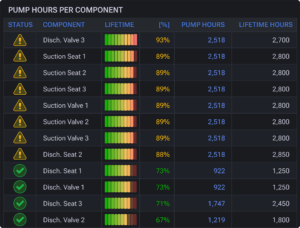
This model has been running on 300+ mud pumps across Precision’s fleet and predicts up to 88% of fluid end failures. In particular, the company has seen an 85% reduction in module failures, which has a significant cost impact since modules are the most expensive fluid end components. The mud pump Code-8 NPT has been reduced by 75%, and Non-Billable Revenue has decreased by over 90%.
Precision has also seen an ROP improvement of 28% for the rigs that had the solution compared with the rigs that had not yet deployed the solution. It is obvious that when the equipment is healthy, there is less disruption to performance. What’s less obvious is that if a pump is down, even if NPT is not affected, it reduces the mud capacity, which can reduce performance. This is an example of invisible performance degradation.
The method described thus far is called anomaly prediction, which is a predictive maintenance technique. This solution shows that anomaly prediction for drilling equipment needs to include real-time operational parameters in the model to make predictions accurate and effective. There is another predictive maintenance technique, called remaining useful life (RUL) prediction, which offers additional benefits to drilling equipment health. Unlike anomaly prediction, which predicts potential failures hours or days in advance, the RUL method predicts equipment component end-of-life weeks or months in advance. In addition, because RUL models capture the behavior of the equipment across its entire lifetime, they can be used to understand equipment performance much better than anomaly prediction models.
Physics-based RUL models have been used in the industry for decades. Techniques such as S-N curve, cycle counting and finite element analysis are well known. However, because the mechanisms of wear and tear for drilling equipment are very complex, these techniques either cannot generate accurate results or are overly time-consuming to build. In all cases, a model needs to be built for each equipment component.
Take mud pump fluid end consumables as an example: These components have complex wear-and-tear mechanisms, there are many of them, and they don’t cause critical failures. Hence, there hasn’t been extensive modeling on them despite the fact that they could cost millions of dollars a year.
The variable operating conditions that challenge anomaly prediction poses the same challenge to RUL prediction. Data has shown that the same mud pump consumables can last from several hundred hours of lifetime to several thousand hours, depending on the drilling condition. This wide variation makes both calendar-based and operating-hours-based replacement ineffective. For example, if replacement is based on the average total operating hours, then half of the time the component would have failed before the average total operating hours is reached. For the other half of the time, while failure is prevented, the component could have lasted much longer, so money is wasted.
If the life of every individual component on every pump can be predicted, then the life of every component can be maximized without running into failures. This sounds like fantasy, but with today’s advanced AI models and powerful computational capability, this has become a reality. Precision Drilling’s RUL models monitor more than 7,000 equipment components today with over 90% accuracy. That means, for nine out of 10 components, the predicted lifetime is within +/-5% of the actual lifetime of that component.
Another benefit of the AI-driven approach is that building the model for one component class is the same as building the model for a different component class. Unlike physics-based models, where if one component’s geometry or wear-and-tear pattern is different from another component, then an entirely new model needs to be built. For AI models, the process is the same for different components. Thus the model for multiple component classes can be trained at the same time.
Precision’s RUL model is based on Transformer, which is a deep learning AI model architecture. Transformer is the foundational model behind large language models (LLMs) such as ChatGPT. In fact, the “T” in GPT stands for Transformer. Unlike LLMs, which focus on text data, the RUL model focuses on numerical data. It is a custom-built model incorporating 96 billion operational data points for training, with over 2 million model parameters.
The major disadvantage of AI is that, because it is entirely data-driven, the quality of the model depends on the quality of the data. If the data is inaccurate or incomplete, the AI output can be wrong. Therefore, AI model accuracy needs to be carefully validated and monitored.
Precision’s RUL models are built into the rig’s operational workflow, and the benefits are immediate. In the past, there was a wide variation in how many consumables each rig uses. Some rigs replaced components conservatively and consumed four times as many components as other rigs. With RUL models, the rigs have the guidance to replace components at close to end-of-life, and the average component life has increased by more than 50% across the fleet. This not only generates significant cost savings in equipment components, but it also reduces unnecessary maintenance activities for the crew.
Another benefit of the RUL model is its ability to evaluate the quality of the components. Because the drilling conditions are so different from basin to basin, the industry has not been able to compare the quality of components from different vendors. Is a liner with an average life of 1,000 hours in the Permian worse than another liner with an average life of 1,200 hours in Athabasca? Not necessarily, because the conditions are very different between the two basins. The Transformer architecture enables the model to normalize the differences, making objective comparison possible. Precision is already using this capability to select the best-quality components for each basin.
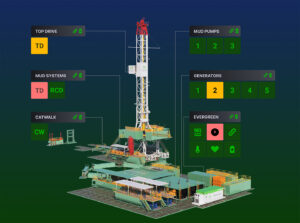
At Precision, the anomaly prediction models and RUL models are built into a comprehensive asset health digital twin solution, which serves not only field crews but also remote operations, equipment managers, technicians, supply chain and the finance department. The solution processes 3 billion data points per day, utilizes 3,300 equipment and 5,000 sensor data tags, and monitors over 7,000 equipment components. This is the largest such solution deployed to date in the industry, and its benefits include sustained 50-70% NPT reduction fleetwide, 38% reduction in maintenance costs, 85% reduction in mud pump fluid end modules and 54% extension of mud pump fluid end component life. This solution demonstrates that when AI-driven solutions are designed to solve the right technical and adoption challenges, they can generate transformative business impact. DC
This article is based on a presentation from the 2026 IADC Drilling Onshore Conference, 14 May, Houston.