Generative and agentic AI solutions unlock new insights for drilling
Gen AI applications for drilling continue to mature even as emergence of agentic systems adds new dimension to use cases
By Stephen Whitfield, Senior Editor
Over the past decade, traditional AI and machine learning technologies have already become widely adopted in the drilling sector. They’re often applied for equipment failure prediction, drilling parameter optimization or reservoir characterization. Most of the value that is generated comes from the technologies’ ability to detect patterns in historical or real-time data and then produce outputs that support faster, more consistent decision making.
Generative AI plays a different role. Rather than simply predicting an outcome, it acts as the interface between people and information. Drilling contractors and E&P companies operate with enormous volumes of structured and unstructured data, such as well reports, maintenance histories, engineering specifications, inspection records, operating procedures, project documentation, safety cases and vendor manuals. Much of this information is difficult to search, compare and interpret quickly.
“The gathering of the data is a huge thing,” said Fabio Concina, Head of AI and Analytics at Kwantis. “I don’t think that should be a specific job of the drilling engineer. The drilling engineer needs to come up with mechanical engineering solutions – for example, why is something not performing as we expect? Or why are we having issues with something? That’s why we’re developing systems to help remove some of that friction for the drilling engineer.”
For technology developers, generative AI serves as the foundation when creating analytic software platforms that can sort through rig and well data and extract insights to help bolster drilling performance.
“A generative AI system is solving an information retrieval problem rather than an information creation problem,” said Viswanath Avasarala, Founder and CTO of DeepIQ. “So, how do we retrieve the data that you need? You can have an agent where you’re asking a basic question like, what’s the best way to drill when I encounter a certain formation? And the system will tell you the signals to look for in a given formation. That output can look impressive, but if you don’t have the deep domain expertise, the output could have very low accuracy.”
When generative AI first emerged, the use cases were easy to spot. Low-hanging fruit involved tasks such as word search, automating reports and summarizing documents, as well as faster access to technical knowledge across well files, maintenance records, engineering documents and operating procedures.
However, as generative AI models have advanced, companies are looking beyond knowledge retrieval and content generation. They’re increasingly focused on systems that can reason across multiple data sources, plan a sequence of steps, interact with enterprise tools and support defined workflows.
For companies like SLB, agentic AI tools have emerged as the next evolution of generative AI. Rather than just summarizing a maintenance history or retrieving an offset well report, agentic AI is now increasingly being used to help drillers and operators identify relevant context, recommend next steps and support decision making. An agentic system can plan, sequence and execute multistep actions by interacting with data sources, enterprise systems, engineering tools and digital workflows.
“How can you have a predictable outcome every time in a drilling operation?” said Maged Eltom, Digital Drilling Global Director at SLB. “If you want to have a predictable outcome and you want to scale it in, say, a deepwater drilling operation, you essentially need to clone your SMEs, but of course that’s not possible. That’s where the agentic AI agents come in. I think the next evolution in boosting performance can be unlocked by wisely using agentic workflows within the drilling domain.”
Using Gen AI to analyze daily reports
For the past decade, Kwantis’ ID3 system has served as a valuable tool for aggregating drilling data, storing that data and analyzing KPIs to optimize drilling and completion operations. Over the past two years, the company has turned to Gen AI tools to help bolster the system’s functionalities.
“We reached a point where we felt the Gen AI technology was good enough for our applications. The models reached a stage where it was feasible to provide the kind of reliable assistant that we had in mind. I would say that’s mainly due to the reduction in hallucinations, which were a big issue with these models. But these models are constantly getting better, and we’ve seen a big shift in the quality of the responses,” Mr Concina said.
Last year, the company added AI agents to its ID3 Reporting module, an application within the ID3 system that helps enhance the monitoring of well execution through a broad spectrum of daily reports, including DDR, HSE reports and BHA reports.
The ID3 Reporting module combines deterministic algorithms – algorithms that, given a specific input, will always follow the exact same series of instructions and produce the exact same output – with large language models (LLMs) to automate DDR data capture and reporting. A segmentation algorithm analyzes stand detection patterns and sensor readings to identify intervals of similar drilling activities. This allows the system to automatically generate time logs while offering configurable granularity, enabling operators to adjust the resolution of activity tracking according to specific operational needs. Once activity segments are identified, descriptions are generated using customizable templates populated with parameters that are derived from rig sensor data. This approach ensures consistent reporting while still capturing the specific details of each drilling operation.
To assign IADC activity codes, the system uses a retrieval-augmented generation (RAG) pipeline built on historical operational data. The model retrieves relevant examples of user-assigned codes from previous operations and infers from them the most appropriate codes and subcodes. Each assignment is accompanied by a justification.
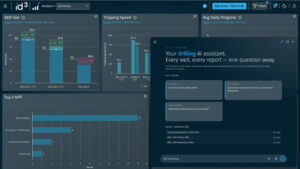
In addition to the reporting module, last year Kwantis launched an upgraded AI assistant to run with the ID3 Benchmark module, an analytics platform that automatically integrates and analyzes high-frequency data (rig sensors) and low-frequency data (reports). The assistant uses LLMs to handle complex queries and reduce cognitive load for drilling engineers. A feature within the assistant enables users to dynamically track drilling performance as operations unfold and continuously compare live results against predefined operational targets. This allows for early deviation detection and faster decision making.
A chatbot was also embedded into the assistant. Instead of navigating multiple dashboards or relying on SQL expertise, drilling engineers can simply ask questions in natural language and receive immediate, data-driven answers. The assistant not only retrieves information from multiple datasets but also interprets results, enabling faster and more intuitive decision making.
Behind the scenes, the system combines technologies such as LangGraph, LangChain and LLMs from OpenAI. User queries are automatically translated into SQL, executed across structured and semi-structured data sources, and returned as clear, contextualized insights. Built-in safeguards ensure accuracy, data security and controlled access.
With natural-language queries, users without SQL expertise can perform advanced analyses, making critical information accessible to a wider range of team members. This instant access to insights allows for faster, more informed decisions, with KPIs interpreted in real time to support operational responsiveness.
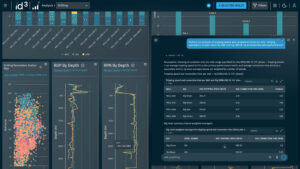
“You can ask any possible question regarding the well, relative to the data we have,” Mr Concina said. “Maybe you have a question about the lithology, formations or trajectory – the chatbot can gather all of that data to answer the question that’s been asked. For instance, you could ask it, ‘How was the drilling performance across the different lithologies?’ Then you can ask, ‘Why was the performance lower within this particular lithology? Can you also analyze what kind of bit was used to cross that specific lithology?’ ID3 is already doing all of this analysis, and the chatbot makes it easier for people to tap into that.”
The assistant supports persistent conversations with saved and titled chat histories that can be resumed across devices. It also introduces resumable streaming, live reasoning that visualizes data retrieval in real time, session memory for reusable datasets and parallel data fetching for faster multi-well analysis.
Going beyond the assistant, Mr Concina said the company is also releasing an agent that would evaluate data quality and highlight potential gaps in reporting and output generation.
“This system is still very much evolving. It’s a constant development. We have a feedback button in the assistant where the user can tell us if it gets an answer wrong, and we see all that feedback. Sometimes the assistant will say, ‘No, I don’t have the data to answer this kind of question,’ or the model selected the wrong tool to answer a question. These are the things we are trying to address. Because these models are probabilistic in nature, that’s not an easy task – you have to expect that sometimes these models will do something unexpected – but we’re trying.”
From generative to agentic AI
Generative AI can help engineers navigate the complex data-sorting process by extracting relevant context, synthesizing information and turning fragmented data into usable insight. Agentic AI takes this a step further by going beyond generating answers or summarizing information. An agentic system can plan, sequence and execute multistep actions by interacting with data sources, enterprise systems, engineering tools and digital workflows. SLB sees significant potential value in applying generative AI within agentic workflows so drillers can process data faster.
“For drillers, the challenge is having a consistent and predictable operation. Every drilling manager wants to improve efficiency over the full well cycle – planning the well, drilling the well, completing the well. That’s the value we want to give to the customer. Agentic AI helps us get there faster,” Mr Eltom said.
Agentic AI systems build on the LLMs used in generative AI, but they add layers of autonomous execution. Autonomous agents are software programs that use AI to perceive their environment, make decisions and take autonomous actions to achieve a specific goal. Unlike traditional chatbots that respond only to text, AI agents use reasoning, memory and external tools to execute complex, multistep workflows.
Most modern AI agents are built using the LLMs in Gen AI systems, which serve as the brains of the agent and are structured around a continuous loop of action. It works by analyzing user inputs or data from its environment. It then processes a goal as defined by a user, planning the necessary steps to execute the goal. From there, it uses built-in tools like applied programming interfaces (APIs) or web browsers to interact with external systems and execute the steps. The agent then reviews the result, catches any of its own mistakes and repeats the cycle.
While agentic AI represents an important step toward autonomous operations, its role must be supported by human expertise, Mr Eltom stressed. “Gen AI and the agents are not there to replace the expertise. There are different levels of agents. You can have an agent that gives you basic insights, and you have the agents doing the data exploration, providing insights for things like planning or drilling fluid optimization. Then you have another tier like advisory agents, where it actually assists and can recommend an intelligent direction to the engineer or to the SME on what to do next. But the human still has to be there.”
Recent developments at SLB illustrate the company’s work with generative AI and agentic AI. In 2024, the company launched SLB Lumi, an enterprise-grade data and AI platform that integrates LLMs, domain-specific foundational models and generative AI algorithms directly into technical workflows like drilling, subsurface interpretation and production.
The platform connects to enterprise and operational systems (like legacy databases, sensors and structured/unstructured documents) to clean, standardize and centralize the data. It also provides a space for cross-functional teams to build and deploy machine learning models, traditional analytics and generative AI.
The open architecture of the Lumi platform frees data from structured and unstructured sources using standard and open protocols, including the Open Group’s OSDU Technical Standard, an open data standard for the energy industry. Cognite Data Fusion is leveraged to connect and analyze data, enabling contextualization functionalities that automate the creation of an intuitive knowledge graph, which is an AI framework that structures information into relationships between entities. This graph provides a flexible data model that allows the LLM to process human language.
To help users interact with the Lumi platform, SLB launched the Tela agentic AI assistant in 2025. Tela uses LLMs and domain foundation models to understand domain-specific contexts, generate insights and adapt workflows in real time based on observed outcomes. Drilling engineers can interact with Tela conversationally to analyze complex datasets, a process that SLB said takes just seconds and is meant to augment the workforce. For example, instead of manually compiling and studying well logs for hours, a user can ask Tela to interpret the logs and instantly receive context-rich, data-driven answers.
Tela follows a five-step operational loop: observe, plan, generate, act and learn. It analyzes real-time or historical data and determines the necessary steps to complete complex tasks. From there, it proposes insights into the data, generating data charts for engineers to further analyze if needed. It can then autonomously execute tasks, such as predict specific drilling issues. The system continuously adapts and improves future outcomes based on results observed by the engineer acting on those predictions.
“I would think of Tela as your co-pilot. If there’s a change in the subsurface model or a new geomechanical insight, how does the agent bring this to the attention of the drilling engineer? Tela is the way that the engineer interacts with the agent. The AI engine, the LLM model, is embedded within a framework, and Tela is the end-user experience that you’re interacting with,” Mr Eltom explained.
Further, Lumi’s agentic framework allows customers to build and manage their own Tela agents using SLB’s drilling foundational agent framework. From there, the customer can integrate partner-developed solutions and tailor capabilities to their operational priorities. SLB can also work with the customer to build tailored agents.
“The differentiating factor from agent to agent, regardless of who builds it, is the domain expertise within that agent,” Mr Eltom said. “Anyone can build a generic agent, but the outcomes and value you get from those agents may differ from customer to customer.”
Using AI agents on fragmented data
In an ideal scenario, a drilling engineer has access to information and data from a variety of sources when planning a well. However, informative records related to the use of a particular contractor or a specific piece of downhole, surface or subsea equipment could be located in a multitude of locations. Yet for most operators and drilling contractors, this knowledge remains scattered across engineering technology (ET), IT and OT systems, making it difficult to find, connect and apply when it matters most.
The result is that engineers spend a significant portion of the well planning process searching for information rather than engineering. Identifying comparable wells, reviewing historical risks, understanding why previous decisions succeeded or failed, and finding proven mitigation strategies often requires manually searching multiple databases and document repositories. Besides consuming valuable engineering time, this fragmented approach increases the likelihood of missed or misinterpreted critical data.
DeepIQ was developed to address this challenge by transforming fragmented enterprise data into contextual engineering knowledge that can be queried naturally using agentic AI. By combining contextual knowledge graphs with grounded AI agents, the company aims to help engineers make faster, better-informed decisions while ensuring that the knowledge they create remains securely under their own control.
“The problem isn’t a lack of data,” Dr Avasarala said. “Operators have decades of engineering knowledge, but it’s distributed across disconnected systems. We contextualize that information into a knowledge graph where every engineering object understands its relationship to every other object. That creates a trusted foundation for AI.”
Unlike conventional document search systems, which retrieve individual files, the knowledge graph preserves engineering context. Instead of asking engineers to piece together information from multiple reports, the platform allows AI to reason across connected operational knowledge. Built on this foundation, DeepIQ deploys domain-specific AI agents that support engineering workflows such as offset well analysis, well planning, drilling optimization and risk assessment. Engineers interact with these agents using natural language, allowing them to query decades of institutional knowledge without needing to understand where the underlying information resides.
For example, an engineer planning a new well can ask for wells drilled through a comparable formation at a similar depth using a specific bottomhole assembly. Rather than simply retrieving documents, the platform identifies comparable wells, summarizes drilling performance, highlights historical hazards, recommends successful mitigation strategies and surfaces optimization opportunities based on previous operational experience.
“Our AI agents don’t spend time trying to connect disparate datasets after a question is asked,” Dr Avasarala said. “Those engineering relationships have already been established in the knowledge graph. The agents reason over that contextual understanding, which allows them to provide highly accurate answers grounded in the organization’s own engineering knowledge.”
Dr Avasarala said this approach also addresses one of the biggest concerns surrounding industrial AI: reliability. While LLMs are excellent at generating language, he said, they can produce plausible-sounding answers that are unsupported by enterprise data.
The DeepIQ platform mitigates this risk by grounding every response in the customer’s contextualized engineering knowledge. If supporting information does not exist within the enterprise knowledge graph, the system identifies that limitation rather than generating speculative recommendations.
A defining characteristic of the platform is that organizations retain ownership of both their data and the knowledge graph created from it. DeepIQ is deployed within the user’s own cloud environment, allowing operators and drilling contractors to build an AI-ready engineering knowledge layer without relinquishing control of their intellectual property or operational data.
“We believe engineering knowledge is one of an organization’s most valuable assets,” Dr Avasarala said. “Customers shouldn’t have to move that knowledge into someone else’s platform to benefit from AI. We build the knowledge graph within their environment, where it remains under their ownership and governance.”
The practical benefits extend beyond conversational AI, according to DeepIQ. By making engineering knowledge immediately accessible, the platform shifts engineers away from manual data gathering and toward engineering analysis. Activities that previously required days or weeks of searching across multiple systems can often be completed in hours. Historical optimization practices become readily available for reuse, previous operational risks can be identified before drilling begins, and successful mitigation strategies can be incorporated directly into new well plans.
The platform is also designed to preserve institutional knowledge. As new wells are drilled, additional operational data, lessons learned and engineering decisions are incorporated into the knowledge graph, continuously expanding the organization’s engineering memory and improving the effectiveness of future AI-assisted workflows.
The company said the platform is being deployed across the energy sector, including with Austrian operator OMV. DC