Nabors, Corva advance digital partnership with integration of edge computing and AI
Combined system adds predictive analytic capabilities, standardizes KPI tracking through RigCLOUD, creates more connected workflows
By Stephen Whitfield, Senior Editor
Human experience and knowledge are critical guides for making decisions on the rig, but relying solely on individual experience can introduce bias and lead to inconsistencies across rig crews. Leveraging data can mitigate that bias, but traditional analytic systems lack scalability and connectivity, often creating disconnected workflows.
In September 2025, Nabors Drilling Technologies and Corva AI announced the launch of an integrated intelligence system addressing those traditional limitations. The system, RigCLOUD Powered by Corva, combines Nabors’s RigCLOUD edge computing platform with Corva’s AI platform-as-a-service (PaaS), providing a single source of KPIs and real-time analytics that drive more informed decision making and can help companies stay ahead of operational targets.
“This was an interesting opportunity to combine what we had and what Nabors had, to put it into a single platform as a service model,” said William Fox, General Manager for Drilling at Corva. “Everything is downstream of data quality, and the main value of something like this is being able to provide the highest quality data with the fewest gaps, all indexed and standardized across different vendors. Once everyone is looking at the same data in one place, the opportunity for stakeholders to collaborate in real time is 100% improved. You’re not looking at data on five different screens and trying to make decisions off of it.”
RigCLOUD captures real-time data from rig instrumentation, saves it securely to an edge computing system located on the rig and streams it to a cloud server. The data can then be streamed from the servers to applications within RigCLOUD, such as the SmartNAV directional guidance system, SmartPLAN execution engine or third-party applications.
The integrated solution takes that existing RigCLOUD platform and combines it with Corva’s AI PaaS. Data from the rig is still streamed onto RigCLOUD from the edge computing system.
But now, before that data is sent out to apps, it is fed into the Corva platform, which hosts AI and machine learning models that can analyze the data and provide various predictive insights, such as anticipating downhole vibrations or optimizing ROP in a given well. That data analysis and the predictive insights can then be sent to the apps hosted on the cloud server.
“If you’re on the rig site and you’re filling out your tour sheet in the morning, you’re doing that on the RigCLOUD platform. The data is exactly the same as the one you’re going to see in the cloud,” Mr Fox said. “As soon as you log in from a computer to go to RigCLOUD Powered by Corva, you are logging into the new RigCLOUD that is running on top of the Corva infrastructure. All the automated data ingestion and QA/QC pipelines are running in the background, so it’s transparent to the end customer.”
The integrated system expands upon a partnership between Nabors and Corva that has been ongoing since 2023, when the drilling contractor began using its own SmartROS rig operating system with Corva’s Predictive Drilling system. Predictive Drilling leverages AI and machine learning models optimized for rotary drilling to analyze drilling parameters in real time and execute optimal set points considering minimum and maximum thresholds. The resulting setpoints are then executed automatically in SmartROS.
RigCLOUD was already being used to connect Predictive Drilling to SmartROS, serving as a conduit for communication and to execute commands on the rig. However, separate data analytics systems – RigCLOUD Analytics and Corva’s own analytic system – were still being used to measure drilling performance. Because each system measured certain KPIs differently, this meant that drillers would get a different picture of performance depending on the analytic system they used.
“Any system calculating KPIs has raw data with logic and filtering, so each one is different,” said Tatiana Borges, RigCLOUD Director at Nabors. “For example, when you’re measuring the time it takes to make a connection, do you calculate from the point when you pick up off bottom, or from when you put in the slips? The differences in those calculations add up over time. Even something like ROP – there are so many different ways to calculate it. In our own systems, there are 10 different ways we’re calculating it. Do you do on bottom? Do you do gross ROP? Do you do it based on depth per hour?”
The integration of RigCLOUD and Corva systems now provides a single platform for analyzing data going through RigCLOUD, with Corva’s PaaS serving as the main analytic engine. It utilizes a set of neutral KPIs to track operational metrics. Aligning metrics in one source enables a shared performance baseline for all stakeholders in a given drilling campaign.
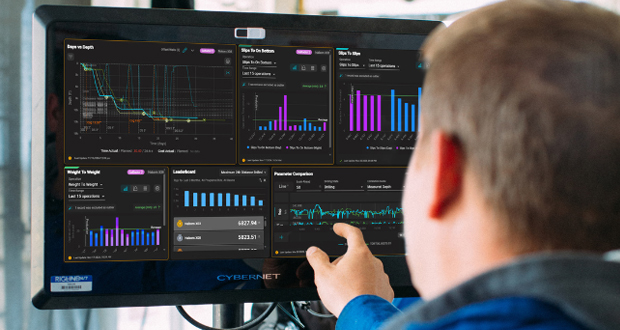
“Putting these metrics in front of whoever is doing the job is part of how we can prove performance,” Ms Borges said. “In the past, you would have the EDR in front of the driller, but you couldn’t really see everything – you couldn’t see your connection times, you couldn’t see your tripping speeds, you couldn’t see how fast you were running casing. These were all calculated in the back office. Now, the driller can see how long it takes to do the connection right after he finishes the connection, in real time. And then you have this ability to set objectives – like, what if you could do the connection in three minutes? How could you stay under that target?”
Ms Borges also noted how the neutral KPIs can help standardize end-of-well and daily drilling reports to minimize disputes and evaluate rig crew performance objectively. “As performance-based contracts become more common, transparency and consistency are critical. Having objective data readily available helps teams align on performance, identify areas for improvement and make more informed operational decisions.”
On top of providing a neutral set of KPIs for analysis, Corva’s PaaS also translates proprietary rig measurements into standardized, vendor-agnostic nomenclature within RigCLOUD. This aligns system architectures to ensure low-latency data flow, eliminating variations across different rig manufacturers. This makes it easier for the integrated RigCLOUD system to be used on non-Nabors rigs, and it can also be integrated with third-party operating systems upon request. Further, these standardized classifications are fed directly into SmartPLAN and SmartNAV for uniform drilling execution and directional guidance.
“We’ve taken on the burden of building a de facto standard and mapping it to how the end customer wants to see it,” Mr Fox said. “You look at something like time codes, for example. The drilling contractor is using their IADC-derived codes, while the operator may have their own codes and their own names for everything. We’ve taken that on. We map everything into an internal Corva standard, and we can automatically map it back out to the operator, the drilling contractor or any other third party. We’ve effectively built a data dictionary for every one of our customers – we may use ‘DRIL’ as our own time code for drilling, and if another company uses ‘DRIL’ for that same code, we’ll map that. It’s a core part of the system.”
The integrated RigCLOUD platform can be used to control the rig directly if paired with SmartROS, which is installed on all Nabors rigs. For third-party rigs not running SmartROS, RigCLOUD can still be deployed in an advisory-only format, providing the rig crew with real-time analytics and predictive recommendations without directly manipulating the physical rig controls.
“Some customers will want to use it only in advisory mode,” Ms Borges said. “They just want to see the numbers; they’re not ready to let it take control of the rig and actually move the pumps, the drawworks, the top drive. You can use RigCLOUD and Corva just to have the analytics.”
Moreover, the unified system gives users access to a single, connected interface where Corva’s App Store and analytics platform are natively embedded into RigCLOUD. The interface includes live 2D and 3D well path mapping and continuous anti-collision calculations, replacing the periodic static reporting that previously took place with the Predictive Drilling application. New operational dashboards will visually present the AI/machine learning outputs generated by Corva’s algorithms, such as optimal ROP and remote autodriller setpoint adjustments. These outputs were previously used solely by engineers at Nabors’ remote operating centers.
“We are a system built by drillers for drillers, so we’re trying not to disrupt the rig crews and the drillers that much,” Ms Borges said. “The workflow of the driller doing the pipe tally or zeroing their differential pressure hasn’t changed at all. They’re still using RigCLOUD. All we’re doing is giving them more visibility into the data that they use to measure their performance.”
The integrated solution has been deployed in the field since March 2026.
“When we first ran this on the rig, the driller was amazed,” Ms Borges said. “He said, ‘Are you telling me that now I can see how fast I’m tripping my pipe? Are you telling me now that I can see how much faster I’m doing my connections compared to before?’ For him, it was eye opening that he could gauge his performance in this way. Now they can even see how the night tour performed compared to the day tour, shift by shift.” DC
Click here to watch DC’s video with Tatiana Borges and William Fox on RigCLOUD Powered by Corva.