Intelligent, scalable digital service puts industry closer to autonomous well construction
Trial runs in Middle East, Australia, Argentina show potential for Baker Hughes’ AI-enabled solution to improve ROP, well placement
By Stephen Whitfield, Senior Editor
As wells become more complex and companies collect more downhole data, the need is growing for systems that can not only help process that data but also use that data to generate actionable insights. On top of that, well construction has traditionally relied on fragmented workflows and reactive decision making as downhole conditions change. Baker Hughes recently launched a new solution attempting to shift that paradigm.
In January, the company introduced its Kantori autonomous well construction solution, which utilizes a combination of AI, physics-based models and live well data to help its customers better evaluate wellbore conditions and guide execution. It encompasses a series of cloud-based and on-premise digital offerings targeting the entire well lifecycle, including applications for fluids monitoring, hydraulics optimization, ROP optimization and autonomous directional drilling.
The solution aims to embed intelligence directly into the operational workflow, enabling continuous drilling performance optimization with minimal manual intervention.
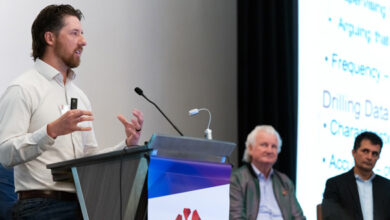
“I think the combination of domain expertise and AI is really the future of autonomous well placement,” said Matthias Gatzen, Executive Director – Digital Business at Baker Hughes. “Kantori is an evolution that we’re seeing in this space. We’ve taken all of our experience in how to drill a well autonomously, and we’re bringing in domain expertise, physics-based modeling and AI together.”
The applications are interconnected through a data analytic layer and a data visualization layer – essentially, the data coming from the rig site can be processed through each app simultaneously, giving a comprehensive view of drilling performance.
While the majority of applications are agnostic, meaning that they can run on their own within any user’s operating system, most of them were designed to run as part of a set of comprehensive services, meaning they’re used with each other or with other Baker Hughes systems.
The applications are scalable, whether for a single well or across an entire field. When used together, the apps consolidate multiple stages of well construction into a single digital framework, connecting data sources across the operation, integrating planning and execution tools, and applying analytics in real time to adjust parameters as conditions evolve.
For real-time drilling operations, the installation of an edge computing device at the rig captures sensor data from the rig and the well and transmits that data in real time locally to whatever application is used. The data captured depends on the application being used – for instance, the Kantori real-time fluids monitoring captures measurements of drilling fluids.
Corva AI functions as a foundational digital ecosystem alongside Kantori, providing more than 150 operational applications, 3D visualization of data and predictive insights. These AI applications work in combination with Kantori’s physics-based models, which are trained on fundamental scientific laws and mathematical equations to calculate real-world physical responses.
“There’s a lot of textbook knowledge in general of how to drill a well that we can use in developing the physics-based model,” Dr Gatzen said. “For example, if we talk about hole cleaning or stuck pipe, we have fluids experts who can develop their own models, and that may actually go way beyond any type of textbook knowledge that you can have. These models are then brought into the applications. If we have to go into something more specialized, we can build a general physics-based model combined with an AI model and then fine-tune that to account for certain behaviors or certain formation tendencies.”
By combining the physics-based models of Kantori with AI, the system can learn from historical and live data, predict outcomes and recommend or execute adjustments during drilling.
Dr Gatzen also noted how the physics-based models provide a realistic guideline of physical behavior within a well, from which the AI applications can analyze the data: “For many types of AI that you use in a drilling operation, you need to have physics-based models tied around that as a guardrail, because at the end of the day you really want to make sure that you’re staying in the window of a realistic envelope.”
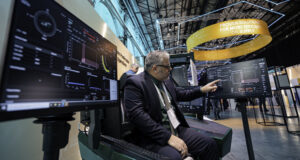
The Kantori apps allow for the autonomous monitoring of current operational data and, combined with Corva AI, the correlation of that current data with historical data, providing predictive insight into emerging trends that could signal potential issues downhole. These real-time insights enable proactive recommendations to improve drilling conditions, helping drilling teams to avoid costly mistakes.
“When you’ve done all of your calculations, you want to drive performance. You want to ensure that you’re maximizing your ROP and avoiding any type of critical situations that could cause NPT. The system assesses the data, making sure you get the ideal well while driving your drilling performance,” Dr Gatzen said.
Those recommendations can either be implemented manually at the rig or – if the operator chooses to utilize it – the Kantori autonomous directional drilling application can steer the BHA. Depending on the parameter that is being sent, connection can be done directly through the rig’s control system or by downlinking to the BHA through a bypass actuator. Dr Gatzen said the decision to run autonomous directional drilling depends on customer preference, although he sees more and more customers choosing this option.
Use in the field
The Kantori solution was officially launched in January, but it had already previously demonstrated effectiveness in trial applications. For one such application in 2025, an operator in the Middle East was experiencing a building tendency in the 16-in. section while managing severe vibrations in the initial well of an onshore pad. The second well on the pad had also seen unexpected instability challenges in the 12 ¼- and 8 ½-in. sections. Further, the geology of the reservoir made controlling the trajectory difficult, and the operator had not been able to land the well within its goal of 0.6 m inside the reservoir target.
For the third well on the pad, Baker Hughes deployed the Kantori solution along with its AutoTrak eXact rotary steerable system (RSS). The Kantori solution analyzed downhole data from the third well in real time, comparing it against data from the previous two wells. It then devised outputs to establish an optimal ROP that would minimize vibrations while also hitting the target. For the third well, those outputs led to a 24% increase in on-bottom ROP in the 12 ¼-in. section and a 49% increase in on-bottom ROP for the 8 ½-in. section.
As a result, for the third well, the BHA hit 100% in the pay zone. The operator also saw a 100% reduction in NPT from the third well compared with the first well.
The Kantori solution was also used in 2025 to help Tamboran Resources with a drilling campaign in a challenging unconventional basin in the Australian outback. The first well in the campaign was an extended-reach well with a 3,100-m lateral section. Severe high-frequency torsional oscillation in the lateral section had caused BHA damage, leading to additional trips and reduced ROP.
For the second well, which required a 3,600-m lateral section, Kantori was run with Baker Hughes’ TRU-Steer RSS. This combination led to a 40% improvement in average ROP, and the operator delivered the well to total depth 2.5 days faster than the first well. It was also able to drill the lateral section with a single steering unit, not requiring any additional trips.
In Argentina, TotalEnergies deployed Kantori on the Fenix project offshore Tierra del Fuego. The system was used to deliver a three-well campaign with well-to-well consistency and at or below planned budget, with the Corva AI apps visualizing and analyzing the performance improvements being achieved with KPI analytics.
The project saw noticeable improvements from the first well in the campaign to the third well, indicating the Kantori system’s ability to self-learn and improve performance. In particular, TotalEnergies saw an 84% increase in on-bottom ROP in the 12 1/4-in. sections from the first well to the third well, as well as a 36% reduction in weight-to-weight times between the three wells. On-bottom ROP in the 17 1/2-in. sections increased by 41%, and weight-to-weight times decreased by 25%.
“When you’re seeing an 84% increase in on-bottom ROP, that’s a big number,” Dr Gatzen said. “We’ve seen significant results. What’s interesting is that you really see those first couple of wells when Kantori is run, you’re getting faster or better because there’s a change management process with it, especially on the autonomous drilling front. It’s very exciting to see over time how the users really adapt and get comfortable with the system.” DC