Deploying cloud-based drilling automation: 7 practical lessons
From safety boundaries to crew trust to latency, these lessons show that successful automation is about more than algorithms
By William Fox, Corva
Over the past several years, Corva’s Predictive Drilling has moved beyond pilot projects to an operational tool deployed across entire drilling programs. Advances in cloud computing, real-time data transmission, machine learning and rig control integration have enabled a new generation of remote automation systems capable of influencing drilling performance from locations far removed from the rig site.
The results have been significant enough that many operators and drilling contractors are now evaluating drilling automation as part of their standard workflow rather than as a standalone technology initiative. Across the more than 310 wells drilled using cloud-based closed-loop automation, field deployments have consistently delivered 10-15% higher ROP, approximately 20% more lateral footage per day, and 35-50% fewer BHA runs compared with manual management of the autodriller.
While these improvements vary by basin, formation and operating practices, the consistency of the results has shifted industry discussions from whether automation can work to how it can be deployed at scale.
By June 2026, Predictive Drilling’s cloud-based drilling automation has executed more than 3 million ft of closed-loop drilling across multiple operators, basins, drilling contractors and rig configurations. And the industry has learned that successful automation deployments depend on much more than algorithms. Data quality, latency, workflow ownership, control hierarchies and user trust have a greater impact on outcomes than the optimization models themselves.
While the technology itself is no longer the limiting factor, real-time data streams, cloud computing, machine learning models and reliable communications have matured significantly over the past several years. The challenge now lies in integrating these technologies into existing drilling workflows while maintaining safety, trust and measurable improvements in performance.
This article summarizes seven key lessons learned from field deployments of Corva’s Predictive Drilling and reviews the practical considerations teams should evaluate when implementing automation into their drilling programs.

Lesson 1: Determine opportunities before deploying automation
Many automation projects begin with discussions around the technology. However, the best projects begin with discussions around performance. Before deploying automation on a rig, teams should identify exactly where the opportunity exists. This requires reviewing offset wells, comparing high-performing and low-performing runs, and determining which drilling dysfunctions are creating the largest performance losses.
In practice, one effective approach is to replay historical wells through the automation platform using the actual drilling data collected during the operation. Physics-based models and machine learning algorithms generate the setpoints that would have been recommended during the run. These recommendations can then be compared against the parameters that were actually drilled.
This frequently reveals unused operating envelopes. In many cases, the well could have supported additional WOB, differential pressure or ROP targets without exceeding operational constraints. Converting those opportunities into estimated time savings provides operators with realistic expectations before deployment begins. The most successful projects establish these performance targets upfront. Without a clearly defined objective, it becomes difficult to determine whether the automation is creating value.
Lesson 2: Integration is more important than intelligence
When discussions turn to automation, the attention typically focuses on machine learning and optimization algorithms. In reality, issues around integration are most often responsible for deployment delays, not the models themselves.
Cloud-based automation only works when data moves reliably between rig and cloud. Every deployment needs to start by answering a few basic questions: How does data leave the rig? How do setpoints return to the autodriller? Who has control authority? How will a crew know when automation is active?
These answers vary depending on the rig. Some contractors provide modern application programming interfaces. Others require integration through rig control systems or third-party automation platforms. Regardless of the architecture, every deployment requires a minimum set of synchronized data. At minimum, an automation system needs visibility into current and maximum values for WOB, differential pressure, RPM, torque and ROP. Even more importantly, they need confirmation that those values were received and executed successfully.
One valuable channel is a control-state indicator. A single value showing whether automation is currently controlling the autodriller eliminates confusion and simplifies troubleshooting. If crews cannot quickly determine who has control of the rig, adoption becomes an issue.
Lesson 3: Latency determines what can be automated
Latency has a direct impact on automation performance. During field deployments, round-trip communication times ranging from 5-7 seconds consistently deliver strong results. At that speed, parameter adjustments occur at roughly the same time as an attentive driller manually managing the autodriller.
As latency increases, performance begins to suffer. At approximately 15 seconds, procedures that require rapid response become increasingly difficult. Tool-joint hangup mitigation is a common example. By the time the system identifies the condition and sends a response, the opportunity to intervene may already be gone. At 30 seconds, drilling through interbedded formations becomes challenging because formation changes occur faster than automation can react. And, at 60 seconds, most closed-loop automation becomes impractical.
This lesson is simple: Connectivity should be treated as part of drilling automation, not an additional IT consideration. Teams evaluating remote automation should establish latency requirements early and validate them before deployment.
Lesson 4: Establish safety boundaries first
Every successful deployment relies on clearly defined control boundaries. A driller should always establish operating envelopes. If remotely generated setpoints exceed the limits entered into a rig control system, the setpoint will be rejected automatically. Likewise, communication failures should immediately trigger a return of control to the driller.
Modern automation systems allow users to build depth-based operating roadmaps that constrain machine learning recommendations. These roadmaps define acceptable operating ranges for each interval and ensure that optimization occurs within limits approved by the drilling team. An additional layer of protection can be created by incorporating manufacturer specifications for bits, motors and other BHA components. Recommendations that exceed those limits should require explicit approval before execution.
One of the more important lessons learned is that automation should never replace existing rig automation. Instead, these technologies should complement each other. Local PLC-based systems that react to conditions at 25-30 hz will always respond faster than a cloud-based platform. Remote automation works best when it operates as a supervisory layer above existing rig automation rather than a competing technology.
Lesson 5: If there’s no explanation, crews won’t trust it
One of the fastest ways to lose confidence in an automation system is to make a recommendation without explaining why. Consider this scenario: An operator has implemented a vibration mitigation procedure that reduces WOB when shock counts exceed a specific threshold. The automation system detects the condition and follows the procedure exactly as designed. A driller notices that the system is not utilizing available WOB and assumes the software is underperforming. Without context, that conclusion is reasonable. The problem is not the recommendation – the problem is the lack of visibility.
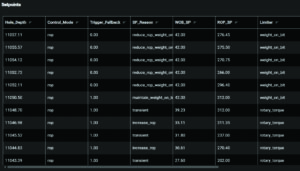
The most successful deployments make automation decisions obvious. Users can immediately see whether the system is active, what it is trying to accomplish and why it selected the current setpoints. Several operators now require every automated action to be accompanied by a reason code that is displayed directly within Predictive Drilling. Examples include:
- Reducing WOB due to elevated shock levels
- Limiting ROP to prevent differential pressure overshoots
- Increasing RPM to mitigate stick-slip
- Holding parameters during formation transformation
- This transparency builds trust and significantly improves adoption.
Lesson 6: Standardize dysfunction management before automating it
One unexpected outcome of Predictive Drilling deployments has been the value created through standardization. Most operators have procedures for managing stick-slip, shock, vibration, differential pressure and other drilling dysfunctions. However, those procedures often vary among rigs, supervisors and drilling teams.
Automation forces organizations to define procedures precisely. For example, an operator may define stick-slip as three torque swing ratio events above a specified threshold within a 30-second period. The response might require increasing RPM by a fixed amount and reducing WOB by a defined percentage for a set duration. Once those definitions are agreed upon, they can be implemented consistently across an entire fleet. These benefits extend beyond automation. Standardized detection criteria create a common language for performance analysis, reporting and continuous improvement. In many deployments, standardization efforts have generated as much value as the automation itself.
Lesson 7: Adoption happens in the first few stands
No amount of capability will overcome a poor first impression. A rig crew typically decides whether they trust an automation system very quickly. If a technology demonstrates clear value within the first few stands, adoption will accelerate. If performance appears inconsistent or confusing, crews will disable it and revert to manual control. During training, every deployment should establish:
- Who can activate or deactivate automation
- Who owns the parameter roadmap
- Who can modify operating limits
- How workflow changes are communicated between tours
- When escalation is required
- Successful deployments remove ambiguity, so everyone understands their role before drilling begins.
Moving toward autonomous operations
The industry continues to make progress toward higher levels of drilling automation. Advances in machine learning, cloud computing and LLMs will accelerate this trend over the next several years. However, the deployments of Predictive Drilling that have delivered the strongest results have not relied on a breakthrough algorithm or a revolutionary control strategy. Instead, they have focused on the fundamentals: established, reliable data flows, clearly defined control hierarchies, standardized dysfunction management, trust within rig crews, and continuously refined workflows based on field performance.
With more than 3 million ft drilled with Predictive Drilling, the most important lessons remain unchanged: Successful automation is an operational discipline enabled by technology, not a technology project supported by operations. The organizations that recognize this distinction are best positioned to convert technology investments into measurable gains in drilling performance. DC