H&P set to launch ROP optimizer combining machine learning with physics-based modeling
Software’s integration with rig control system will allow for automatic execution of driller-approved setpoint recommendations
By Stephen Whitfield, Senior Editor
Finding the sweet spot for rates of penetration (ROP) is key to the optimization of rotary drilling and, therefore, cost reduction. It’s not about just going as fast as possible. While high ROP can shorten the time needed to reach a target depth, an excessively high ROP can trigger drilling dysfunctions and deteriorate the quality of the wellbore trajectory. That could consequently reduce the possible total depth achieved.
Finding that sweet spot is challenging due to the complex, non-linear and multi-parameter nature of drilling processes, which are affected by multiple factors like weight on bit (WOB), mud properties and the bit type. Additionally, the industry still primarily looks to traditional ROP prediction and optimization methods, which often rely on empirical data analyzed by a human, or physical models that were limited in their ability to generalize data across varying geological formations and operational conditions.
Later this year, H&P plans to launch a new technology, the ROP Optimizer, to help address this challenge. It utilizes a cloud-based, machine learning ROP optimization algorithm for laterals, which would help ensure accurate predictions of optimal ROP in the lateral section while adhering to realistic and safe drilling constraints. Historical and real-time data are leveraged to train the ROP prediction model based on input variables such as surface rotation speed, downhole motor rotation speed and surface-estimated WOB.
“If you’re looking at the old ways of developing an analytical, purely physics-based model for ROP, it couldn’t work learning quickly and efficiently from wells to wells,” said Stéphane Menand, Technical Fellow at H&P. “You always had to calibrate the model with new parameters – the BHA may be different, the rock is different, the bit is different. But with this system, it’s a hybrid. We’re using the physics-based modeling, but we also have this machine learning in real time.”
Machine learning addresses the challenges in predicting and optimizing ROP, Dr Menand said, primarily by capturing hidden patterns and complex relationships within large volumes of drilling data. However, using machine learning comes with its own challenges.
Most existing systems lack integration with physical principles and rely solely on data to optimize ROP, potentially overlooking essential dynamics of the drilling system. Also, optimization algorithms often do not incorporate operational constraints on suggested drilling parameters, such as rotary speed or WOB. Because of this, these parameters may be infeasible or even unsafe to implement in real-time field operations.
“Drillers know what minimums and maximums they want to set,” Dr Menand said. “They know they want to do a weight on bit, for example, between a certain range. They know the limits of the equipment. We wanted to make sure to allow for these limits in our software. We want to make sure that the recommendations this software makes are in line with what a driller would see. If the software gives you an output that’s beyond the specs of the equipment, he’s going to reject it right away.”
To integrate physical constraints into the software, the ROP optimization algorithm is augmented with a predictive vibration model. This model calculates the resonance rotary speed – or the specific rotational speed at which a drill bit’s operating frequency matches its natural mechanical frequency – needed to avoid vibrations. This threshold is then embedded as a constraint within the model, ensuring that suggested rotary speeds remain within safe operational limits.
“One of the goals with the ROP Optimizer is to avoid dysfunction with the bit. We want proper bit engagement. Any drill bit should have a very targeted depth of cut, so we have to make sure we have that proper bit engagement. And, to avoid vibration, we need to have that model to select the right RPM to avoid resonance frequency,” Dr Menand said.
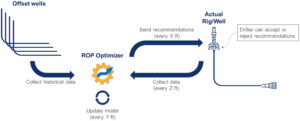
The software’s workflow starts with the collection of data from offset wells that are as close as possible to the current well conditions in terms of formation, wellbore trajectory, BHA, bit and mud motor specifications. These wells serve as a baseline to compare the performance of the optimization model. Actual drilling data from the current well is collected through WITSML or directly from the rig – this data also helps fine-tune the model’s performance.
The predictive vibration mapping model uses the wellbore trajectory, drilling data and the specs of the BHA to recommend a surface rotation speed that avoids vibrations. This output feeds the ROP optimization algorithm, which then determines the optimal ROP within the predetermined constraints on drilling parameters. The ROP Optimizer sends its recommendations of the optimal ROP to the rig at intervals pre-determined by the user – for example, every 10 ft – for a projected distance ahead of the current drilling depth.
The system runs on a cloud server. H&P developed a custom middleware – a software program that bridges different applications – for the cloud server and the rig. The recommendations are sent to the rig control system through that middleware, and the autodriller executes the set points automatically. However, Dr Menand said that the system comes with manual override, so the driller can take over command from the software at any point.
“The driller is always in control,” he said. “Really, they’re deciding what’s happening. You need to have that if you’re going to develop any trust in the system. If the driller sees anything that’s going on, for any reason, he can abort the connection, take control, mitigate any potential issue, and then turn the optimizer back on as he wishes.”
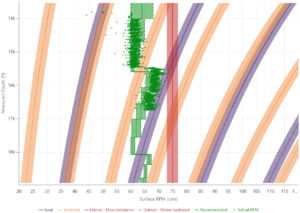
Virtual and field testing show positive results
Initial testing of the ROP optimization algorithm took place last year at H&P’s offices on a virtual rig – a software application modeling a real drilling rig. The data used to train the algorithm was generated by separate physical models that emulated the behavior of a target well. A bit-rock interaction model simulated the behavior of the bit, while a torque and drag model computed surface torque. Separate physical models replicated differential pressure, flow rate, ROP and WOB.
In this test, the optimizing agent collected data from the rig for every foot drilled. Every time it accumulated 100 ft worth of data, it would update its internal prediction model.
At the same time, the agent would also send a recommendation to the virtual rig every 10 ft. The rig would execute this recommendation immediately and keep all recommended values constant until new recommendations arrived.
The virtual rig testing showed that the algorithm could drive the drilling system from the chosen initial conditions to optimal conditions by progressively increasing both parameters.
“The virtual testing was more about how the model behaved using the data. We wanted to make sure that it could respond well to changes with the values and that those computations could stay robust,” Dr Menand said.
H&P then followed up with field testing on a rig in South Texas, running the ROP Optimizer for the drilling of a 7,000-ft lateral section. For this test, H&P’s real-time operating center (ROC) set up and monitored both the predictive vibration model and the ROP Optimizer model. Real-time WITSML data was received from the rig and processed by the ROP Optimizer model to provide updated recommendations in the lateral section.
The ROC also connected the optimizer with the rig control system, allowing the optimizer to regulate the autodriller setpoints (WOB, ROP, surface rotation speed and differential pressure). With the driller’s approval, updated recommendations were transmitted to the rig control system at regular drilled depth intervals. The updated recommendations were implemented without any further interaction from the driller at a regular interval. The frequency and limits of these recommendations were agreed upon with the operator.
While the driller maintained the ability to resume manual control whenever necessary, the ROP Optimizer governed operations for 97% of the drilling for this test, during which the driller adhered to 100% of the model’s recommendations. H&P noted a 26% increase in average ROP for the lateral section of the horizontal well compared to two offsets, which were drilled on the same pad, in the same formation and with the same BHA design.
The ROP Optimizer is currently undergoing additional field testing on a rig in West Texas and another rig in South Texas. The company plans to make the system commercially available on H&P rigs later this year. DC
For more information, please read IADC/SPE 230787, “A Rotary Drilling Optimization Framework Using Machine Learning and Predictive Vibration Modeling for Real-Time Rig Control.”