Generative AI agents reduce manual labor in extraction, digitalization of mud report data
NOV adds self-learning capabilities to system, streamlining parsing process even for unknown report formats, unstructured text
By Stephen Whitfield, Senior Editor
Monitoring daily drilling mud data is essential for maintaining optimal performance at the rig site. However, the process of parsing and digitalizing that data can be difficult. While digital systems have helped make that process easier, it remains highly manual, labor-intensive and error prone. Part of the reason is that mud reports are often unstructured and vary widely in formats across operators and service providers, making it difficult to standardize automated parsing and data extraction.
Over the past two years, NOV has been developing an autonomous cloud-based system to enable end-to-end mud report processing. This system, Mud Report Automation, utilizes generative AI models to extract structured data from daily mud reports. A self-learning agentic AI component within the system accommodates new and evolving report templates. Launched in 2025, the system can deliver reliable data from mud reports in a fraction of the time compared with traditional manual workflows.
“We’re receiving a lot of different forms of mud reports from different vendors, and traditionally that requires the engineer to go through them one by one. That information was just stored in someone’s computer,” said Junzhe Wang, Data Scientist at NOV. “We wanted to create a system that allows us to access all the data through one entry point. It catches these reports, downloads them, parses them and digitalizes them into a standard format. When you can do that and then store the information centrally, you can easily use and reuse the data.”
Mud report data is typically organized into large tables containing multiple subsections. Such reports are structured as multipage PDF documents, with each page comprising extensive tabular data organized into distinct sections. These reports commonly include general well information, drilling equipment system parameters, fluid properties and solids control analysis, fluid volumes and changes, chemical additive inventory and accompanying engineering remarks, and fluid treatment recommendations.
Although the overall content remains similar, the detailed structure, organization logic, table layout, parameter naming conventions, recorded variables and even the presence of certain subsections can vary significantly among vendors, across wells or over different reporting dates for the same well.
Further, although most of the content in these reports is now available in selectable digital text format, some information – such as vendor names and API well numbers – may still be embedded as text within images. This adds to the work that engineers have to manually execute for each report.
On top of that, the industry has no standardized or readily available approach for fully automating the parsing process. “There could be a network drive for everyone to share the reports they had parsed in the past, but it wasn’t structured. It wasn’t valuable for any kind of analytics,” said Jay Yoon, Manager of Data Science and Applied AI at NOV.
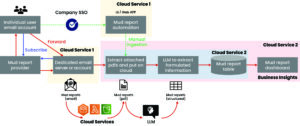
The core of NOV’s new system consists of two modules: an extraction module and a large language model (LLM) module. The former extracts textual data from PDF-based mud reports and converts them into an LLM-readable format, such as Markdown or plain text. This processed content serves as the direct input for subsequent LLM analyses. Because of that, Dr Yoon said, extraction accuracy is critical, particularly to maintain data integrity and preserve table structures. To ensure accuracy, NOV developed a custom data extraction model that consistently captures all parameters while retaining tabular layout information as much as possible.
“We’re extracting all the useful information out of these documents – probably 100 to 200 per day – for our analytical purposes,” Dr Yoon said. “However, with each mud report, each vendor may have their own jargon that they use within an engineering unit. To make it work for our analysis, we have to be able to convert this jargon into a proper name.”
The LLM module serves as the central processor of the system. It interprets the extracted content, identifies structural patterns retained from the mud reports and reformats any unstructured text – any text that lacks a pre-defined data format – into a standardized, structured data format that is suitable for storage and further analysis.
While the LLM is interpreting content being fed from the extraction module, AI prompting agents are simultaneously working to determine the source of the incoming report. For known vendors, a corresponding prompt is retrieved and applied directly for parsing. For reports from a vendor that has not been previously seen, two additional modules are activated – for autonomous prompt generation and self-improvement. An AI agent drafts an initial prompt by analyzing historical content from existing vendors’ mud reports. It then refines, optimizes and stores it in a dynamic prompt registry.
Throughout the parsing process for a report from a new vendor, a drilling engineer performs evaluation and calibration of the system, manually parsing a small number of reports to initialize ground truth data – effectively, verifying the outputs from the models are correct.
“The human engineer is always in this loop. They’re serving as a bridge between the various components. We need the human to consume the end result and check everything,” Dr Wang said. “When we’re onboarding reports from a new vendor, people also need to check for things like outliers. The human is providing a good example of what a good report should look like, then the agentic system can learn from that behavior.”
The system’s parsing results are compared against the human-verified records in a ground truth database. A separate accuracy assessment module then analyzes these comparisons to quantify the performance of the system. This analysis is then fed back to the prompting agents, creating a closed feedback loop.
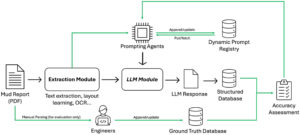
This agentic AI-based system marks the second iteration of NOV’s Mud Report Automation. The first iteration, developed in late 2024 and rolled out to active rig sites in March 2025, used a prompt engineering module. That module contained a set of designed prompts that could be fed into the LLM, but it did not have the self-learning capability of an AI agent. Therefore, it could not refine prompts or adapt to structural variations in the mud reports, meaning the designed prompts remained static and non-adaptive once the system was running.
NOV added the AI agents to the system in mid-2025.
“The first model we tested ran really well with the test datasets, but we noticed some false outputs for various vendors, edge cases where the template for that vendor looked very different from what we typically see or from new vendors,” Dr Wang said. “That led us to look at developing an agentic system that could learn from the historical data and automatically improve itself to help us with onboarding new vendors. We wanted something that would not require as much of the human interaction as we previously needed.”
Testing of the agentic AI-based system took place in mid-2025, with the system processing historical mud reports from six vendors. NOV performed two tests – the first assessed the quality and efficiency of the AI agents’ prompt generation process, whether it could parse mud reports as accurately and as quickly as a human. The second test verified the self-improving capability of the system.
For the first test, NOV found that manual prompt creation typically required around 960 minutes per report, as engineers needed to analyze report structures, design initial prompts and refine them to reach optimal accuracy. By contrast, the AI agents produced prompts of equivalent quality in an average of 8.8 minutes per report. The AI-generated prompts also outperformed manual prompts by 2-8% in average parsing accuracy. This confirmed that the agents could effectively learn vendor-specific formatting and reporting patterns.
For the second test, reports from four vendors were used, each associated with an initial vendor-specific prompt generated in the first test. The AI agents achieved on average a 6% improvement in parsing accuracy. DC
For more information, please see IADC/SPE 230772, “Self-Improving Generative AI Agents for Automated Daily Mud Report Parsing”