Oil & Gas Markets
Transocean, Valaris deal shakes up offshore market
The offshore drilling market is set for a big transformation with the announcement of the Transocean/Valaris merger on 9 February. The $5.8 billion transaction, if finalized, would result in a combined company of 73 offshore rigs, comprised of 33 ultra-deepwater drillships, nine semisubmersibles and 31 jackups. The company’s combined backlog would be approximately $10 billion.
In an analysis by Westwood Global Energy Group’s Americas Research Director Cinnamon Edralin, she noted that Transocean is positioning itself for an uptick in demand by focusing on high-specification rigs across asset types and regions. “From this perspective, even the cold-stacked floaters bring meaningful value to the transaction, as some of these will be reactivation candidates when market conditions call for adding capacity,” she stated.
She further noted that the merger will bring Transocean back to the jackup market for the first time since it spun off its jackup fleet in 2017. At that time, Borr Drilling had acquired from Transocean 10 high-specification jackups and five others that were under construction.
Transocean has indicated its intent to keep the Valaris jackups, she noted, as it sees the segment as an opportunity to add cash flow. Six of the Valaris-owned jackups are managed by ARO Drilling, a 50/50 joint venture between Valaris and Saudi Aramco. The other 25 are under Valaris’ direct management.
Nearly 40% of the 31 owned jackups that are being marketed for work are in the North Sea, Ms Edralin noted. The next-biggest region is the Middle East, where Transocean currently has no rigs.
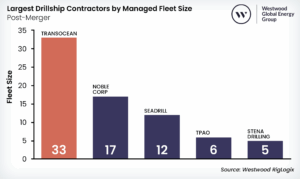
Post-merger, Transocean would also have the second-largest semisubmersible fleet (nine), behind China Oilfield Services Ltd (15), and the largest drillship fleet (33), with nearly twice as many drillships as Noble Corp (17).
The analysis also noted that the merger could create an opportunity for Transocean to retire or sell off some units. Potential targets for fleet rationalization include two benign Valaris semis that are warm-stacked in Southeast Asia. While both were working offshore Australia as of late Q4 2025, “neither of these is likely to be stacked long term, should new assignments not be found,” according to the analysis.
The combined company would also have 13 cold-stacked rigs. Six of these are drillships, which are potential candidates for reactivation and are less likely to be retired. The jackups could be attractive units to sell off at some point, rather than retire, according to the analysis.
Syrian oil, gas production set to recover in 2026
Recent actions by the Syrian government could pave the way for the country to increase its oil and gas production, according to Wood Mackenzie. Syrian government forces have reasserted control over key oil and gas assets in Deir ez-Zor and Al-Raqqa provinces, including the Omar oil field (the country’s largest) and the Tabiyeh gas field. A handover of energy assets was included in the ceasefire deal.
According to Wood Mackenzie, this handover, combined with sanctions relief and early foreign engagement, creates conditions for Syria’s energy sector to begin recovering after more than a decade of conflict. Before 2011, Syria produced roughly 380,000 barrels per day (bpd) of oil and 900 million standard cubic feet of gas per day (mmcfd). By 2021, its oil output had dropped to between 50,000 and 80,000 bpd.
“While infrastructure and political risks remain, particularly in the near term, Syria’s resource base, combined with strong domestic gas demand and persistent power shortages, makes a compelling case for selective reentry,” said Alexandre Araman, Director, Middle East Upstream at Wood Mackenzie.
Wood Mackenzie expects oil production to begin recovering in 2026, initially driven by low-cost workovers, artificial lift upgrades and surface facility repairs. More meaningful growth will depend on foreign capital, technology transfer and access to export routes.
Several international oil companies have already signed agreements to return to Syria. Dana Gas signed a memorandum of understanding (MOU) to redevelop key gas fields, followed by MOUs involving ConocoPhillips and Novaterra. Additionally, four Saudi firms – TAQA, ADES, Arabian Drilling and Arabian Geophysical and Surveying – signed agreements to provide technical support.
Wood Mackenzie estimates Syria retains remaining discovered oil and gas resources of at least 1.3 billion barrels of oil equivalent, with large areas of the country still underexplored. Beyond onshore recovery, Syria’s offshore sector remains entirely untapped, with no exploration wells drilled to date.