Multi-company analysis reveals concentrated risk patterns with serious injuries and fatalities
Systematic improvement is possible as 2-3 exposure categories drive up to 91% of SIF risk
By Atif M. Ashraf, Texas A&M University, and Erika Gwilt, DEKRA North America
Across industries, a troubling pattern has emerged. While recordable injury rates have declined substantially over the past two decades, serious injuries and fatalities (SIFs) – events that result in death, permanent disability or life-threatening injuries – have not decreased at the same pace. Research has demonstrated that the causes of SIFs differ fundamentally from minor incidents. They involve different exposures and failure modes, and they require different prevention strategies.
A landmark 2015 study across seven multinational corporations analyzed more than 1,000 incidents and revealed a critical finding: 21% of recordable injuries involved circumstances with SIF potential. These “high-potential” incidents appeared identical to minor injuries in standard safety metrics but represented fundamentally different risk exposures. These are situations where, if repeated or if minor variables had differed, the outcome could have been life-threatening or life-altering.
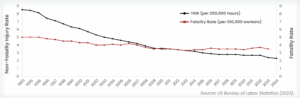
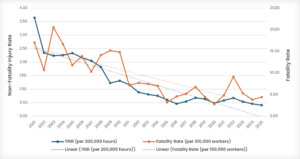
This pattern holds true in drilling operations. IADC industry data from 2001-2025 shows that, while total recordable injury rates declined by 89% — from 3.64 to 0.41 per 200,000 hours — fatality rates declined by only 74%, from 16.99 to 4.39 per 100,000 workers. Despite the drilling industry achieving better overall injury reduction than the broader industrial population, the diverging trendlines reveal the same fundamental challenge: Traditional injury prevention approaches have limited impact on preventing fatalities.
But where does SIF risk concentrate in drilling work?
To answer these questions, IADC partnered with DEKRA to examine SIF exposure patterns across multiple drilling contractors. Five companies representing diverse operations, spanning land and offshore drilling across nine geographic regions, agreed to share incident data for independent analysis. The data set included 331 recordable injury incidents, providing the first multi-company view of where serious injury risk concentrates in drilling operations and whether systematic improvement is achievable.
The findings reveal predictable concentration patterns and proven pathways for reducing drilling’s most severe safety risks.
The study: 331 incidents, 5 companies, 9 geographies
Each of the 331 recordable injury incidents was evaluated using established SIF exposure assessment methodology based on the framework developed in DEKRA’s 2013 multi-industry study. Rather than focusing solely on actual outcomes, the analysis examined each incident’s potential severity. An incident was classified as having “SIF exposure potential” when the circumstances could have reasonably resulted in a life-threatening injury, life-altering injury or fatality if repeated or if minor variables had differed.
This approach reveals the “near-misses hiding in plain sight.” These are incidents recorded as minor injuries that involved high-consequence exposures like falls from elevation, caught-between situations with heavy equipment or release of stored energy.
Finding #1: Risk concentrates in predictable exposure categories
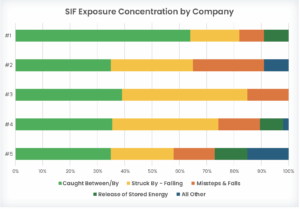
Analysis revealed that across all five companies, two to three exposure categories accounted for 73-91% of all SIF potential. This concentration held true regardless of company size, operational focus or geography.
The dominant exposure categories driving SIF risk were:
- Caught between/by or in (30-58% of SIF potential across companies): workers pinched, crushed or trapped by moving equipment, tubulars or rig components.
- Struck by – falling/flailing objects (15-43%): impact from dropped objects, swinging loads or flying projectiles.
- Missteps and falls (7-26%): slips, trips and falls from elevation or same level.
- Release of stored energy (0-16%): pressure releases, hydraulic failures, spring-loaded equipment, tensioned lines.
- Either “caught between “ or “struck by” exposures appeared among the top two categories in all five companies. This finding aligns with the fundamental nature of drilling operations. The constant manipulation of heavy tubulars, operation of high-energy mechanical systems with rotating and hoisting components and manual tasks performed in proximity to moving equipment inherently create pinch points and line-of-fire situations.
The value of this finding lies not in its novelty but in quantifying the concentration. The data reveals that “caught-between” exposures account for one-third to over half of all serious injury potential. This quantification enables more strategic resource allocation. Rather than spreading prevention efforts across dozens of potential hazards, drilling contractors can focus on engineering and operational controls on a few well-defined exposure types.
Importantly, the specific exposure mix varied by company. Some operators showed “struck by” as their dominant risk driver (up to 43% of SIF potential), while others showed “caught between” as most prevalent (30-58%). This variation suggests that while certain exposures are common across drilling, each company needs to understand its specific risk profile rather than assuming all drilling operations face identical hazards.
What this means: The concentration of risk in just two to three categories creates an opportunity for focused prevention. Engineering controls, operational procedures and training efforts can be prioritized based on which exposures drive the most serious injury potential in each company’s specific operations. However, the appropriate interventions will vary based on their own dominant exposure types.
Finding #2: Geographic patterns reveal systemic factors
When injury rates were compared across the nine regions represented in the study, a notable pattern emerged. North American operations (US and Canada) showed injury rates significantly higher than operations in other regions, particularly the Middle East. In some cases, the injury rate was two to 10 times higher, depending on the operation type.
This geographic disparity appeared across both land and offshore operations, suggesting the difference isn’t driven by equipment type or drilling method, but by regional systemic factors. These could include workforce stability, production pressure, safety culture, regulatory environment, labor market dynamics or differences in injury reporting practices.
The Middle East demonstrated consistently low injury rates (average recordable rate of 0.19 per 200,000 hours) across multiple companies and operation types. However, it’s important to note that data interpretation requires caution. The performance difference could reflect genuinely better safety practices, or it could partially stem from differences in injury recording and reporting thresholds across regions. Without detailed investigation of incident reporting systems and cultural attitudes toward injury disclosure in each region, definitive conclusions about the root causes of this disparity remain uncertain.
What is clear is that the same companies achieved notably different safety outcomes depending on where they operated. This demonstrates that operational context, whether driven by genuine safety performance factors or reporting culture, or a combination of the two, varies substantially by region and warrants systematic investigation.
What this means: The geographic performance variation points to an opportunity for comparative investigation. Understanding whether differences stem from transferable safety practices (workforce stability, training approaches, production scheduling) versus reporting and cultural factors (disclosure rates, injury classification thresholds, regulatory requirements) would provide valuable insights. Companies operating in multiple regions should examine what drives performance differences, while being careful not to assume low rates always indicate superior safety without understanding reporting practices.
Finding #3: Improvement is possible and measurable
One company in the study stood out, achieving 49-73% reductions in injury rates across multiple regions over a three- to four-year period. These improvements appeared in:
- US land operations: 49% reduction (from 0.53 to 0.27 recordable rate)
- South America land operations: 73% reduction (from 1.56 to 0.42)
Critically, these improvements showed in both recordable rates and lost-time rates, indicating genuine severity reduction rather than just better recordkeeping or injury classification changes.
The fact that improvements appeared across multiple geographies suggests this company has a transferable, systematic methodology rather than a one-time success or region-specific advantage. While the specific interventions weren’t documented in this analysis, the pattern strongly suggests:
- Systematic approach to identifying and controlling high-risk exposures;
- Effective transfer of learnings among operations;
- Sustained leadership focus over multiple years;
- Likely emphasis on engineering controls and process improvements.
Meanwhile, other patterns emerged that warrant investigation. South America showed diverging trends, with one company’s offshore operations deteriorating (+305% increase in injury rate) while another company’s land operations improved dramatically (-73%). This demonstrates that, even within the same region, company-specific practices drive outcomes more than external factors.
What this means: The drilling industry doesn’t have to accept its current SIF rate as a ceiling. Systematic improvement is achievable when companies implement the right interventions with discipline and sustained focus. The industry would benefit from understanding what interventions and organizational factors enabled these improvements.
Finding #4: SIF exposure varies by company
Beyond examining where risk concentrates within incident types, the analysis also revealed variation in how much of each company’s overall incident profile involves SIF potential. The percentage of incidents with SIF potential ranged from 30-61% across companies. This “SIF exposure rate” reveals how much of a company’s incident profile involves high-consequence potential versus truly minor injuries.
Company #2 showed the highest SIF exposure (61%). This means that when incidents occurred, they more frequently involved circumstances with serious injury potential. Company #1 showed the lowest (30%). This variation likely reflects:
- Different work exposures and operational hazards;
- Equipment age and maintenance practices;
- Nature of wells being drilled (pressure, depth, complexity);
- Effectiveness of hazard elimination and engineering controls.
Companies with higher SIF exposure percentages face greater fatality risk, even if their overall injury frequency is low. Conversely, low overall injury rates don’t guarantee low SIF risk if those incidents that do occur have high-consequence potential.
What this means: Drilling contractors need visibility into their SIF exposure rate. This is the percentage of incidents that involve high-consequence potential versus truly minor injuries. This metric provides better risk insight than total recordable injury rate alone. Organizations can determine their SIF exposure profile by systematically reviewing incident investigations through the lens of potential severity rather than actual outcome.
Implications for the drilling industry
These findings point toward three strategic imperatives:
1. Focus prevention on caught-between exposures
Caught-between exposures warrant focused attention given their prevalence across all companies that participated in the study. Organizations should prioritize prevention efforts through:
- Engineering controls: Design solutions that physically prevent workers from entering pinch points or that stop/slow equipment when workers are in danger zones.
- Operational controls: Procedures that eliminate time pressure during high-risk operations, ensure adequate planning and hazard recognition before tasks begin, and establish clear roles and exclusion zones around moving equipment.
- Design improvements: Incorporate safety features into rig design and equipment specifications rather than relying on add-on solutions or administrative controls.
The specific interventions will vary based on each operation’s equipment, work processes and dominant caught-between scenarios.
2. Study and replicate successful improvement approaches
The industry would benefit from detailed case studies of organizations that achieved substantial injury reductions. Key questions include:
- What specific changes were implemented (engineering controls, process changes, training, culture initiatives)?
- What was the implementation timeline and sequence?
- What organizational factors enabled success (leadership, resources, culture)?
- How were improvements sustained over multiple years?
- What barriers were encountered and how were they overcome?
Knowledge transfer through conference presentations, site visits and published case studies that detail both successful and unsuccessful improvement attempts would benefit the broader industry.
3. Shift from lagging to leading indicators
Traditional injury rates provide limited insight for proactive prevention because:
- Serious incidents are rare, making statistical trending difficult;
- By the time trends emerge, multiple injuries have already occurred;
- Injury rates don’t distinguish high-consequence exposures from minor hazards.
Leading indicator approaches offer an alternative by tracking:
- SIF precursor rate: Near-misses and minor incidents involving high-consequence exposures;
- Critical control failures: Instances where barriers designed to prevent SIFs failed or were bypassed;
- Line-of-fire observations: How often workers are positioned where caught-between or struck-by exposures could occur;
- Exposure hours in high-risk activities: Time spent in elevated work, confined spaces, under suspended loads, near pressurized systems.
These leading indicators provide more data points, enable earlier intervention and focus attention on high-consequence exposures rather than total injury counts. Standardized definitions and measurement approaches for these metrics could enhance industrywide learning and benchmarking.
Conclusion: finding a path forward
This multi-company analysis demonstrates that serious injury risk in drilling concentrates in predictable patterns, varies substantially by region and company, and can be systematically reduced. The findings challenge several assumptions:
- Not all injuries are equal – a small percentage of incident types drive the majority of serious injury potential.
- Context matters – the same companies achieve different outcomes in different regions.
- Improvement is achievable – substantial reductions have been demonstrated across multiple operations.
The path forward requires:
- Quantifying risk concentration – understanding which two or three exposures drive SIF potential in specific operations.
- Learning from success – investigating what enables substantial improvement in operations that achieve it.
- Engineering solutions –prioritizing controls that address caught-between and other high-consequence exposures.
- Measuring what matters – tracking SIF precursors and high-consequence exposures alongside the more traditional injury metrics.
The data shows this risk can be identified and reduced. The question is whether organizations will allocate prevention resources accordingly. DC
Companies interested in confidentially assessing their SIF exposure profile and comparing performance with industry peers can participate in future analysis phases.
This article is based on a presentation at the 2026 IADC Health, Safety, Environment & Training Conference, 18-19 February, Houston, Texas.
Reference: Martin, D. K., & Black, A. A. (2015). Preventing Serious Injuries & Fatalities: Study Reveals Precursors & Paradigms. Professional Safety, 60(9), 35–43. https://www.jstor.org/stable/48690857