Measuring well placement, completions efficiency: Chemical tracers can fill diagnostics gap
Ability to directly measure well performance at stage/interval level can validate assumptions, inform future drilling and completion decisions
By Patrick Hayes, Tracerco
Drilling and completion technologies have advanced rapidly over the past two decades, enabling operators to access increasingly complex reservoirs with greater precision. However, while execution has become more sophisticated, the industry still faces a fundamental challenge: accurately measuring whether drilling and completion decisions have delivered the intended results.
Traditionally, success is inferred from high-level economic indicators such as production rates or cumulative recovery. While useful, these metrics offer limited insight into how a well is performing along its length, which completion stages are contributing, or whether well placement decisions achieved their design intent. As a result, uncertainty remains around execution efficiency, particularly in horizontal wells and multistage completions.
Reducing this uncertainty requires diagnostic approaches that can provide quantitative, phase-specific well performance insights. Chemical tracer technologies have emerged as one such tool, enabling operators to directly measure contribution, cleanup efficiency and fluid movement at the stage or interval level. This provides valuable feedback for future well placement and completion design decisions.
The diagnostic gap
As wells have become longer and completions more complex, traditional diagnostic tools have struggled to keep pace. Logs, pressure data and surface production measurements can indicate that a well is flowing, but they rarely provide definitive answers to questions such as:
- Which sections of the wellbore are contributing?
- Is flow evenly distributed along the lateral?
- Are certain stages underperforming or bypassed?
- How effectively has completion fluid been recovered?
In unconventional developments, where drilling and completion designs are replicated across pads, the inability to quantify execution outcomes can lead to repeated design assumptions being carried forward without validation. Over time, this compounds uncertainty and increases the risk of sub-optimal well placement or completion design choices.
What is often missing is a direct measurement technique that can operate under steady-state conditions and distinguish among oil, gas and water contributions without disrupting operations.
Quantitative diagnostic tool
Chemical tracer technology offers a means of addressing this gap by embedding unique chemical identifiers within completions fluids or materials. Once deployed, these tracers are produced back to surface and analyzed, enabling operators to quantify contribution and behavior at a granular level.
Unlike indirect diagnostics, tracer-based methods provide measured data rather than inferred results. Phase-specific tracers allow differentiation between hydrocarbons and water, while stage-specific tracers enable operators to assess individual completion segments along the wellbore.
One key advantage of chemical tracers is their ability to function during steady-state production, eliminating the need for well shut-ins or intrusive interventions. This allows diagnostics to be conducted without interrupting drilling or completion schedules.
Applying tracers to well placement validation
Well placement decisions are among the most critical factors influencing well performance. However, validating whether a lateral has been optimally positioned relative to reservoir quality, faults or natural fractures can be challenging using conventional data alone.
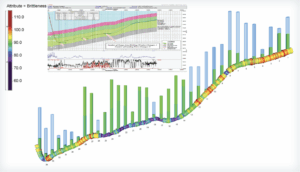
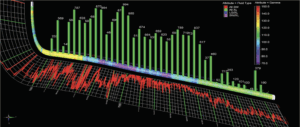
Tracer diagnostics enable operators to quantify contribution along the length of the wellbore, revealing variations in inflow that may indicate placement issues. For example, disproportionate contribution from heel or toe sections can highlight uneven reservoir contact or completion effectiveness.
In wells intersecting faults or stratigraphic boundaries, tracer data can provide evidence of fluid movement between compartments, offering insight into reservoir connectivity and helping validate geological models used during the planning phase. By feeding this quantitative information back into subsurface and drilling workflows, operators can refine landing zone selection and lateral placement in subsequent wells. This can reduce costs and build efficiencies into drilling.
Evaluating completion design effectiveness
Beyond placement, chemical tracers are increasingly used to assess completion design performance at the stage level. In multi-stage horizontal wells, tracer data can identify stages that contribute disproportionately — or not at all — highlighting potential issues with stimulation effectiveness, cluster efficiency or mechanical isolation. This information is particularly valuable when evaluating new completion designs or materials. By comparing tracer-derived contribution across stages, operators can determine whether changes in spacing, fluid volumes or treatment techniques are delivering consistent results.
Tracer-based diagnostics can also be applied to evaluate fracture-driven interactions, helping identify communication between stages or adjacent wells that may influence completion effectiveness.
Measuring completion fluid cleanup efficiency
Completion fluid recovery plays a critical role in well performance and integrity, yet cleanup efficiency is often difficult to quantify directly. Residual fluids can impair flow capacity or mask the true effectiveness of the completion.
By tagging completion fluids with specific tracers, operators can measure the rate and extent of fluid recovery over time. This enables assessment of cleanup efficiency on a per-stage basis, providing insight into whether completion designs facilitate effective fluid removal.
Quantifying cleanup performance allows operators to refine fluid selection, pumping strategies and flowback procedures, reducing uncertainty before applying designs at scale.
Importantly, this approach focuses on execution efficiency, rather than downstream production outcomes, aligning closely with drilling and completion decision making.
Reducing uncertainty through steady-state diagnostics
A notable advantage of chemical tracer methods is their applicability under steady-state conditions, including wells operating with artificial lift. This allows diagnostics to be conducted without altering operating parameters or introducing additional operational risk.
By providing continuous, phase-specific insight, tracer data can support ongoing evaluation of completion behavior and well integrity during early life — a period when design learnings are most valuable.
This steady-state capability distinguishes tracer diagnostics from many traditional tools and supports data-driven refinement of drilling and completion practices.
Implications for drilling and completion decision making
As drilling programs scale across multiple wells and fields, the ability to validate assumptions becomes increasingly important. Chemical tracer diagnostics offer a feedback loop that connects execution decisions with measurable outcomes.
By incorporating tracer-derived insights into drilling and completion workflows, operators can:
- Improve confidence in field development strategies;
- Refine completion designs based on measured performance;
- Identify execution inefficiencies early;
- Reduce uncertainty before replication at scale.
Rather than replace existing diagnostics, tracer technologies complement traditional tools by providing quantitative confirmation of what has been executed downhole.
In an environment where wells are becoming more complex and margins for error continue to narrow, reducing downhole uncertainty is critical. Chemical tracers provide a practical, quantitative means of evaluating well placement and completion design effectiveness, delivering insights that support better-informed drilling and completion decisions.
By focusing on measurement rather than inference, tracer diagnostics help close the gap between design intent and execution reality, enabling operators to move forward with greater confidence as they optimize future wells. DC