New vibration dampener tool leverages internal inertia mass to fight damaging HFTO
By Stephen Whitfield, Senior Editor
Many tools designed to address high-frequency torsional oscillation (HFTO) focus exclusively on managing bit-induced stick-slip, or drill bit rotation that alternates between periods of slowing down and periods of sudden acceleration.
These tools, which are often placed above the BHA, mitigate vibration by reducing the depth cut through a reduction of the weight on bit (WOB). While reducing depth of cut can minimize HFTO amplitude, it is not a foolproof solution. In instances where the amplitude is high enough, or the downhole conditions are severe enough, these conventional tools may struggle.
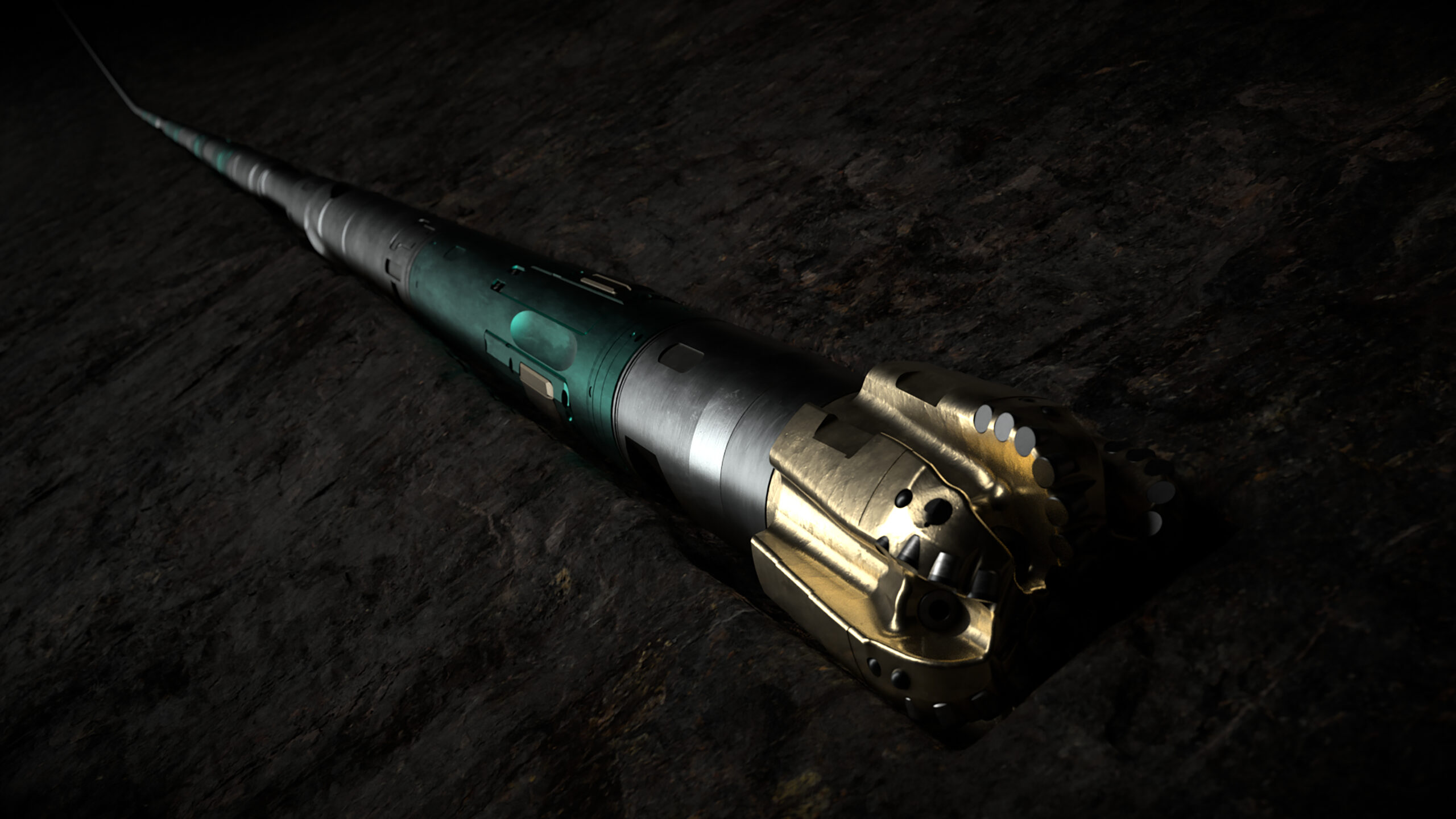
In June 2025, Baker Hughes launched its GuardVibe torsional vibration dampener, which the company says was purpose built to suppress all modes and instances of HFTO for all drilling parameters. Its design utilizes internal inertia mass to counteract the effects of the torsional vibrations.
“Stick-slip has its damaging nature, and lateral vibration has its damaging nature. So does axial vibration. But the biggest thing, the most impactful to our rotary steerables and the BHA, is the HFTO,” said Daniel Bell, Senior Global Product Manager — Downhole Motors & Hole Enlargement at Baker Hughes. “The only true way to completely mitigate it is to completely back off of your parameters to the point where it doesn’t even make sense to run your tool. We wanted to design something that specifically targeted this major impactor.”
The tool is made from a rigid piece of metal affixed to the BHA. When no torsional vibrations are present, the tool freely rotates within the BHA. When HFTO occurs, the inertia mass of the tool resists the motion of the vibration, thereby suppressing the HFTO.
Mr Bell, who was part of the tool’s development team, pointed out that the tool’s presence on the BHA does not restrict drilling in any way. “The great thing about this is that it’s built into the subs,” he noted. “It’s dumb iron for much of the run, right up until we see HFTO and it gets to the process of mitigating it. It’s effectively working on a model of mass against force. When you reach the height of your frequency, the mass of that dumb iron is going to mitigate it. Its sole purpose is to push back on what is coming at it. It doesn’t care about the depth of cut that your bit is drilling. It’s pushing through the BHA.”
The tool is equipped with proprietary thread connections on the pin and the box side that can increase makeup torque by 30% compared with standard API connections, according to Baker Hughes. Cross-over subs were provided to connect to standard oilfield thread connections.
To reduce abrasion wear on the annulus side, wear bands on the outer diameter increase the service lifetime of the dampener and maximize maintenance intervals. The dampener is optimized both for static drilling torque and superposed dynamic torque to meet the high requirements from torsional vibrations in HFTO-prone applications.
Further, its design removes the mechanical and electrical failure mechanisms of conventional dampener tools. This eliminates the reliability concerns associated with previously available solutions. It also boosts BHA durability for increased run life in difficult intervals. This durability extends to the shaped cutters in the drill bit, keeping the cutting edge sharper for longer.
The dampener runs above the BHA and below the downhole motor when one is present, but can also function without a downhole motor. For deployment, the torsional vibration dampener would be preconfigured as part of the BHA and delivered to the rig site as one piece.
Laboratory testing of the tool took place in 2021 using cyclic bending, shock and vibration, temperature and pressure testing methods. With the design focus on robustness and verification of resistance in extreme conditions, the dampener string did not limit drilling parameters such as weight, torque, tension, cyclic bending, pressure or temperature.
The tool was then tested in 2022 on more than 350 drilling runs in the field, primarily in the Permian Basin, where long lateral wells are common. During these trials, the system eliminated HFTO during 98% of the drilling process, according to Baker Hughes. This led to improved rates of penetration and WOB compared with BHAs using traditional vibration mitigation tools. Similar results have been recorded in other deployments in the Middle East and South America, the company said.
One field test in the Permian Basin benchmarked the GuardVibe dampener against vibration mitigation tools from two other vendors. All runs were conducted with a similar BHA and bit. In all runs, the vibration mitigation tools were placed between the mud motor and the wired part of the BHA at a similar position. A load sensor was mounted on the BHA to measure dynamic torque, while accelerometers were positioned in two other areas – one next to the load sensor and another farther up the BHA. The accelerometers measured tangential acceleration amplitude and dominant frequencies.
This test saw 44 runs of the BHA with the new dampener (255,500 ft drilled and 2,157 circulating hours), compared with 39 runs of Vendor 1 (144,137 ft drilled and 1,280 circulating hours) and 113 runs of Vendor 2 (752,119 ft drilled and 5,641 circulating hours).
Testing showed close to zero time with HFTO with the GuardVibe tool, while runs with Vendor 1 experienced an average of more than 44 hours of HFTO per 1,000 ft drilled and runs with Vendor 2 experienced an average of more than 9 hours per 1,000 ft drilled. The new dampener also showed a significantly higher reliability – the mean distance drilled between failure and mean time between failure were 100% higher compared with Vendor 1 and 30% higher compared with Vendor 2.
In another application in the Permian, a driller had seen excessive lateral and tangential vibrations during a run. HFTO was leading to excessive BHA damage and premature tool failures and multiple unplanned trips. On the next run, Baker Hughes deployed the GuardVibe tool with a 4 ¾-in. Lucida rotary steerable system (RSS). On that run, the driller was able to drill to total depth in one run with no instances of HFTO, no impact on WOB or ROP, and no restrictions in bending.
In the Middle East, Mr Bell noted that deployments of the new dampener have proven the tool to be effective when used in conjunction with MWD/LWD drilling BHA while operating without a downhole motor.
Unlike the deployments in the Permian, which were performed using an RSS, the drilling runs in the Middle East were done using a rotary from surface, without a drilling motor. This was noteworthy, he said, because traditional HFTO solutions have typically been ineffective in the region, where drilling with advanced LWD tools is common and drilling programs do not use motor assist.
“We have always run this system with rotary steerables, but this was our first experience to test it with a non-motor driven RSS,” he said. “There are different considerations when you have LWD tools in there, so it was important that we were able to adapt the system in that scenario.” DC