Environment, Social, & Governance
Regional fragmentation, data center proliferation to heavily influence sustainability strategies in 2026
Companies in 2026 will likely take a more pragmatic and risk-averse approach to sustainability amid an increasingly fragmented global landscape where regional differences play a larger role, according to a report from S&P Global. These megatrends were cited as key over the coming year as companies assess sustainability strategies:
- Geopolitics and multilateralism — Sustainability action continues to fragment into regional approaches. Central to the US approach, fossil fuels will remain a significant portion of total global primary energy demand over the coming decades.
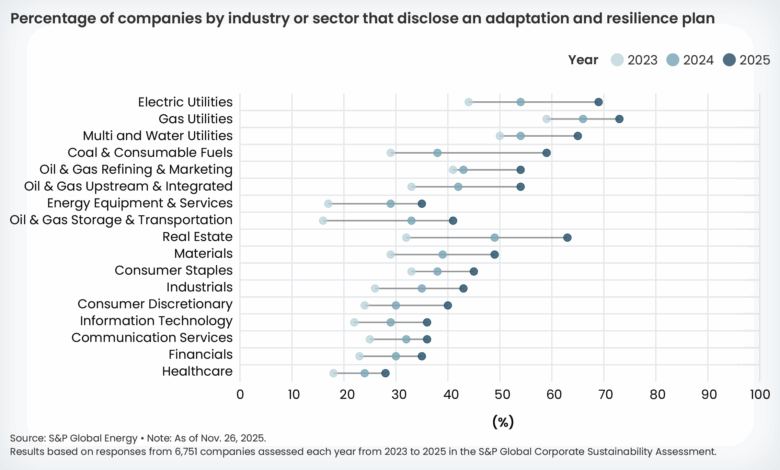
- Climate adaptation and resilience — Sectors vulnerable to extreme weather and lacking resilience investments may face significant operational and financial challenges.
- Energy transition — Rising power demand, electrification and grid constraints sharpen the challenge of scaling renewables and flexibility. Global trade and climate policy increasingly focus on harmonizing emissions reporting.
- AI and data centers — Rapid expansion of data centers to power AI elevates pressure on water resources and raises new scrutiny on emissions, local infrastructure impacts and operational sustainability. The exponential growth of the data center industry will lead to higher power grid emissions and water stress.
- Water and food systems — Water stress, extreme weather and ecosystem strain intensify water-related business risk across supply chains and food systems, accelerating demand for water stewardship and disclosure.
- Supply chains — Trade protectionism and policy uncertainty complicate sustainable sourcing and due diligence, while climate disruption keeps resilience and continuity planning front and center.
- Biodiversity and nature loss — Only 8% of companies in the S&P Global Corporate Sustainability Assessment have a biodiversity protection commitment.
- Standards, reporting and regulation — Companies face a patchwork of reporting expectations across jurisdictions.
- Sustainable finance — The gap between climate and development financing needs and available capital remains significant, but transition finance has an opportunity to break to the fore in 2026, from the slower 2025 sustainable debt market.
- Aging populations and workforce — Global aging and labor markets could become more of a pivotal issue in 2026.
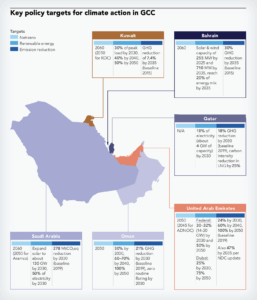
Energy transition report shows GCC growing energy exports while cutting emissions
DNV recently released its “Oil & Gas Decarbonization in the Gulf Region” report, which looks at how Gulf Cooperation Council (GCC) countries are cutting the emissions intensity of their core oil and gas production while continuing to play a central role in global energy supply.
Since 2005, the GCC has produced nearly 18% of global oil and gas. As global energy demand increasingly shifts toward Asia, the Middle East’s location and cost competitiveness strengthen its position as a preferred supplier. At the same time, decarbonization measures are becoming an integral part of long-term competitiveness.
Oil and gas production in the GCC continues to expand alongside a stronger focus on reducing operational emissions. Electrification of assets is being used to cut Scope 2 emissions from pumps, compressors and offshore facilities through grid connections, renewable power and hybrid solutions. These efforts are supported by energy-efficiency measures and the use of digital tools and AI to optimize drilling, reservoir management and asset operations, reducing energy intensity and emissions per barrel produced.
Methane reduction remains one of the most immediate and cost-effective options for lowering emissions. Across the GCC, routine flaring is planned to be phased out by 2030 and leak detection and repair (LDAR) programs are increasingly standard. National oil companies are also aligning with international methane initiatives, enabling continued production growth while reducing methane intensity in line with national net-zero targets.
GCC countries are realigning domestic energy systems to reduce oil and gas use at home and free up volumes for export and low-carbon fuel production. Growth in renewables, electrification of transport and buildings, and efficiency gains are driving this shift.
Hydrogen and ammonia feature in DNV’s forecast as viable long-term export options. With access to low-cost natural gas, strong solar resources and established industrial and export infrastructure, the region is well placed to scale both low-carbon hydrogen (produced from natural gas with carbon capture) and renewable hydrogen produced through electrolysis. By 2060, the Middle East and North Africa (MENA) region is projected to produce around 19 million tonnes of hydrogen and 13 million tonnes of ammonia per year.
“Hydrogen, ammonia and carbon capture are becoming core elements of the GCC’s energy export model,” said Jan Zschommler, Market Area Manager for the Middle East, Energy Systems at DNV. “As emissions requirements tighten, access to international markets will increasingly depend on carbon intensity. Integrating hydrogen production with renewable power, carbon capture and existing industrial clusters allows the region to remain competitive while meeting these requirements.”
Carbon capture, utilization and storage (CCUS) supports much of this transition. More than 98% of CCUS projects planned or operating in MENA are located in the GCC. In January 2026, the UAE’s Supreme Council for Financial and Economic Affairs introduced Carbon Capture Policy as a further commitment to meeting the country’s carbon reduction targets. Captured CO2 volumes (including CO2 removal) are expected to reach around 250 million tonnes per year by 2060.
Carbon dioxide removal will also increase. By 2060, bioenergy with carbon capture and direct air capture combined are expected to remove around 81 million tonnes of CO2 per year.
US EPA announces repeal of 2009 vehicle greenhouse gas endangerment finding
The US Environmental Protection Agency (EPA) on 12 February that is had finalized a rule repealing the 2009 greenhouse gas (GHG) Endangerment Finding and removing federal GHG emission standards for motor vehicles and engines for model years 2012 and later.
The action also eliminates associated compliance programs, credit provisions, reporting requirements and all off-cycle credits, including those related to vehicle start-stop systems. The EPA stated that the rule does not affect regulations addressing criteria pollutants or hazardous air pollutants.
EPA Administrator Lee Zeldin called this “the single largest deregulatory action in US history” and said it will help US consumers save costs and improve affordability of vehicles.
The Endangerment Finding had served as the legal basis for federal regulation of GHG emissions from vehicles under Section 202(a) of the Clean Air Act. In the final rule announced today, the agency states that it has reevaluated that authority in light of subsequent court decisions and concluded that the Clean Air Act does not provide statutory authority for regulating motor vehicle GHG emissions in the manner previously applied.
Prior to the rule announcement, the EPA held a 52-day public comment period, which included four days of virtual public hearings where more than 600 individuals testified. The agency said it received about 572,000 public comments on the proposed rule and made substantial updates to the final rule in response to comments.
A summary of public input and EPA’s responses to all comments can be found in the final rule preamble and accompanying documents.
Click here to access the full EPA announcement of the final rule.