Drilling & Completion News
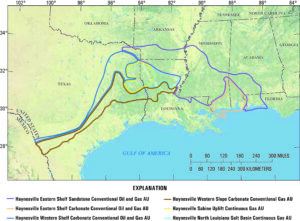
assessment units (AUs) in the Haynesville Formation. (Click the image to enlarge.)
USGS: 47.9 trillion cu ft gas potential in Haynesville
In its new assessment of potential for undiscovered gas and oil in the Haynesville Formation underlying the onshore US Gulf and adjoining state waters, the US Geological Survey (USGS) estimated that the formation contains technically recoverable resources of 47.9 trillion cu ft of gas and 152 million barrels of oil. The last USGS assessment was issued back in 2017.
Since the 1921 discovery of oil sands near Haynesville, La., the formation has produced 49.1 trillion cu ft of natural gas, which is as much gas as the United States uses in 18 months at the current rate of consumption. More than 11,000 wells have targeted the formation.
While the assessment area stretches from the Texas-Mexico border along the Gulf Coast to the Florida panhandle, resources are concentrated on the Texas-Louisiana border.
The Western Haynesville, referring to the western side of the East Texas Basin, was not included in this assessment. It will be included in a future USGS assessment of undiscovered oil and gas resources in the Bossier Formation.
H&P set to reactivate 7 land rigs in Saudi Arabia
Helmerich & Payne received notice in November 2025 to recommence operations on seven land rigs in Saudi Arabia that had been suspended. The reactivations will occur in stages throughout the first half of 2026. In accordance with the terms of the drilling contracts, all days accrued during each rig’s suspension period will be added to its remaining contract.
H&P noted that these reactivations reflect strengthening market conditions across the Middle East. By mid-2026, the company expects to operate 24 rigs in Saudi Arabia, including eight proprietary FlexRigs and 16 rigs acquired through the KCA Deutag transaction. The company also reiterated its commitment to the Eastern Hemisphere as it seeks to strengthen its international operations.
Nashville exploration well proves successful in US Gulf
Shell and INEOS Energy announced a new deepwater oil discovery in the Norphlet formation in the US Gulf. The Shell-operated exploration well, Nashville, was drilled more than 5 miles beneath the seabed and confirmed high-quality oil. The discovery could be tied back to the nearby Appomattox production platform, which is operated by Shell and jointly owned with INEOS.
The discovery was drilled using Transocean’s Deepwater Proteus drillship. Further technical work is under way to determine the size of the find.
Shell holds 79% working interest in the discovery, with INEOS holding the remaining 21%.
VALARIS DS-8 wins 800-day contract with Shell in Brazil
Valaris was awarded a multi-year contract with Shell offshore Brazil for the VALARIS DS-8 drillship. The contract is expected to commence in Q1 2027, with an estimated duration of approximately 800 days and a total contract value of approximately $300 million. The contract also includes options with a total estimated duration of approximately one year.
E&P CAPEX down 9% in new Petrobras 5-year plan
Petrobras’ new 5-year Business Plan for 2026-2030 calls for total CAPEX investments of $109 billion, including $69.2 billion allotted to E&P projects during that time period. That total reflects a 9% decline over the prior 5-year plan of $76.4 billion for E&P spending.
Of that portfolio, 62% corresponds to pre-salt fields, 24% to post-salt fields and 10% to exploration. The remaining E&P CAPEX are related to onshore, shallow waters, assets outside of Brazil, and technology or decarbonization projects.
The company also raised the level of the oil and gas production curve in the short and medium term compared with the previous plan, citing better reservoir management, new complementary wells and the startup of new production systems, as well as an increasing availability of natural gas compared with the current supply.
Under the new business plan, Petrobras forecasts reaching a peak oil production of 2.7 million barrels per day in 2028 and a peak total production of 3.4 million barrels of oil equivalent and gas per day in 2028 and 2029.