Drillers keep eye on technologies for tomorrow even as investors focus on getting returns today
Precision sustains investments in people, robotics and automation to build strong fundamentals for long-term performance gains

By Stephen Whitfield, Senior Editor
Carey Ford is President and CEO of Precision Drilling.
What do you see as the most critical challenges facing the onshore drilling industry right now?
When I think about that question, first I think about how the industry is always facing challenges and how, no matter what those challenges are, the industry finds a way to overcome them.
With that said, I believe today’s primary challenges are people, technology and capital. On the people side, we have a generational knowledge gap. Over the past 10 years, we’ve had three significant downturns where a lot of people and knowledge left the industry, and, because of that, fewer careers have started in the industry. We must continue to address that talent shortfall.
With technology and capital, those challenges are closely linked, but the conflict is due to differing time horizons and complications from commodity price volatility. Technology typically requires capital, and capital requires a return, but the investor timeline is currently focused on the short term. Our customers’ capital providers want them to deliver returns today. They want to see technology driving efficiencies and cost reductions – today.
That means there’s a huge focus on speed and efficiency. But for drilling contractors, if we’re going to have technology innovation to meet the demands of our operators, we need to have the time to scale and deliver repeatable results.
Onshore drilling capital providers increasingly expect us to meet emerging customer demands while investing minimal capital in the rig upgrades and technological innovations required to do so. This mismatch creates challenges for technological deployment.
But I think this is like any other challenge in the industry – we are well positioned to overcome it.
The relationship between drillers and investors does seem to be pretty complicated these days.
Four years ago, if you were talking to investors, many of them would have said that the 10-year terminal value of all oil and gas production and oilfield service companies was zero.
There was this thought that, at some point, maybe 2030, oil and gas was going to be such a small part of the energy mix that these investments would have a negligible terminal value. Now, even though that sentiment about where oil and gas fit into the longer-term energy mix has changed, the mentality around capital investment hasn’t changed much. The focus remains short-term.
Capital discipline has been a mantra for the industry for several years. Do you think the industry is running as lean as it can? Are there any more cost efficiencies left to seek out?
If you start from a customer standpoint, our customers need to attract investor capital because the industry will always be capital intensive. They must generate attractive returns on every well – not just a promise of future returns but returns today. So, they’re highly focused on operations being safe, efficient, predictable and fast.
The results we’ve produced with our customers are astounding and undeniable. Speed, as measured by footage per day, along with the ability to address innovative well designs, has pushed the limits of what the industry believed was possible just a few years ago. The efficiency gains for our customers are well understood.
What’s not understood is the impact that all of this speed is having on rig equipment. When you think about the drill pipe, the mud pumps, the engines, the top drives and other components, they’re wearing out much faster than they used to, and I don’t think the consequences that will have on capital investment are understood yet.
For example, if a string of drill pipe lasted five years, and it typically costs $2 million to buy that string of drill pipe, you can make a pretty good estimate that you would need to be paid $400,000 a year to get your money back. Then, if you expect a 20% return on your investment, you’d need to make another $80,000 a year on top of that, so $480,000 per year. If that drill pipe wears out in one year, that return framework is completely different. You would need to make $2.4 million in a year to get compensated for your investment.
That’s a hypothetical, and there are a bunch of moving parts here, but this is where the industry has the biggest opportunity to create more efficiencies. We need to develop a better understanding of that capital investment return framework around the equipment required to drill a well in 8-10 days, when that well was previously drilled in 20 days.
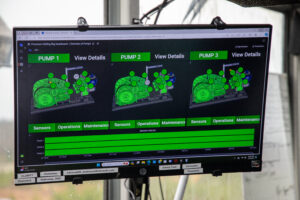
I believe digital twins are key. By incorporating digital twins into our operations, we gain a deeper understanding of wear patterns and economic returns in this new environment, which will enable predictive maintenance of critical components and optimized supply chains, ultimately leading to enhanced capital efficiency.
The next step to realize capital efficiency requires closer collaboration between drillers and operators, optimizing well designs, materials and operating parameters together, so performance gains come from better system design, not from pushing equipment past its economic limits.
Additionally, we have demonstrated meaningful emissions reductions and fuel savings for our customers by incorporating our EverGreen suite of solutions on our rigs. EverGreen offerings include emissions monitoring, hydrogen blending, BESS (battery energy storage) units, highline power, digital fuel optimization and many others.
The benefits are real, including economic benefits, and we expect innovations in this space to continue.
What will it take for drilling contractors to deliver that next step change in performance with their rigs and equipment?
I would take a step back with that question and say that an idea or technology doesn’t necessarily need to produce a step change. That being said, I think step-change performance improvements require integrated approaches across four key dimensions.
One is technology integration. We know that individual technologies can deliver incremental gains, but integrated systems create step changes. At Precision, we’ve learned that combining directional automation, advanced drilling dynamics mitigation and real-time optimization delivers compounding benefits. The rig must function as a cohesive system, not a collection of independent tools.
The second dimension is data-driven operations. You must take advantage of the data-driven opportunities that are available.
Modern rigs generate massive amounts of data, but the value in that data comes from actionable insights. We need edge computing for real-time decision support, machine learning models that continuously optimize drilling parameters, and digital twins that enable scenario planning before problems arise.
Third, you must look at human-machine collaboration. The goal isn’t to replace human expertise but to amplify it. Automation handles routine processes and maintains optimal parameters, freeing operators to focus on complex decision making, exception handling and continuous improvement.
Then you need to look at standardization with flexibility. The technologies and equipment deployed on a drilling rig are very important, but if you have an innovation that can only go on one rig, then it’s not really much of an innovation. We must have standardized platforms that facilitate rapid deployment and crew familiarity, while also maintaining configuration flexibility to meet specific basin requirements.
Precision Drilling has been an early adopter of automation in our industry, with its AlphaAutomation platform and adjacent systems. What has automation enabled Precision to do with its rigs that it couldn’t do otherwise?
We’re going on 10 years of incorporating automation into our operations. This has led to not only enhanced drilling performance but also remote support, predictive maintenance on key assets, and the utilization of digital twins to eliminate equipment failures from the critical path.
But that’s just the start of it. Precision has deployed AlphaAutomation on more than 90% of our AC Triple rigs. That’s opened a world of scale benefits. You talk about stuff like turning data flows into operational insights, performing in increasingly complex downhole environments, performance documentation that ensures trust and transparency with customers, enabling a predictive approach for service delivery and equipment management – these are all huge wins for us.
But I think our biggest win has been developing our people in the Alpha world of Precision. Many of the employees who were part of the day-one struggles in 2016 and 2017 have worked within these systems to drive the enhancements we rely on today. And now those employees have become our leading experts across the organization. Many of Precision’s current superintendents cut their teeth as the first Alpha Drillers eight or nine years ago!
This evolution gives us a unique advantage, as we now have an organization with a digital mindset, capable of co-creating and leading the next wave of digital initiatives. As a team, we’re aligned, engaged and positioned to take the next step forward together.
Automation sounds very much intertwined with Precision’s operational philosophy.
I would describe it a bit differently. There’s our AlphaAutomation platform, which automates all the routine tasks and gives us data from the rig. That data’s rolling to our optimization team, which identifies the insights on equipment performance and well plans.
It’s like a bookshelf full of books. We’re building this huge database of all the wells we’ve drilled over the past decade, in different basins, with the parameters and drilling techniques that produce the best results in different parts of the formation. All of this information has given our optimization team a lot more insight into helping customers design their well plans.
In 2022, we rolled out a platform called Clarity, which delivers real-time monitoring of the performance of the rig versus the well plan. That allows us to see where the deviations are and what caused those deviations. Was it one of our pieces of equipment? Was it something from a third-party service provider? Was it some portion of the formation that nobody really knew was an issue? We can see all of that in real time. We have the crews and expertise to resolve these issues quickly and effectively while also maintaining effective internal and customer communication.
On top of that, the digital twin monitors all the critical components on the rig to detect issues like vibration anomalies. This allows us to optimize our maintenance procedures to even further fine-tune our condition-based maintenance.
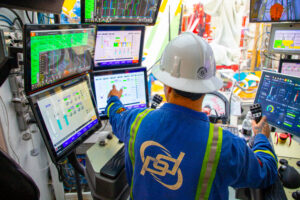
Precision Drilling has also seen the deployment of the AlphaARMS robotics system in the field. Where do you see robots fitting onto the modern drilling rig? Is this the type of technology that can be deployed at scale?
It can 100% be deployed at scale. As you noted, through our partnership with NOV and a valued customer, we successfully deployed the first modular robotics system, which has been in operation for nearly two years in the Montney Shale in Canada. This experience has provided us with a firsthand understanding of the actual operational impact that robotics can have on a drilling rig. It allowed us to clearly identify which problems can be solved through automation and which activities must remain manual. This level of insight into the nuances of deployment enables us to integrate robotics effectively into our long-term strategy.
When you look at AlphaARMS, the benefit of these robots is that they’re modular. They can fit onto an existing drilling rig. We have 95 AC triple rigs with the NOV Amphion control system, and most of those rigs have the NOVOS platform, as well. This technology is really the heart of the operation – it’s what enables and coordinates the robotic system. This solution enables us to deploy AlphaARMS on these rigs, whenever we need it, and it’s ready to be rolled out to the rest of our fleet. We expect to deploy additional systems on other rigs in the near future.
The challenge goes back to the capital, like I mentioned earlier. There is a capital commitment needed to outfit a rig with robotics, and there’s a return requirement. Robotics make the rig safer because there’s nobody on the rig floor. That’s a benefit, but is it faster? Is it more reliable? Is it adaptable to different drilling programs? As a contractor, we must work with our equipment partner to show that it’s faster and that it creates cost benefits.
But I’m optimistic. I think we’re close to having more customers ready to incorporate AlphaARMS onto their rigs.
At an industrywide level, what do you see as the significant challenges to accelerating technology adoption?
The best-case scenario is when you have a customer with a longer-term vision, and a technology provider and a drilling contractor that can sit at the table with them and agree on how to make that vision work. We had that with our robotics deployment, and it’s generated significant benefits for all of us.
But there are several fundamental challenges that still exist to accelerating adoption. A big one is that contractors have a difficult time making investments in technology without a guaranteed return, and most customers typically don’t want to incorporate technology without proven results.
Beyond that, you have two other challenges. First, we have to consider the influence of organizational inertia for technology adoption, as it requires field embracement by both the contractor and operator. Many effective technologies have stalled at the field level: “We’ve always done it this way” remains a powerful sentiment. Successful technology adoption requires a culture change, investment in training, and the empowerment of field personnel to adopt new approaches.
Second, the integration of technology into existing systems introduces complexity, as rigs operate with equipment from multiple vendors, resulting in a complex integration process. Ensuring interoperability, managing software updates and maintaining cybersecurity across diverse systems create technical and commercial challenges.
I’ll give you an example of that last challenge: You have to consider whether the rig has a network connectivity that can handle a new technological innovation. When we rolled out AlphaAutomation, one of the things that we had to deal with was the data load coming off that platform. That data load was multiples higher than what would come off a typical EDR system, so the bandwidth that we had at our rigs was not large enough to handle the data streams. We had to incorporate Starlink on all our rigs to handle that data flow.
It’s not an issue anymore, but it’s an example of the infrastructure challenges that can accompany new technology deployment.
How critical is collaboration among industry stakeholders in developing the technological innovation that drives the industry forward?
Collaboration among drillers, operators and OEMs is essential for meaningful innovation. Although collaboration has its challenges, we have proven it to be transformational when we have alignment on technical goals, deployment and field-hardening timelines, capital return frameworks and information sharing.
It’s worth noting that this multi-point collaboration also includes an internal customer for the drilling contractor. Whereas external customer solutions require significant collaboration, validation and feedback to ensure alignment and the delivery of value, internal customer solutions can often be deployed rapidly and evolved in real time, allowing us to prove value quickly, close gaps and refine solutions before broader adoption.
When collaboration works well, it can be powerful and foundational for rapidly scaling technology. We proved this in our rollout of AlphaAutomation, working with NOV and multiple customers to scale the standardized digital technology across more than 70 rigs in North America. We are proving this again with our collaboration on AlphaARMS, which continues to yield incremental performance improvements due to the strong collaboration among all parties.
What do you see as the most significant opportunities for drillers to leverage data from the wellsite?
Our Clarity platform is essential to this process. Everybody has an app – all the salespeople, rig managers, superintendents and the optimization teams. Everyone can pull up any rig and look at performance in real time. That supercharges communication among those groups, and we avoid situations where a customer might be having an issue and only certain parties know about it. With the customer, whether it’s the operations manager or the COO, someone is going to know right away.
We want to make sure that we are aligned with how our customers view their overall drilling program performance. That real-time data availability improves communication internally and with our customers.
The real differentiator is when these platforms are embedded in the driller’s workflows and built around the nuances of execution at the rig. That’s when it moves beyond updates and reporting to delivering contextual intelligence that integrates with automation systems and drives real-time action across all parties.
Earlier you mentioned people as a challenge the industry faces, particularly the knowledge gap that companies have seen following the departure of experienced personnel. Given the state of the market, can the industry afford to recruit and train incoming personnel to the extent needed to close that knowledge gap?
Regardless of the type of market we’re in, we cannot afford to pause recruiting or training new employees, as people remain our most valuable asset and the most important driver of success in the field. At Precision, we view training as a competitive advantage, not a cost center. Despite the rig count bleeding out and the capital constraints we’ve faced on growing the business, we’ve never stepped back from recruiting and training.
Much like our approach to technology, we must drive performance from day one, equipping newhires with the necessary tools, training and expectations to contribute immediately while continuing to build long-term capabilities. One example of how we achieve this is through our investment in Alpha University, simulator training and structured career development.
Our success will continue to be determined by our ability to provide employees with a safe and stable work environment, along with skills and leadership training, and a career that offers opportunities for growth.
What skills should companies be looking for as they recruit the next generation of oilfield workers?
Some things never change: The desire to work safely is always important. You need to have a strong work ethic and personal drive.
However, the current market has introduced several new requirements, like digital literacy, critical thinking and an understanding of operating systems. It used to be that you just needed a mechanic who understood how to repair an engine. Now you need to understand how the digital automation system interacts with all the critical components. You need to monitor performance through a digital twin that’s advising you.
You need all these skills, on top of the personal attributes of work ethic and safety, to be able to succeed in today’s environment.
But this also goes back to the recruiting question: How do you recruit people in this industry? You have to give them an opportunity to work with leading-edge machinery that’s digitally supported and to work with machine learning and artificial intelligence to generate an outcome that’s good for their drilling company and their customer. That’s a much more attractive work environment in today’s economy. DC