Drilling & Completion Tech Digest
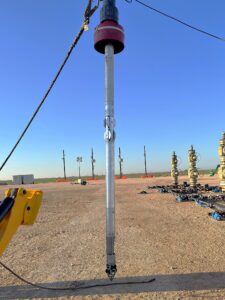
Jet-propelled, battery-powered well conveyance technology completes field trial in Permian Basin
UK-based WellSense recently completed a field trial in the Permian Basin for a jet-propelled, battery-powered well conveyance technology that is able to rapidly deploy bare fiber into highly deviated wells. The system aims to improve the speed, quality, cost and efficiency of diagnostic surveys in horizontal wells.
The field trial, completed in August 2025, saw the FiberLine Intervention Conveyance System (FliCS) deploy bare fiber into a 19,000-ft uncompleted well in the Permian for cross-well strain monitoring. The deployment took 50 minutes – approximately 10 times faster than a standard pumpdown operation. The trial was delivered for a major international operator that provided support for early technology development.
FliCS was developed at WellSense’s UK headquarters and R&D hub in Aberdeen, aiming to deploy fiberline intervention into horizontal wells to acquire distributed acoustic sensing and distributed temperature sensing data across the reservoir.
The FliCS uses lightweight battery-powered jet propulsion, which is triggered by a magnetic switch at launch. Jet-drive technology accelerates well fluids through an impeller sub to generate thrust while the probe de-spools optical fiber along the well to enable highly sensitive distributed fiber optic sensing data to be acquired.
The prototype model deploys 25,000 ft of fiber in just over an hour, traveling at approximately 350 ft/min versus approximately 35 ft/min for a conventional tractor conveyance. The lightweight components can be left in the toe of the well or pushed to the bottom, minimizing risk to future operations.
WellSense is working to deliver its first, multi-unit prototype order while also developing a slimmer model for deployment through smaller tubing. The technology is expected to be ready for commercial launch in early 2026.
Uncrewed technologies set to help monitor deep ocean currents, mitigate hazards
A recently completed uncrewed technology collaboration in the US Gulf proved out a new way to monitor previously hidden but disruptive deep ocean currents in near-real time. Sonardyne and SeaTrac Systems used advanced sensors and uncrewed surface vehicles (USVs) to deliver deep ocean current data on the Gulf’s Loop Current System.
The project opens the door to reliable, on-demand and sustained high-resolution observations of ocean systems without the need to send people offshore. In turn, this boosts scientists’ ability to improve predictive models, helping industry and science understand and mitigate the hazards posed by disruptive deep ocean currents, like the Loop Current System.
The project was completed during fall 2025 and funded by the US National Academies of Sciences, Engineering and Medicine’s Gulf Research Program.
“This mission has demonstrated a new global precedent for using USVs to make critical, sustained ocean data accessible, consistently – with zero crew risk, zero emissions and a repeatable approach we can scale to other regions,” said Hobie Boeschenstein, Director of Operations and Business Development at SeaTrac.
The collaboration used Sonardyne’s Origin 65 seabed acoustic doppler current profilers and SeaTrac’s SP-48 USV to gather near-real-time current profile data from the Loop Current System. Over 18 months, four Origin 65s and five pressure-inverted echosounders were deployed in 1,800- to 3,200-m water depth, 200 nautical miles off the coast of Louisiana.
The operation leveraged Origin 65’s integrated edge processing capability and acoustic modem so that data could be acoustically harvested from the surface by SeaTrac’s remotely piloted USV.
The solar- and battery-powered SP-48 navigated ocean currents and weather conditions to reach the sensor locations and harvest the data. It was then able to send the data to shore through its dual Iridium and Starlink satellite links, which also enabled high-data-rate and real-time communications back to shore.\
Updated 3D printing standard addresses industry needs
DNV announced a new edition of its standard for additive manufacturing (AM), DNV-ST-B203. Key enhancements include:
- Comprehensive guidance to help engineers optimize part geometry and material selection to leverage AM capabilities.
- A new methodology that enables the estimation of the carbon footprint for AM parts, supporting more informed, environmentally conscious decision making aligned with sustainability goals.
- An expanded qualification framework that is streamlined to group parts under shared qualifications, reducing redundant testing, lowering costs and accelerating time-to-market.
- Inclusion of a qualification framework for polymer parts, ensuring consistency and reliability across material types.
The standard also provides defined acceptance criteria and guidance on part families and in-process monitoring.
The updates in the new edition were driven by the ProGRAM Joint Industry Project (JIP). Its next phase will focus on digital inventories and new AM technologies.