Transparency on risks, vendor flexibility among OEM strategies to drive technology adoption
Collaboration, R&D investments help HMH spearhead innovations in BOP electrification, offshore MPD systems, data-driven automation

By Stephen Whitfield, Senior Editor
Jeff Fisher is VP – Products & Innovation (Pressure Control) at HMH.
We know that acceptance and adoption of new technology can be slow in the risk-averse drilling industry. What do you see as the biggest challenges to encouraging stakeholder investment in technology development today?
This industry absolutely adopts new technology, but the pace is slower than what we see in many other sectors, largely because of the cost of out-of-service time for a drilling facility. New technology usually requires out-of-service time to be deployed and comes with an additional risk of unintended out-of-service time for the drilling facility as the new technology is new to the operation and to the crews.
Operators and drilling contractors have to evaluate not only the development and CAPEX investment but also the operational implications. That level of scrutiny naturally makes adoption more deliberate.
One of the best ways to help overcome that hesitation is to increase transparency. When we openly communicate the risks involved in deploying new technology, customers gain a more accurate understanding of what the process truly requires. Too often, those risks are kept internally, but the more transparent we are, the better equipped our customers are to anticipate uncertainties, plan effectively and make informed decisions.
When all parties understand the risks and can plan for contingencies, achieving the common goal of deploying improved technologies is much more obtainable.
Can you elaborate on what you mean when you talk about risk?
When we develop new technology, we conduct extensive factory acceptance testing in our full‑scale labs. However, lab conditions can never fully replicate the realities of rig operations. That gap between factory testing and actual field environments creates inherent risk, because performance may differ once equipment is deployed. Even with field testing, there are always variables you cannot fully anticipate. That uncertainty is part of the risk I’m referring to.
How would you describe the importance of collaboration between HMH and its stakeholders throughout the development timeline?
Collaboration is essential at every stage of development. The more we collaborate with our partners, the more successful the outcome tends to be, especially for large R&D efforts like our Managed Pressure Drilling (MPD) System and our Electric BOP. When we talk about how to implement these systems and how to place the equipment on the rig in the most effective way, those answers only come through a truly collaborative process.
I often compare it to moving a piano. If everyone is not lifting together, the piano simply does not move. These major R&D initiatives require that same kind of coordinated effort in order to be deployed successfully.
HMH is doing quite a bit of work with MPD. How much enthusiasm for MPD are you seeing within the industry?
Industry enthusiasm for MPD is very strong. All of the market indicators we monitor point to continued growth, and most new operator tenders now require MPD‑capable rigs. It is clear that the industry is moving in that direction.
There’s a flip side to that coin, though. MPD remains costly to operate, and that leads some customers to question whether it is necessary for every well or whether they can continue drilling conventionally. That is exactly the challenge we are addressing with our integrated MPD System.
Today’s MPD systems are typically add‑ons. They require deliberate planning, extra rig‑up time, and troubleshooting that can slow operations if something needs to be corrected. Because of our expertise in riser design, we are working to integrate MPD capabilities directly into the riser itself. When MPD becomes part of the riser, it stops being an add‑on and eliminates the additional run time, allowing MPD to be used on‑demand whenever the operation calls for it.
The industry is also asking for improvements in reliability. That largely comes down to sealing technology. With our Hydril Pressure Control elastomer technology working in synergy with marine‑grade polyurethane, we are extending seal life and strengthening overall seal integrity, which directly improves the economics of each well.
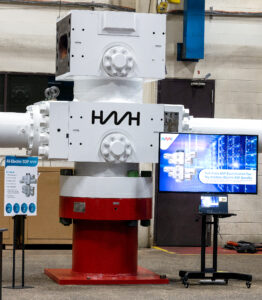
As you also mentioned, HMH has done a lot of work around electric BOPs, including the launch of a BOP electrification lab. You’re also planning to commence a JIP on electrification of BOP actuators. How are these projects helping you optimize electric BOP design?
These ongoing projects have played a major role in optimizing our Electric BOP design, and it starts with client feedback. We gather detailed input on the hydraulic systems currently operating in the field, including the issues customers face and the capabilities they wish they had. We also evaluate feedback on our existing electric design, identifying what works well and what needs to be improved.
The electrification lab at our Houston facility has been especially impactful. While we can model a great deal on paper, you learn much more when the entire system is connected and running as a complete unit. Seeing how the equipment behaves in a physical environment allows us to validate or challenge our assumptions. Those real‑world insights are what let us refine the design, improve performance and accelerate the optimization process.
Can you talk a bit more about insights that you’ve gained into electrification through your work at the lab? Any examples you can give us?
One clear insight has been seeing how differently hydraulic and electric BOP systems behave during shearing operations. Our lab work showed that, as the pipe is being cut, the reaction forces and the way the pipe pushes back into the system are not the same between hydraulic and electric designs.
Understanding those differences has been valuable. With that data, we can refine the control software for the Electric BOP so it adjusts speed, force and behavior in real time.
Do you see the Electric BOP as a step change in BOP technology? How far do you think the industry is from electric BOPs becoming more of a standard versus a hydraulic BOP?
We do believe the Electric BOP represents a step change in BOP technology. Rather than viewing it as a replacement that will immediately become the new standard, we expect electric BOPs and hydraulic systems to coexist for quite some time.
The Electric BOP offers clear advantages in most applications. It is lighter than a hydraulic unit and allows for better verification of functional integrity during operation. As one example, the Electric BOP is particularly attractive for plug-and-abandonment operations, where customers are seeking lighter, faster and more efficient solutions.
What other innovations do you see coming down the pipeline with BOPs in general? Have we engineered as much reliability into the BOP as possible, or can we improve them further?
I like the way you’ve phrased this question, because innovation is broader than just technology. We continue to innovate around the BOP, but it is important to recognize that innovation can take different forms. Many people immediately think about the next technological advancement, but innovation can also come through new business models. For example, our industry‑first BOP contractual service agreement was a business model innovation that created value without changing the underlying hardware.
That said, there is still meaningful work to be done on the technology side. Two areas that stand out are the need for increased shearing capacity and advancements in elastomer technology to handle the higher temperatures and elevated H2S levels appearing in more wells around the world.
When it comes to reliability, many drilling contractors already achieve high performance, often reaching 99% uptime. The gains are more incremental now, but there is still room for improvement. HMH participates in the IADC RAPID‑S53 Committee to contribute to the industry’s work in understanding BOP performance and identifying opportunities to further enhance reliability.
Do you think our current business models are good enough to encourage innovation?
In some ways, yes, current business models can support innovation. What I would say, though, is that becoming more creative with how those models are structured can help accelerate deployment and adoption.
In the onshore space, we’re seeing operators and drillers pushing lateral lengths farther than we could’ve imagined just a few years ago. Do you think the equipment we have available right now will be sufficient to handle the physical demands of drilling these laterals as they keep getting longer?
We are seeing the gap narrow between onshore and offshore specifications. The technology needed to support these longer laterals already exists, because offshore operations have used high‑spec equipment for decades. The real challenge is adapting that higher‑spec equipment so it can be installed and operated efficiently on an onshore rig.
To your point, yes, laterals continue to get longer. We are reaching the limits of current onshore equipment, which is why more customers are looking for higher‑torque top drives and higher‑pressure mud pumps to support extended‑reach lateral drilling. Much of this capability already exists in the offshore space. The work now is about bringing that technology onshore in a way that meets land rig constraints without compromising performance.
Fitting the higher-torque top drives onto a land rig sounds like squaring a circle.
This is where innovation really shows its value. If you look at other industries, they have been able to develop progressively smaller motor solutions while delivering the same level of power. That is the direction we are moving toward, as well.
How is HMH using data analytics to improve the performance of its drilling equipment?
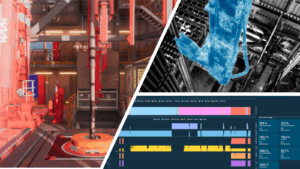
We apply analytics across both our topside and BOP equipment. On the topside, the focus is on improving consistency, strengthening asset performance and increasing automation. We recently formed an AI partnership with Cognite to enhance analytics within our DrillPerform offering. Among other things, this collaboration is helping us drive greater efficiency in drilling operations, diagnose issues more quickly, and gain deeper insights into how human factors influence performance from rig to rig.
Another example of our data-driven approach to automation is the Bulldog Roughneck series. These fully automated roughnecks leverage advanced analytics and remote diagnostics to reduce manual interventions by more than 90%, resulting in safer and more efficient operations.
Would you call yourself an AI enthusiast?
From an HMH perspective, we absolutely are. The focus is on how we can use AI to best support the needs of our industry. We look at it through the lens of how AI can improve the speed at which we deliver information to our customers and how quickly we can help them make decisions.
How far along are we in that journey of figuring out where AI fits in the oilfield?
I compare it to the Dunning‑Kruger curve. Different companies and different AI applications sit at various points along that curve based on how they are approaching AI. At HMH, we have made significant progress in select AI applications and are already realizing measurable value. There are also other areas where we see strong potential, but like many others, we are still in the early stages of understanding and adoption.
Where do you see humans fitting in an increasingly automated and digitized drilling landscape?
Automation is intended to take on the repetitive tasks and perform them more consistently. That allows rig crews to increase their cognitive capacity and focus on what is most important. For me, that is well safety, equipment performance and overall drilling performance.
Another benefit of automation and digitalization is improved communication. Anyone who has played the game of telephone knows that the more people involved, the more time it takes and the greater the chance for information to get lost or misinterpreted. With digital systems, everyone receives the same information at the same time, which helps teams make decisions more efficiently and with greater accuracy.
I wanted to ask about silos. There’s an attitude in some corners of this industry that being too open isn’t necessarily the best thing, that competition breeds innovation. What steps do you take when you encounter silos?
There are two key parts to how we think about silos. When we encounter them at HMH, the first thing we do is reinforce the common goal we all share. We are all focused on delivering for our clients, and when everyone is aligned around that, we can accomplish much more together.
The other piece is we don’t want our customers to feel what we would call “vendor locked.” They want options, and they want the freedom to collaborate with other vendors when it benefits their operation. We support that, and keeping that flexibility in place helps break down silos.
HMH has had open-source platforms in its portfolio for years. Do you think the drilling industry is embracing open source and interoperability as much as it should?
I think the industry is naturally moving in that direction. There is growing interest in more open source and greater interoperability, but we are not all the way there yet. HMH considers itself a leader in this space. We are creating an environment where open‑source platforms can thrive.
Our goal is to give customers integrated access to the best solutions available, even when they do not come from HMH. We are not experts in every part of drilling, nor do we plan to be. When there is technology that strengthens our system, we want to integrate it because that delivers the most value to our customers.
Open source supports that in two ways. It helps us be a stronger partner to our clients, and it allows us to incorporate leading technologies into our system so we can continue improving automation and overall rig performance. DC