Ensign advances workforce training through IADC-accredited competence assurance program
Integrating competency framework with structured training, operational data leading to improved safety, performance in the field
By Katlyn Gaudet and Jamie Keeley, Ensign Energy Services
As digital tools and AI-driven learning platforms continue to evolve, the importance of a strong competent foundation among the workforce is more critical than ever. Technology can enhance training, but it must be grounded in clearly defined standards and validated processes.
At Ensign, training and competency development programs are designed not only to build technical expertise, but also to strengthen safety performance, leadership and operational consistency across all crews.
A defining milestone in the company’s workforce training journey has been achieving full accreditation through the IADC Competence Assurance program in January 2024. This achievement reflects Ensign’s global IADC certification and its distinction as the only land-based drilling contractor in North America to achieve full accreditation across this range of roles.
While accreditation is a significant achievement, its true value is realized in the field, where a structured competence framework enables:
- Stronger safety outcomes through validated skills and consistent practices
- Operational reliability across crews, rigs and regions
- Clear career progression pathways for employees
- Greater client confidence in workforce capability
Rather than treating training as a compliance exercise, Ensign embeds competence directly into performance, ensuring that skills are measurable, transferable and aligned with real-world operational demands.
From frameworks to field performance
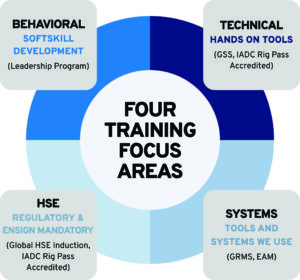
Ensign prioritizes training and competency at every level and delivers structured programs and career development opportunities. This approach is known as the Global Skills Standard (GSS), which aligns defined competencies with role-specific expectations across operations. It is reflected across four key areas: health and safety, environmental stewardship, soft-skill development and operational systems.
The Global Risk Management System (GRMS) supports the collection of data and insights from serious and potentially serious events, helping the organization better understand where the greatest risks exist. It enables a direct connection between field performance and training design, effectively closing the loop between what happens in the field and how people are trained. This includes incorporating insights gathered from serious injury or fatality (SIF) trends; serious injury or fatality potential (SIFP) trends; and lessons learned from field operations.
These inputs allow competency frameworks to become dynamic rather than static, continuously adapting to reflect real-world conditions.
Building into the future of drilling
The GSS reflects a broader shift in how competency is understood across high-reliability industries, connecting past performance, current capability and future readiness.
- Past: Lessons learned and trend analysis from SIF and SIFP data provide insight into where incidents have occurred and where gaps may exist.
- Present: A consistent, structured framework ensures workers are trained, assessed and equipped to perform their roles safely and effectively.
- Future: Data-driven insights are applied to understand what the greatest risks are so training can be developed to avoid future incidents.
This model helps the organization move beyond responding to incidents and focuses on building the skills and competencies to prevent them. This is a pivotal point for Ensign’s GSS, as incident data is now shaping how the company identifies what’s next in its competency journey. It allows the organization to be proactive, using lessons learned to strengthen its approach and target development.
While IADC accreditation provides an important benchmark, industry leaders recognize that certification alone is not the end state. At Ensign, this means competency frameworks are actively used to strengthen performance and reduce incidents over time. Competency systems must continue to evolve, integrating new technologies, adapting to changing operational demands and strengthening global consistency.
Across the industry, there is growing recognition that safety outcomes are directly linked to workforce capability. By integrating structured training, competency frameworks and operational data, organizations are developing a more comprehensive view of their workforce, enabling better decision making at all levels, greater consistency across operations, and stronger alignment between people, processes and performance. Competency, when properly defined, measured and continuously improved, becomes a leading indicator of performance rather than a lagging one. DC