H&P breathes new life into existing diesel engines with dual-fuel gas-blending system
New generation of retrofittable DGB kit offers drilling contractors a cost-effective way to displace up to 75-85% diesel with natural gas
By Stephen Whitfield, Senior Editor
In a time of shifting industry regulations and cost pressures, onshore drilling contractors remain under tremendous pressure to maintain capital discipline. This means that, even though replacing traditional Tier 2 diesel engines with natural gas, or even dual-fuel, engines can reduce emissions output and fuel costs, the substantial capital cost outlays would be a tough pill to swallow.
Instead, drilling contractors like H&P are looking for reduced emissions at low cost – a win-win situation for both themselves and operators.
“Right now, drillers are in an overhaul wave with their engines. There’s a demand for gasification,” said Michael Weidenfeller, Product Strategy Manager at Caterpillar Oil & Gas. “But they’re looking for a system that gives you a lot of the emissions savings at a fraction of the cost of a 100% gas engine.”
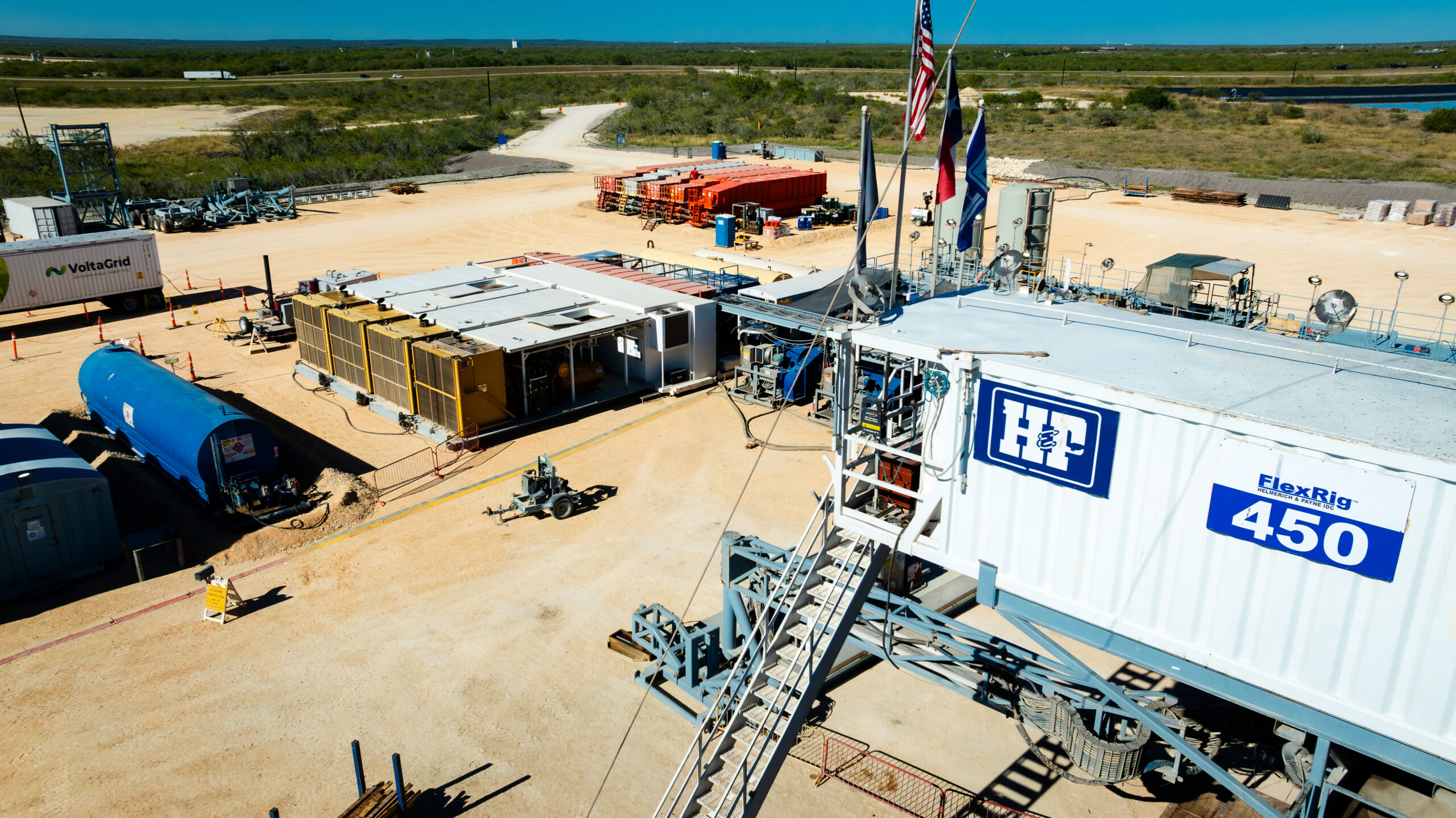
To address this need for both emissions reduction and cost efficiency, Caterpillar developed its Dynamic Gas Blending (DGB) Gen 2 Kit, which has been deployed on 50 engines across 12 rigs in H&P’s FlexRig fleet in the US Lower 48 over the past year. By retrofitting existing Cat 3512C Tier 2 diesel engines with the dual-fuel gas-blending system, those engines can now operate on a mix of diesel and natural gas. This allows H&P to use gas while preserving the redundancy of diesel. Compatible fuel types include pipeline-quality gas and field gas, as well as compressed (CNG) or liquefied natural gas (LNG).
The kit dynamically blends natural gas into the diesel engine’s intake, displacing as much as 85% of diesel fuel with natural gas. Each engine cylinder is fitted with gas injectors that deliver gas near the intake ports and an in-cylinder pressure sensing system that monitors injection.
Caterpillar has made DGB available for drilling and well services since 2012, but those systems did not utilize port cylinder injection. They were fumigated systems, which meant that they mixed a secondary fuel – such as natural gas – with the intake air. The DGB Gen 2 Kit was designed for drilling and requires the installation of new cylinder heads, a natural gas injection port in each cylinder, and gas piping.
While more complex, these additional components allow for more precise control of the amount of gas going into the engine, Mr Weidenfeller said, which can lead to higher efficiency and power compared with fumigation.
“With a fumigated system, gas is getting injected upstream and then flowing down to the combustion chamber. With an engine that’s spinning at 1,200 rpm, there’s a lot going on every second, so even a delay of a couple of moments getting down the line can create a different combustion scenario with different load demands,” he explained. “With the gas getting injected right at the port, it’s an instant reaction. And with the pressure sensors now in the cylinders, the system has a better idea of what’s going on. We can control by each cylinder how much gas is getting injected instead of dumping a bunch of gas at the air intake that then goes to all the cylinders. It’s more efficient.”
The DGB kit also comes with Caterpillar’s ADEM A6 engine control module, which allows drillers to optimize combustion in real time. This enables a faster response to load changes and minimal unburned gas, according to the company, compared with its other dual-fuel kits for land rig gensets.
By using combustion data being fed from the in-cylinder pressure sensors into the control module, the system can then fine-tune the gas/diesel blend for each cylinder. This ensures stable combustion across varying loads and fuel qualities. Beyond that, the system can also leverage the Cat Smart Engine Management System (EMS) to automatically stop or start engines on a multi-engine rig to match power demand, which further boosts operational efficiency.
Caterpillar began field testing its DGB Gen 2 Kit in 2024, conducting tests on three separate sites in the US Lower 48 over a 10-month period. In that time, the company measured an average of 70% diesel displacement – the average volume of diesel fuel replaced by natural gas – and up to 85% peak displacement.
H&P’s success in the field
Since the commercial launch of the DGB Gen 2 Kit in the US Lower 48 in January 2025, it has also been deployed to other markets such as Canada and the Middle East.
H&P was the first drilling contractor to purchase the kit for its rigs, announcing in April 2025 its plans to integrate the kit with the Cat 3512C engines on its FlexRig fleet. The company currently has retrofitted 50 engines on FlexRigs in the Permian Basin, the Eagle Ford and the Denver-Julesburg Basin.
H&P has seen positive performance so far, said JT Brady, Senior Manager of the FlexRig Support Department at H&P. Prior deployment of fumigated dual-fuel engines on select rigs had sometimes led to excessive methane slip and low diesel displacement, he noted.
“A fumigated system is essentially the path of least resistance,” Mr Brady said. “We introduce some natural gas into the air intake of the engine, and the cylinders closer to the gas source get more of that fuel. It wasn’t metered. We just flooded the engine with natural gas, and the system would burn what it could, expelling the rest of it out of the tail pipe. With something like DGB, we’re optimizing how much gas we’re putting into the engine. There’s no excess gas coming in.”
H&P and Caterpillar had jointly conducted field trials of the DGB Gen 2 Kit on two FlexRigs in the Eagle Ford in 2024. Results showed an average 65% diesel displacement over a nine-month period, with peak displacement reaching 75%.
That latter displacement rate saved over 94,000 gallons of diesel on a single rig with more than 4,500 engine hours, according to H&P.
Combustion data input into the Cat Smart EMS also helped H&P enhance efficiency by reducing engine runtime to conserve fuel and limit engine wear, as well as lower diesel consumption – Caterpillar estimated between 5% and 10% fuel savings for engines running Cat Smart EMS and 25% fewer engine hours compared with engines that ran the DGB Gen 2 Kit without EMS. Collectively, these positive outcomes helped H&P decrease the number of days on site and the cost per well.
“With the Smart EMS, we were essentially able to automate the starting and stopping of the engines to meet the rig power demand,” Mr Brady said. “If we were drilling out in the lateral section and we needed high engine loads — lots of power demand from the mud pumps and top drive — we’re going to need all four engines running. The Smart EMS can tell this is what the rig is demanding and calculate that we need to be running all four engines. If we’re cleaning the hole or getting ready to run casing, we don’t have that power demand anymore. Smart EMS will sense that, too.”
One issue H&P faced in the field trial was adjusting the filtration within the DGB kit depending on the gas source. One test site that sourced field gas was able to run without any issues. However, for another rig at a different test site that used CNG, H&P observed that gas wasn’t always blended effectively. For example, the field team observed extra condensation in the fuel, as well as particulate matter falling from the compressor and gathering in the gas supply. This resulted in lower levels of diesel displacement.
To alleviate the issue, Caterpillar added what it called a “water catcher” into the kit design. The catcher, which measures 3 in. in diameter and 10 in. in length, is installed at the point where gas comes into the engine and functions much like an oil/gas separator, capturing particulate matter larger than 5 microns in a mesh filter. As part of standard maintenance, the rig crew opens the filter and empties the particulate matter into a collection pan on a weekly basis.
There have also been instances when the system couldn’t blend as much gas as possible, perhaps due to an insufficient gas flow rate. “And in those instances, the system just goes back to 100% diesel, and the rig can continue to operate while we troubleshoot. That’s a big advantage of having a system like this,” Mr Brady said.
While H&P has deployed all 50 of the DGB kits it purchased in 2025, further installation will depend on operator demand – Mr Brady said H&P can convert additional engines with the right commercial model.
“What makes this system so attractive to us is that H&P already owns these diesel engines. If we add these kits on these engines, they have a new life as a dual-fuel engine,” he said. “It’s still a diesel engine, but the displacement is such that you’re getting very close to natural gas performance. That’s significant for us, as it expands our available offerings to our customers seeking out alternative energy sources.” DC