Oil & Gas Markets
South Atlantic sees high exploration success rate, but fewer than a third are potentially commercial
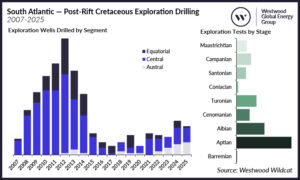
New analysis from Westwood Global Energy Group highlights the challenges of bringing exploration success in South Atlantic post-rift Cretaceous plays to market, with technical discoveries not consistently translating into commercial success. The study comes as the appetite for exploration across the Atlantic margins increases. However, while the technical success rate from exploration drilling across the region remains high, the chance of a discovery leading to a commercial development is significantly lower.
Westwood analyzed 425 exploration wells targeting post-rift Cretaceous stratigraphy drilled between 2007 and 2025, assessing performance across the Equatorial, Central and Austral segments. The research shows that less than a third of the discoveries led to a potentially commercial development. Exploration drilling peaked in 2012, following success at Jubilee and Brazilian pre-salt plays, before falling sharply following the oil price crash of late 2014. Since 2021, activity has cautiously returned, with more than 10 wells drilled per year.
Texas sees continued growth in geothermal wells
In July, the Texas Railroad Commission (RRC) issued its second permit for a deep geopressured geothermal well for energy storage, highlighting the continued growth of geothermal development in Texas. The permit was issued to Quidnet Energy Deployment for a well located in Galveston County.
The first permit for a deep geopressured geothermal well was issued in February 2025 to Sage Geosystems in Atascosa County, providing energy storage for the San Miguel Electric Cooperative.
The RRC, which assumed jurisdiction over geothermal well regulations from the Texas Commission on Environmental Quality in September 2023, said it has also seen significant growth in the average number of shallow closed-loop geothermal wells in the state.
During fiscal years 2024 and 2025, approximately 1,400 shallow geothermal wells were completed each year. In the current fiscal year, 3,162 wells have been drilled and completed at 39 sites across Texas. The RRC attributes the growth to a new rule for shallow geothermal wells that clarified regulatory roles and activities without increasing the agency’s permitting fees or staffing requirements.
Devon takes FID on Solitude pipeline to move Permian gas to Gulf Coast region
Devon Energy announced a positive final investment decision (FID) on the Solitude Pipeline System, a WhiteWater-led joint venture that will construct two 48-in. natural gas pipelines connecting the Permian Basin to Katy, Texas.
Solitude is the latest in a series of steps Devon has taken to integrate and consolidate the infrastructure supporting its Delaware Basin position. The Solitude Pipeline System is designed for a phased build-out of approximately 2.25 bcf per day entering service in the second half of 2029, followed by a similarly sized second phase in 2030 and the ability to expand further to meet shipper demand. Construction and in-service timing remain subject to customary regulatory approvals.
Permian producers have long absorbed volatile and periodically negative pricing at the Waha Hub, where takeaway capacity has repeatedly failed to keep pace with associated gas growth. Firm, long-haul capacity to the Gulf Coast changes that equation: It moves the majority of Devon’s Delaware gas out of Waha and into markets that will be tied to expanding LNG export and power generation, where North American liquefaction capacity is expected to more than double by the end of the decade.
Devon has already initiated the process of securing international LNG-linked pricing, including a 100 MMcf per day agreement beginning in 2027 and an additional 150 MMcf per day in 2028. Solitude is expected to provide the scale and duration to access this growing LNG demand.
“Solitude is not a standalone investment; it is the next step in an integrated model we have been building for years,” said Clay Gaspar, President and CEO. “We have taken the hardest constraints in the Delaware Basin: water, processing, compression, takeaway and power, and have de-risked the physical constraints turning each one into a source of value rather than a tax on our returns.”
Devon holds one of the largest operated positions in the economic core of the Delaware Basin.
Mid-year review: Industry holding tight on capital discipline despite oil price surges
Wood Mackenzie’s mid-year upstream and corporate outlook finds the global upstream sector could accumulate a cash windfall of $495 billion this year, assuming Brent prices average $90 per barrel. That would be more than double the cash flow expected based on initial planning assumptions of around $60 per barrel.
The 49 largest IOCs and NOCs in Wood Mackenzie’s corporate coverage would net $272 billion of this, which is equivalent to 70% of their combined investment for the year. Yet to date, investment budgets remain flat and the windfall has not triggered a surge in buybacks.
Companies entered the year expecting Brent crude to average around $60 per barrel. With dated Brent prices averaging $91 per barrel through the first half of the year, capital budgets have barely moved. Companies have broadly maintained their original shareholder return frameworks against a backdrop of increasing equity values. Wood Mackenzie forecasts buybacks for the peer group will be down around 5% year-on-year in 2026.
“What is perhaps most telling about the corporate response to the turbulent macro forces impacting the oil and gas sector is just how little changed. Most players have adopted a wait-and-see approach to the market turmoil, preferring to accumulate cash on the balance sheet rather than return it to shareholders or increase investment. Capital discipline has proved more durable than either the bears or bulls expected,” said Tom Ellacott, Senior Vice President, Corporate Research at Wood Mackenzie.
While CAPEX discipline is holding, corporate resolve could be tested. Global upstream development spend is on course for a second consecutive year of slight decline. Operators have prioritized maintenance deferral, optimization and low-capital activities over new major commitments to capture near-term upside.
The cash is staying on the balance sheet. Most of the peer group has accumulated rather than deployed its windfall, with elevated prices accelerating deleveraging for more leveraged operators.
M&A has defied expectations though, with deal spend in the first half of the year reaching its highest total in two years.
In the meantime, the global supply picture has deteriorated sharply. Oil output is expected to be down at least 3% in 2026, against a forecast increase of similar magnitude. In the Middle East, Iraq has been hardest hit, with up to 3 million barrels per day offline. Global LNG supply will be down at least 2%, against an earlier forecast rise of 8%, with Qatar taking the hit.
Despite near-term disruption, however, no region matches the Middle East for scale and cost advantage. Wood Mackenzie expects it to remain central to the longer-term plans of the world’s largest operators.
Rystad analysis: China bolsters synthetic gas supply amid increasing geopolitical risks
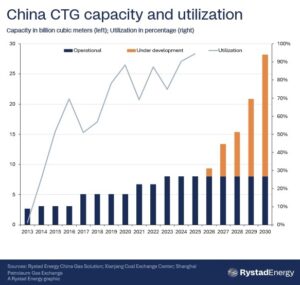
As nations race to cut import exposure to geopolitical tensions, China is building the world’s only large-scale coal-to-gas (CTG) industry as a strategic buffer against supply shocks, according to Rystad Energy. China’s 15th Five-Year Plan, covering 2026 to 2030, strengthens CTG’s role in its domestic supply architecture, signaling a move from consideration to active execution.
The country’s Xinjiang province has emerged as the hub for CTG expansion, driven by mine-mouth coal prices delivering a cost advantage to delivered gas prices: Xinjiang CTG reaches East China at $9.1-$9.6 per million British thermal units, generally below China’s average LNG import price. Existing plants are running at over 90% utilization, reflecting strong demand and the cost competitiveness of domestic synthetic gas versus imported alternatives.
This support for CTG is coming event as the government imposes project-specific carbon and environmental requirements. For example, the CHN Energy Zhundong development, a plant with anticipated capacity of 2 billion cubic meters (bcm) per year set to begin gas production in 2027, is designed with electrolytic hydrogen integration, wastewater recycling and 550,000 tonnes per year of planned carbon capture capacity.
Although the market for permanent storage-based carbon capture projects is limited in China, the country already has a well-established market for utilization-based carbon capture projects. Whether the economics of decarbonized CTG will prove bankable over the long term is still a question, but for now the global security imperative is diminishing any hesitation.
As CTG capacity ramps up despite these challenges, the effect on China’s LNG demand — and therefore on global LNG prices and long-term supply contracting — will become increasingly material for producers from Australia to Qatar to the US.