Raising the bar: Industry rethinks MPD training to close competency gaps
As MPD scales up, companies are seeking to standardize operational procedures, training while still allowing for rig-specific processes
By Stephen Whitfield, Senior Editor
While the managed pressure drilling (MPD) sector has grown substantially in recent years, the available pool of experienced personnel remains limited. The field requires high-level, localized technical training and hands-on operational experience, as well as deep knowledge of hydraulics and narrow downhole pressure limits.
As MPD is distinct from conventional drilling, standard rig crews should receive additional training and be deemed competent to run MPD operations. Through the implementation of standardized competency programs and procedures, drilling contractors and service companies are providing avenues to better develop their crews, identify competency gaps and maintain consistent service standards as they expand into new regions.
“It’s all about execution,” said Leiro Medina, Executive VP at Beyond Energy Services and Technology. “It’s no different from when you’re the pilot of a commercial aircraft. You have a checklist, but it’s not about just memorizing the steps. You know the steps, but you need to understand why those steps are there. You need to spend some time executing under supervision. You need to have the same set of steps in one place, and you need to know what each step really means.”
MPD training has typically been done on a campaign-to-campaign basis, meaning that the driller or service company would develop a customized educational program based on a specific MPD campaign. This type of learning prepares rig crews and engineers for a specific drilling project or field, using the exact well data, software and equipment hardware assigned to a given campaign.
However, this style of learning, while effective, can lead to challenges as drillers change out personnel over the campaign or scale up their MPD operations. Personnel are only learning skills relevant to one rig in one location at the start of the campaign, which can create knowledge gaps when rigs and personnel move.
More recently, training programs are focusing on role-based training, developing educational frameworks that customize curriculum based on specific rig positions and job disciplines. Rather than teaching a generic overview, role-based work trains everyone – drillers, engineers, technicians – on the exact skills, equipment and decision-making responsibilities required for their distinct roles.
“In the past, our client would come to us and say, ‘I want X rig. We’re going to use MPD,’ and we would run the class for that crew assigned to that rig at that time to make sure that they were trained on that system,” said Patrick Ewbank, Head of Learning and Development at Noble. “Now we’re standardizing that across our fleet for a uniform approach. But we need to start building that muscle memory and getting them the repetitions. What if we’re on a well that hasn’t used MPD, and now we’re moving to one that does? What about ongoing operations? We needed a framework to help train people in a way that ensures our crews can handle everything onboard.”
On top of a shift in training focus, drillers and service companies have also prioritized unifying their operational procedures for MPD within one companywide umbrella, instead of having different procedures for different rigs. Standardized procedures ensure that the rig crews and engineers have a shared language to respond identically to real-time anomalies, allowing personnel moving between different rigs or fields to perform tasks seamlessly without have to re-learn site-specific or rig-specific quirks.
“For each rig previously, we had step-by-step procedures that were created by the rig team and approved internally,” said Felippe Marques, MPD Performance Superintendent at Seadrill. “That gave each rig the detail it needed, but it also meant there was room for variation in how procedures developed over time. As our MPD activity matured, standardizing the procedures became a huge step for us.”
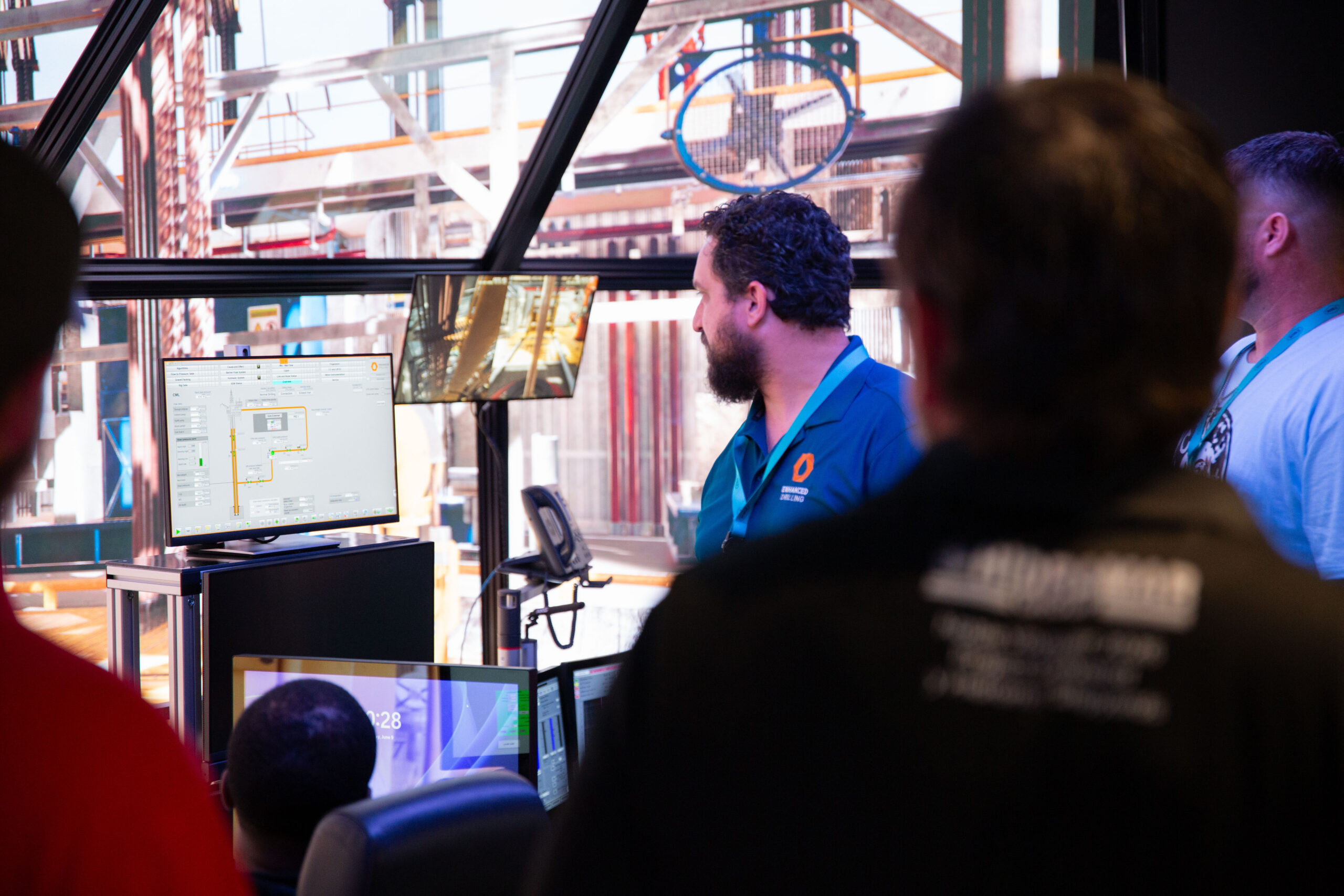
Realignment of training structure based on IADC MPD Accreditation Program
Web Jones, Senior Manager of Technical Training at Noble, likens the company’s approach to MPD training to learning how to drive. A driver can understand the rules of the road, but they still need to get behind the wheel with an instructor.
That’s the classroom-to-simulator progression that most MPD training programs offer, but Noble’s program takes it one step further: Once you can drive, you still need to learn the specific vehicle you’re going to be driving.
“If someone owns a Toyota Corolla and the introductory driving course covers most of what you need for that car, you can go out and drive that car. But if you have an F-250, you might need an extra course that orients you specifically on that vehicle,” he said. “From a rig concept, you’re looking at the differences between the control system and equipment that a given client or rig actually runs.”
In other words, the training incorporates three stages: standardized theory, standardized simulation and the specifics for the equipment in front of you. This explains what Noble has spent the last couple of years trying to fix: A training program that, previously, needed to be rebuilt from scratch every time a client asked for it.
“We would actually have to list on the certificate what was covered in that course, because there was no common understanding,” Mr Jones said of the company’s previous approach. “But you look at something like well control, you don’t have to put what was covered in each of those because everyone knows it. The certificate says what level it was, and you move on. That’s what we needed with MPD.”
Every campaign meant renegotiating what “MPD trained” actually meant for that client, that rig, that control system – and proving it meant digging through certificates rig by rig. “Every time you sit down with a client and they say, do your people have MPD training, you pull this spreadsheet that shows them as compliant,” Mr Jones said. “And they say, great, what did that consist of?”
Noble has now moved to a role-based model, standardized across its fleet, following the structure established in IADC’s MPD Accreditation Program, published in 2023. That includes an introductory level for personnel like floorhands who need situational awareness, up through operator and supervisor levels that require progressively deeper technical fluency.
A driller, for instance, needs to actually interpret what the well is telling them – surface back pressure, or where the mud level sits under a controlled mud level MPD strategy – not just recognize that MPD is running.
Training begins with classroom learning with varying lengths depending on the level, between one to three days, followed by a test. From there, everyone moves into Noble’s own simulator training – a further two days built around its in-house environment. If the actual job requires a different control system from Noble’s default, that becomes an additional course. At the supervisor level, an employee would spend approximately five days moving through the classroom-and-simulator sequence before ever touching control system-specific training.
Last year, Noble opened its simulation center, NobleAdvances, in Houston, where it houses a permanently installed simulator for MPD. However, a growing share of the company’s MPD training is now actually conducted using three sets of portable simulators deployed around the world. In September, Noble will run its first MPD training in Africa, sending instructors and a mobile simulator to Nigeria rather than flying Nigerian crew members to Houston. A parallel session is running in Aberdeen the same month ahead of an upcoming campaign on that control system.
The decision of where to train isn’t left to convenience. Mr Ewbank described it as governed by a “close to home” principle: Noble’s rotational workforce already spends significant time away from family, and the company prioritizes minimizing additional travel for these employees.
“If we can ever prioritize getting to train our guys close to where they live, that’s better. Once we reach a threshold where we can ensure training at the same quality doing it remotely, we can connect to that ‘close to home’ principle and make that decision,” he said.
Once employees complete the training course, they still have to get a competency sign-off, which happens offshore, in the crew’s own driller’s cabin with their own control system.
That offshore competency structure is built around Noble’s safety case. Certain MPD elements are classified as safety critical – barriers against major accident hazards – and those require immediate attention, within a short window of a crew member taking on responsibility for underbalanced drilling on a given rig.
A second, broader layer of role-based competency covers things a supervisor might not encounter often, like rigging the MPD system up or down, which might happen only once a year on a given rig. Noble tracks whether someone has been deemed competent before, within a realistic window, rather than penalizing a supervisor simply because a rig-up or rig-down hasn’t happened during their current hitch.
“We do want to make it a human-focused approach to competency, but using the safety case as sort of our base. I’m not going to punish someone for not being a part of that rig-up, rig-down process, but I do need to at least track that they have done that before. So, we built a system to accommodate that,” Mr Ewbank said.
Training isn’t treated as a one-time credential. Noble’s most direct form of ongoing reinforcement happens on the rig itself, through drills drawn from the company’s MPD manuals – an assisted well control shut-in, for instance, or a surface-back-pressure-assisted shut-in. Each is designed to test how a crew responds when multiple variables simultaneously affect downhole pressure. Section leaders also have latitude to design drills around a specific well’s influx management envelope, simulating an instrument failure – a Coriolis meter going down, for example – to see how the crew adapts.
Separately, Noble tracks whether a given rig has gone through a layup period or extended stretch of conventional drilling. When that happens, the company treats it as a knowledge-decay risk and brings the crew back through simulator training before resuming MPD operations, confirming competency rather than assuming it’s held. That determination is made before a campaign begins, not reactively – part of the same planning process that decides which level of training a role requires in the first place.
It’s early to point to measurable outcomes from the IADC-aligned version of the program specifically – Noble only recently received its accreditation earlier this year and is still running its first cohorts through it, without yet having visibility into how that training holds up once crews return to their rigs. But Mr Ewbank pointed to a broader shift already visible in how teams engage with each other.
“The efficacy we’ve seen from our pre-existing training and now dovetailed into IADC is not only a deeper technical understanding. We have seen a broader understanding of the necessary knowledge they need for MPD,” he said.
Building a feedback loop to absorb continued learnings
The first time a floorhand sees a certain procedure that he or she is supposed to execute, it’s sometimes on the drill floor, standing behind the driller, with the procedure sheet already in hand and the situation already unfolding.
That can be one consequence when procedures and operating knowledge develop independently from rig to rig. Each crew builds experience around its own equipment, clients and operating environment, but the lessons learned in one place do not necessarily travel easily to another.
Seadrill is addressing that by strengthening the way MPD operations are governed across its fleet, preserving the rig-specific detail needed for safe execution while bringing common operating principles, terminology and learning into a clearer companywide framework. For Seadrill, that has meant changing not only how its MPD procedures are structured but also how they connect with training and the experience being generated offshore.
The objective was not to remove the knowledge individual rigs had developed. Much of that knowledge reflects genuine differences in equipment, configuration and client requirements. Instead, Seadrill wanted to distinguish between what should be consistent across its MPD operations and what legitimately needs to remain rig-specific. It also wanted lessons learned on one operation to move more readily across the fleet.
“We found that lessons learned from one rig could not be properly addressed in the procedure for another rig that uses the same equipment,” Mr Marques said.
Last year, Seadrill accelerated its work to address that gap, developing not a single master procedure but a hierarchy that connects companywide MPD principles with the details that crews need on individual rigs.
At the top is Seadrill’s overarching MPD manual, which establishes the high-level requirements governing the use of the technology across the fleet. Beneath it are standard operating manuals, setting out procedures intended to apply to any rig conducting MPD regardless of class or generation, and incorporating industry best practice, API requirements and the regulatory demands of different regions and classification societies.
The final layer remains deliberately rig-specific. Each unit maintains its own notebook, containing the information needed to translate those common procedures into the physical reality of that rig – its actual layout, its particular valve configuration and its client requirements.
For Brian Clelland, MPD Performance Superintendent at Seadrill, the distinction is important. Standardization does not mean pretending every rig is the same.
“Within that notebook, you’ve got the piping and instrumentation diagrams for that rig’s particular system,” he explained. “When a rig goes from one client to another, that new client may require four chokes on a manifold while the old client wanted three. Those are the kinds of rig-specific details that we capture in the notebook.”
The result is a common operating logic, while retaining the details needed to execute on specific equipment. But changing the documentation was only part of the work. Seadrill has also been bringing that same philosophy into the way people are trained.
Its five-day classroom and simulator course, capped at 10 participants, deliberately brings together personnel from different rigs rather than training established rig teams in isolation. Drilling supervisors may find themselves working alongside MPD supervisors from other vessels, while participants can also be placed in roles different from those they normally perform offshore.
The intention is to make people reason through the operation rather than simply rely on the hierarchy and familiarity of their normal crew.
“When you take your team on a training exercise, everybody already knows each other’s strengths and weaknesses, and you lean on that. But if you put the Assistant Driller in the MPD supervisor’s chair, you’re forcing an AD to reason through decisions they would normally defer upward. If you can build a team strong enough that somebody looking from the outside doesn’t know who’s in charge, then you have the strongest team,” Mr Clelland said.
Simulation provides another opportunity to test that thinking. Rather than simply walking participants through a procedure, instructors introduce built-in scenarios in which something goes wrong – an influx or a loss of circulation, for example – and allow the group to work through the developing situation in real time. The exercise can be paused so decisions can be examined and discussed without the pressures of an actual operation.
“When they train on a simulator, we give them scenarios where something always goes wrong. They have to stop and assess the situation,” Mr Clelland said. “One of the crew will say, this happened on our rig, or this happened to me five years ago. That kind of knowledge sharing brings a massive amount of value.”
Those conversations also serve another purpose. They create a place where experience from different rigs and operations can be compared, challenged and, where appropriate, incorporated back into Seadrill’s wider MPD approach.
Competency assessment is built around the same progression. An initial ungraded questionnaire establishes a baseline for each participant. That is followed by classroom instruction involving drilling and crew resource management coaches, before the week concludes with an industry-standard examination based on IADC’s MPD Accreditation Program and a live-scenario evaluation.
The level of training depends on a person’s exposure to MPD operations. Roustabouts and other lower-exposure roles complete an introductory e-learning module, while more technical personnel add a second module covering well control fundamentals. Personnel directly involved in operating the equipment complete the full classroom and simulator course. Refresher training is also undertaken where required by operator clients, typically on a three-year cycle.
Perhaps more important than the individual elements of the program is the link Seadrill is trying to maintain between them. The training room provides a route for offshore experience to find its way back into procedures, while the procedures give crews moving between rigs a more familiar starting point. Trainees are encouraged to contact instructors directly when something they encounter offshore does not align with what they have been taught.
“We get loads of feedback. The more competent and the better our offshore teams are, the more frequently we get a good night’s sleep,” Mr Clelland said.
That feedback is already influencing how information is presented to crews. In one example, an influx procedure was converted into a decision tree, allowing personnel to follow a clearer visual path during an operation rather than work through dense written instructions.
It was a relatively simple change, but it illustrates the broader approach: Procedures inform training, training exposes people to situations before they encounter them offshore, and what crews subsequently learn in the field is fed back into both.
For Seadrill, that means standardization is not the end of the process. The aim is to create enough consistency for knowledge to travel across rigs and crews without losing the operational detail that makes that knowledge useful.
“You have to have that continual maintenance,” Mr Clelland said. “You have to listen to the feedback from the offshore crew. You have to keep the documentation aligned with industry standards. This is not a one-off project but a system we’ve built to keep absorbing what the fleet learns.”
Training beyond the classroom
In the drilling world, a technician can pass every course a company offers and still not be considered competent. For Mr Medina, competency is not solely something a classroom certifies. It’s something a qualified assessor watches you do, step by step, in the field, and is willing to put their own name on.
That distinction is key to Beyond Energy’s competency assurance program, which has been running since 2021. The program is built around three layers; QHSE certification, technical courses and a list of 60 to 70 individual procedures, each requiring their own sign-off. For example, a technician would not just test for competency in operating separators. He would have to be competent in the five or six specific procedures a separator requires, one at a time, each verified independently.
And the person doing the verification has something at stake. Assessors, who are typically comprised of senior engineers or supervisors, receive additional compensation for their role as an assessor. Mr Medina said this helps keep the sign-off honest. “If an investigation finds that an assessor cleared someone who wasn’t actually ready, that person will lose their status as an assessor,” he explained. “There is an impact to improperly performing your duties as an assessor. Both your career progression and compensation are tied to performing those tasks in the most professional way.”
The path to that sign-off runs through a deliberate sequence. Technical courses come first, covering MPD equipment fundamentals and operations. That’s followed by hands-on time in the shop learning how to service the equipment.
That field stage can run for months. A new hire works under a more senior person, executing procedures under supervision until they judge themselves ready to be evaluated independently – Mr Medina estimates six to 10 months before someone typically requests their first assessment. Only then does an assessor step in, watching the trainee execute a specific procedure from start to finish. Miss a step, and the assessor reports that the person needs more time. There’s no cap on how many times someone can be reassessed.
Each procedure is certified independently, and a technician can be signed off on several procedures during the course of a single job if the work calls for it. But the record is granular by design – being competent in readying up a rotating control device (RCD) is a different line item from servicing a separator – and a manager staffing a crew checks that record directly.
“If you, as a manager, don’t have anyone with those competencies, you should not accept that job. If a crew is short on a specific competency, the fix isn’t training on the fly. It’s pulling someone in from another crew who already has it,” Mr Medina said.
Not every competency applies everywhere, and Beyond Energy’s program is built to reflect that. A core set of competencies is common across all MPD operations regardless of region. Sitting alongside that core, the company established what Mr Medina called an “extended” layer of competencies. This layer applies only where specific equipment or conditions are actually in use, and a certification in one region doesn’t necessarily travel to another.
One example of this is the MPD separator and flare stack, which is standard in some regions but not usually part of the MPD package in most US land operations. The split isn’t always regulatory though. Sometimes it’s a technical difference or an environmental one. Offshore work, for instance, requires competency on offshore-specific RCDs, which differ entirely from their onshore counterparts.
The system isn’t static once someone is certified. A serious quality event – an incident traced back to how a procedure was executed – can trigger a change to that procedure. When it does, certification against the old version doesn’t carry over.
Procedure resets, which aren’t frequent, are decided by senior operations management on a case-by-case basis. However, the mechanism exists so the company’s certification record cannot go stale behind an outdated procedure, Mr Medina said.
Beyond Energy’s training and competency program has expanded in stages since 2021. It started with MPD field personnel, a group that made up roughly half of the company’s employee base. This group, Mr Medina said, was most critical to bring into a structured system. After a year, the company built out a parallel version for MPD engineers, and then last year it built a version for shop technicians. Each version has a different set of procedures, developed by senior employees well-versed in the disciplines.
Two efforts are still under way to extend the program further. The first is moving most technical courses onto a web-based platform, which will allow someone to review information without having to wait for the next in-person training session. Hands-on procedural assessments would still require an assessor in the room. The web-based platform is already available with some courses, and most technical courses should be available by next year.
The second effort involves bringing simulation into procedures that are, by nature, difficult to train for – specifically, equipment failures that are rare enough that no crew will build real-world experience with it.
Beyond these efforts, the company is also developing its next-generation of MPD control software alongside an expanded simulator, which should be available by Q4 2026. DC