AI still requires human expertise to close the loop, says industry panel
IADC ART Conference features discussion on how AI’s real value lay in connecting disciplines and closing gaps, not in replacing judgment of drillers
By Stephen Whitfield, Senior Editor
AI, machine learning and automation are becoming ever-present components of drilling operations. However, the industry is not on the verge of handing the well over to the machines. In fact, it’s the opposite – it’s in the middle of redefining what its human experts do alongside them. The technology is real, and it’s moving fast, but the human expert isn’t going anywhere.
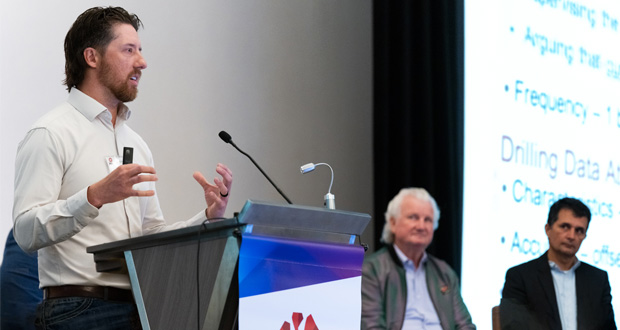
That was the throughline of a panel discussion held 26 August at the 2026 IADC Advanced Rig Technology Conference in Austin, Texas, where three SMEs took the stage with a different angle on the same underlying question: As AI and automation advance, what’s actually closing the loop, and what is the industry getting wrong about it?
AI as the newest team member
Peter Kowalchuk, Director at Taurex Drill Bits, framed the last three decades of drilling technology as a steady progression of closing loops – seeing data from downhole, verifying the data and acting on it. He argued that AI’s real role isn’t to be the next closed loop but rather to connect disciplines. “AI’s really going add another team member that will be able to connect all of these different disciplines and close the loop at the workflow level,” he said.
His presentation traced several decades of closing the loop in drilling. In the 1980s, the industry gained the ability to listen downhole in real time through MWD telemetry. The following decade brought rotary steerable systems, giving the industry an ability to act on that information. That shift was significant enough that, as Mr Kowalchuk put it, operators thought at the time they wouldn’t have much need for directional drillers anymore. He offered that observation as a reassurance to anyone nervous about AI: “We know that directional drillers are still around today, so if you’re wondering about AI taking away your job, just hold on tight.”
By the 2000s, real-time surveillance centers were adding another layer of verification, extending that same discipline from surface operations back downhole. Then, the 2010s saw intelligence moving downhole with bottom-hole closed loop control.
That history set up Mr Kowalchuk’s central belief about the present day. Rather than treating AI as simply the next loop in that history, he urged the audience to see it differently; he framed AI as an additional team member rather than its own separate mechanism.
He added that AI is nothing new to the industry, pointing to reservoir modeling, history matching and probabilistic decision making as work that predates the AI label by years.
“We’ve been doing AI upstream for a long time before AI was cool, before the MBAs in the C-suite knew anything about it. You can go online and find many white papers that might not say AI, but they’re describing all of the techniques we know as AI today,” he said.
Mr Kowalchuk grounded this argument in his own career path. His early years were spent working in upstream petrophysics, followed by a stint in the technology sector – including time at Microsoft – before moving to drilling. He described his work in upstream petrophysics as fostering collaboration between subsurface and engineering teams, recognizing in that work an early version of what AI does today. “You’re taking the SMEs from each of these different disciplines and allowing them to combine their work and collaborate. AI, effectively, is that same integration layer.”
He also drew a direct comparison to Microsoft’s “ship room,” a space where different disciplines came together to get software out the door – a precursor, in his telling, to what AI is doing across different drilling disciplines now.
“It wasn’t AI taking over,” he said of the ship rooms. “It was using AI to amalgamate that knowledge between the disciplines. It’s the same in drilling: We don’t want to get rid of those engineers.”
Defining what autonomy is
When it comes to automation and autonomy, Ryan Carroll, Drilling Automation Product Champion at SLB Well Construction, encouraged the audience to be more precise about what achieving that actually requires. From a service company perspective, he said, there are a lot of different components that have to come together to actually make an operation autonomous – and the objectives driving those loops aren’t always aligned. A system operating one part of an operation can inadvertently create risk elsewhere.
He framed the goal of automation in operational terms: minimizing the time between interpreting what’s happening downhole, understanding what needs to happen next and acting on it. Achieving that goal consistently, he argued, is what elevates outcomes.
Mr Carroll was careful to identify the human’s role within that picture. That role, he said, would shift from making individual decisions to shaping how automated systems behave.
“Our personnel now are talking more about how they should make the engines that drive these systems behave. Do they want them to be aggressive? Do they want to be conservative? There still has to be oversight,” he said.
He also drew a clear line between automation and autonomy, with two distinctions. The first is adaptability. For instance, a rotary steerable system told to hold a line will try its best, but it doesn’t inherently understand why it’s drilling in a given direction or recognize when it’s drifting from the well plan. “That’s really what’s important,” he said. “The objective is to stay on the plan, but that system doesn’t know why. If doesn’t know when it shouldn’t be matching certain set points because other things are going on downhole.”
The second distinction is context, which refers to whether a given loop understands the objectives of other loops around it, not just its own. Service companies, drilling contractors and OEMs are typically responsible for different pieces of an autonomous operation, with no standardized way for their respective systems to talk to one another. “Most of our interfaces today are very specific to whichever provider we might be working with,” he explained.
Moreover, in the industry’s current state of domain autonomy, different loops – for instance, geosteering software, wellbore placement or dysfunction mitigation – coordinate with one another as needed. That is unlikely to hold up in the near-term future, Mr Carroll added. As drilling operations grow more complex – juggling ROP limits, formation variables, ECD, MPD and intricate trajectories simultaneously, the industry will need to move toward an integrated autonomous system focused on total-well decision making. There is the need for an intelligent coordination layer connecting each loop at all stages of the operation – whether that comes from the drilling contractor, the operator or the service company.
“As a certain point, we’re going to need a bit more ability to collaborate and coordinate within all of these different systems,” he said.
Domain knowledge and data quality
John de Wardt, Global Consultant – Wells Delivery at De Wardt and Company, brought a healthy dose of skepticism to the panel, warning that the data underpinning automation and AI in drilling isn’t yet good enough to support it. He also asserted that the industry’s loose use of words like “autonomous” can be detrimental.
“Never forget that expertise is required on the input side of these systems, in the supervising of the data, and verifying that actions on the output side are realistic,” he said. “Domain knowledge is indispensable at both ends of any automated or AI-driven process.”
He described drilling domain knowledge as something with genuine breadth – spanning the well’s lifecycle from subsurface to abandonment – combined with depth in specific technical areas and an understanding of the well’s existence as a system of systems rather than a series of handoffs. The drilling engineer’s role in that system is centralized: Mr de Wardt compared it to that of a scrum half in rugby or a quarterback in American football, someone who needs to be goal focused and carry full knowledge of the game.
Turning to data quality, Mr de Wardt cited a 2014 study (“Chesapeake: The Role of Data in Drilling”) conducted for an SPE DSATS workshop. It found that approximately 24% of drilling data – including rotary torque and pit volumes – across six tested rigs were inaccurate. While the industry has taken strides to improve this issue, through groups like the Operators Group for Data Quality and industry documents like the IADC Rig Sensor Stewardship Guidelines, Mr de Wardt says he remains skeptical. “The big ‘but’ I have with all of this is that the data is now being consumed by automation, software-as-a-service (SaaS), data analytic systems and AI. But, unfortunately, our (data) attributes are miserable for those uses. It’s still inaccurate.”
He ran through specific failures he’d noted in his discussions with people across the industry, such as inconsistent sensor calibration across rigs, latency that delivers information late and unclear sampling conventions. He also brought up unresolved issues around data conversion, sensor offsets and repeatability, along with uncertainty, a broader concept he said the industry has largely ignored.
His proposed starting point for addressing this issue was something modeled on AUTOSAR (Automotive Open System Architecture), a global partnership of leading companies in the automotive and software industry to develop and establish the standardized software framework and open E/E system architecture for intelligent mobility. Ten companies founded the AUTOSAR partnership in 2003 to consolidate the expertise of partner companies in the automotive industries and define an automotive open system architecture standard to support the needs of future automotive applications. The partnership now has 350 members.
By contrast, Mr de Wardt said drilling has “a bunch of groups” that are focused on their own channels, with little coordination among them.
“With AUTOSAR, their philosophy is to collaborate on delivering value, and to do that, they collaborate on data standards, on interfaces, on interoperability, whatever is necessary for them to deliver that value. We have a bunch of groups within our industry, but we don’t have a get-together between those groups,” he said.
On AI specifically, Mr de Wardt framed it as the latest in a long line of augmentation tools rather than something new. Fundamentally, he believes it has a lot to offer the industry, but he thinks the industry needs to emerge from a “fog of hype” surrounding it in order to best understand how to use it to its full potential.
One issue with AI is simply with the overuse of the term – companies often use the label as a marketing buzzword to make ordinary automation and software sound advanced. Another issue is that startups offering AI applications might not be positioned to absorb the operational risk if something goes wrong with the application, largely because they lack the financial resources and insurance backing of large tech companies.
Mr de Wardt presented five questions that companies should ask themselves when evaluating the efficacy of a specific AI application:
- Is the input data valid for generating the desired solution?
- Who verified the attributes of input data, and what skills did they have?
- Do the attributes of the data match the processing envelope?
- Is the output logical and representative?
- What risks does the output generate that need addressing?
Beyond that, he said the industry must understand the current limits of AI applications and be cognizant of what limits they will continue to have in the near- and long-term future. The message is that human oversight will still remain a critical accompaniment to AI.
“In these systems, the human’s still involved,” he said. “The human’s going to have supervisory control over the system. The human is accountable for the well and the liability. I don’t see the system itself doing that. That’s dreaming too much.”