Tech adoption becomes easier when incentives align with economic realities of business
Corva’s partnerships highlight importance of measurable, consistent efficiency gains as driver of digitalization, automation investments

By Stephen Whitfield, Senior Editor
Ryan Dawson is Chief Corvanaut (Founder and CEO) at Corva.
Coming from the perspective of a technology-driven company, how accepting do you feel drilling contractors are of innovation in general?
I think drilling contractors are increasingly open to innovation, but they’re still pretty pragmatic. When they can see new technology that clearly improves safety, efficiency or the consistency of outcomes, that acceptance rises – trust in new technology really builds through proven field results rather than promises.
It seems like many companies don’t want to be the first mover on new technology. When you’re talking with drillers and operators about Corva’s offerings, how much of a barrier do you find that hesitancy to be? Or do you even see it as a barrier?
The real challenge is not technology. It is incentive alignment. Rig contractors operate in a mature business with tight margins and limited ability to charge operators more, which makes innovation difficult to justify.
What differentiates Corva, through our partnership with Nabors, is a deliberate focus on efficiency as the value driver. Nabors had the foresight to build a culture around data and automation, using technology to reduce nonproductive time and improve execution consistency at scale. Through that partnership, innovation pays for itself through measurable efficiency gains and aligns with the economic realities of the drilling business.
So, yeah, no one wants to be the first to move. But when they see things working, they all jump on it quickly. Operators will see something and say we need to move fast on this, and then things move. Then everyone’s innovating, and no one has a question about paying for it.
That’s an interesting position. You need success with new tech to gain interest, but you can’t get that success without someone willing to give it a try. How do you show a company that your tech is viable if you haven’t had that initial work in the field? Is it just a leap of faith?
Yeah, early on there’s always some level of leap of faith. We’ve had these conversations a lot, especially with rig contractors, and they tend to move pretty carefully. That’s understandable given the risks and what’s at stake operationally. With Nabors, there was a willingness to step out early and actually put it to work in the field.
The other piece of it is maturity. Corva’s been around for 11 years now, and we’ve spent that time building the foundation. A lot of the heavy lifting around data, reliability and integrations has already happened. We’re getting to a point where this isn’t experimental anymore. The systems are open, they’re connected, and they’re ready to scale.
So when a company helps enable something like Predictive Drilling, it’s not just about proving one tool works. It’s about putting infrastructure in place that others can build on. Once that’s there, any third party can come in and add their own capabilities, and that’s when it really starts to take off.
The word “silo” often comes up when discussing innovation and technology in drilling. There are some people within the oil and gas space who say that competition breeds innovation and that it is not necessarily ideal to be too open with technologies and ideas. Have you found silos to be a challenge in your work? How do you overcome that challenge when you see it?
Silos remain a major barrier for us. They limit access to contextual data and slow down the learning process.
We’re trying to break silos by integrating real-time data from multiple sources and promoting transparency across teams. I’ll give you an example: Right now, operators are prioritizing the automation of time-log entry. On a lot of rigs, people are manually putting this information into the log. There are some rigs in the world where people are really good about putting in NPT, but there’s a vast majority that aren’t. They don’t write anything because it wouldn’t look good for them. So, we’re seeing a push toward automating this.
One thing we’re doing at Corva is we’re using sensors on the rig to generate time-log data and then automatically inputting that data into a database. From that, you can add in comments from the rig contractors. Maybe the companyman comes in at the end of the day and adds some context that is perceived to be important, but the data is already inserted.
I think something like this is important because the foundations of LLMs and text mining algorithms that we can use will be based, in part, on these time-log entries. If you have the performance data entered there automatically, that puts you on the cusp of breaking so many silos.
How close do you think this industry is to really breaking down those silos?
I don’t know the answer to that, but I would say that it’s Corva’s business to break down silos. I feel we are at the forefront of that. But I’m an overly optimistic person. A service company might come to me and say, we can do something, and then a year later it’s a different story.
We’re partnering with a lot of service providers across frac, wireline and geology, along with the rig contractors. That’s one of the best things we have going. The integration of all of these companies and all this information is what everyone has been asking about for the past 20 years. That’s where we see the future going.
There always seems to be this balance between innovation and competitive advantage in this industry. At Corva, you’re developing new technologies that can benefit the industry at large, but you’re still a business trying to maintain market share. Where do you see your work as it sits within that balance? How much do you worry about competitive advantage?
The longer we have offered Predictive Drilling, the more we realize that there’s always something new that we can work on. You find out the stuff you don’t know. There are so many different components to a system like that.
One is rig control. We need this rig to drill as smooth as butter, and we need to avoid dysfunctions as they happen. Those problems are quite difficult on their own, and they require a lot of experience and a lot of iteration. You have to operate within certain limits to avoid dysfunctions, and if you can automate the limits to be tighter and tighter, you can eke out more differential pressure and drill more smoothly. This is a complicated thing that I don’t think anyone else is doing, and it takes a lot of effort and iteration, but it’s a function we’ve built into the system.
All of this is to say that there are a lot of hard problems to solve in this industry, and we’re always going to find something.
As you mentioned earlier, Corva has been involved in a partnership with Nabors over the past couple of years, with the companies announcing an expansion of the partnership into Nabors’ RigCLOUD platform in 2025. Were there any challenges that you initially found with incorporating your system with their technologies?
I think the initial challenges with integration were really centered on aligning the architectures and ensuring low-latency data flow.
What are some of the challenges you find with getting data as close to real time as possible?
I think the main problem is that companies have their own home-built systems, including us, and the integration of those systems isn’t always smooth. With certain WITSML providers, our system would overload their servers and cause them to crash because we’re built on a cloud platform. When we need extra server space in the cloud, we can just add that. That’s harder to do when you’re integrating with a system on a physical server. Now, we have DevOps engineers who are focused on watching every single blip and investigating it. These real-time mission-critical systems are systems where you can’t have any gaps in time.
For instance, if you make a request to an API (application programming interface) and then you get the data back, you can close the request right away and that’s fine. But if you wanted to keep the connection open for whatever reason – maybe you wanted to do something based on that request and come back to the interface later – 90% to 95% of the time spent when you do come back is just on making sure the connection is still secure. That adds up.
Unfortunately, that’s just something we have to deal with.
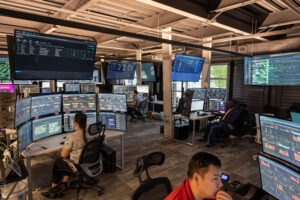
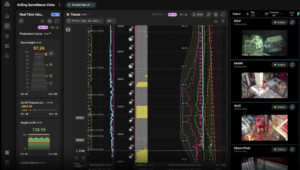
latency data flow during the initial integration of its technologies with Nabors’ RigCLOUD. To that end, Corva now has DevOps engineers who monitor for and handle any potential issues that might slow down data delivery. (Click the image to enlarge.)
It sounds like you’re a fan of open-source APIs. Are you encouraged by the increasing industry discussion we’ve seen around interoperability?
I am encouraged. I’m optimistic that we’re all moving in that direction. Some people are just moving faster than others.
Do you think the industry is moving as fast on this front as it should be?
No, I think it needs to be faster. When I first entered this industry, I’d look at WITSML and think, wow, this is such a crappy format, just because of my software background. But now, I realize that it is what it is. It works. It’s an open standard, and everyone knows it. I think it’s one thing that has really propelled this industry forward. It’s one thing I’ve noticed people getting behind on the frac side, for instance.
The key here is working with the standards body. If you’re a big company like Microsoft or Google, you can take a standard and add your own customization. We’re not seeing enough of that – meaning that we’re not seeing companies take WITSML 1.4 and add these things to make the world better. We need to push harder.
You mentioned using WITSML for frac data. That brings me to another question: Corva offers Predictive Drilling, but the company has also touted the usefulness of that system in completions and how it can help companies shift from reactive to predictive completions. How would you define predictive completions?
Predictive completions – or as we call it here, Predictive Frac – is a longer-term strategy that includes connecting to the equipment directly. We don’t have that capability yet, but we’re working on something we call Guided Frac. In real time, we want to bring in all of the pump schedules and actively monitor the pumps, which is not dissimilar from other service companies.
What we’re doing that’s different is we want to overlay past stages in real time, so you can see, for instance, how the pressure response is compared with past stages.
We’re also working to predict the pressure response, as well as building a lot of things around anomaly detection. As soon as we see these pressure spikes, we will be able to respond very quickly, and the system will have this ability to create alerts and actually tag and put comments in them so that the frac crew can review it later.
We’ve talked a bit about data already, and you’ve talked about the industry’s need to better maximize the data it already has. Is there a specific area where you think a company like Corva is closest to helping the industry understand data in a way that it hasn’t before?
We provide all of these analytics, but from our perspective, we’re not the company that goes and finds the one thing that you need to know. If you just ran a well, what are the three things you need to know from that well? What’s the lesson learned? Those are things the customer determines.
But what I would say is that we’ve turned a corner from just giving them all the analysis and then moving on to the next phase. With Corva, we’ve built somewhere around 200 apps that can help you distill that data down as much as you want. But that still goes back to figuring out what’s really important and what’s driving value.
When you talk to anyone in this industry about automation, the conversation always seems to pivot back to the role of the human on the rig. No one wants to take the human off the rig completely. From a tech company standpoint, how much does the role of the human factor into your thinking?
The human is central to the pace of innovation. From a technology standpoint, we can build very quickly, but real progress happens when what we build fits naturally into how people work. That’s where the user experience becomes critical. The interface matters a lot. If it’s intuitive and fits the workflow on the rig, everything moves faster.
Right now, we’re doing a lot around directional and geo integration, things like landing the curve directly within our interface. The technology is there, and the demos are strong. The focus now is making sure it’s delivered in a way that feels seamless and natural for the people using it day to day. We’re constantly pushing to improve how the technology shows up for the user.
More broadly, we see automation and AI changing the role of the human on the rig, not removing it. The human shifts more toward supervision, strategy and decision making.
The goal with automation is to augment human expertise, not replace it, so people can spend more time applying judgment, experience and creativity where it matters most. DC