Drilling & Completion Tech Digest
ADNOC launches intelligent real-time operations platform to oversee 120+ rig fleet
ADNOC has deployed its AI-enabled Real-Time Operations Center (RTOC) platform across its fleet of more than 120 rigs, providing teams with a faster and more connected way to monitor, analyze and manage drilling operations.
RTOC replaces multiple tools and reduces engineering effort by 30-40%, enabling engineers to support two to three times more rigs while maintaining effective oversight. Through automated dashboards and AI-powered performance insights, the platform turns large volumes of drilling data into clear and actionable information – reporting cycles that previously took several days can now be completed within hours.
By analyzing real-time rig data, RTOC can also identify potential issues before they escalate, helping reduce incident response times by 4-12 hours and avoid one to two days of rig downtime.
Enabled by SLB’s DrillOps intelligent well delivery and insights solutions, the platform brings live rig data from across drilling operations into a single environment. This gives business, asset and drilling teams a real-time view of activity across the rig fleet, helping them identify risks earlier, improve coordination and make faster decisions. By combining operational data, advanced analytics and AI-driven insights, previously full-day analyses now only take minutes.
Deployed on ADNOC Drilling’s rig fleet, the AI platform analyzes real-time operational data to help ADNOC Onshore and ADNOC Offshore make faster decisions, improve performance and reduce operational risks across their assets. Through this deployment, ADNOC is continuing to put intelligence to work across its operations, embedding AI into core workflows and accelerating the transition toward more autonomous and optimized operations.
Developed in the UAE and hosted within ADNOC’s cloud environment, RTOC also keeps critical operational data and workflows securely within the country while providing a trusted foundation for AI-driven operations. This helps ADNOC to strengthen data security, operational resilience and long-term digital independence.
Advanced drill bit saves 10 days rig time in North Sea
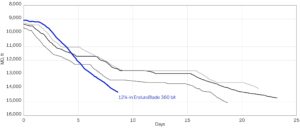
SLB recently deployed its EnduroBlade 360 rolling diamond element bit to help an operator in the Central North Sea drill a 12 1/4-in. section to TD in a single run. This saved 10 days compared with the previous sections drilled.
The operator had previously encountered significant challenges due to the section’s risks of erratic torque, shock and vibration, stick-slip, downhole tool failures and premature drill bit wear. It was anticipated that these issues would likely require multiple drill bits and BHA runs. In addition, the planned section length had never been drilled in a single run within the field before. Previous 12 1/4-in. sections had required multiple bit runs, increasing both operating time and costs.
Using SLB’s EnduroBlade 360 bit, however, the operator was able to drill a total of 5,092 ft from the shoe to TD in a single run.
The bit was supported by the DBOS drill bit optimization system and the IDEAS integrated dynamic design and analysis platform, which helped provide a comprehensive drillers’ roadmap. The roadmap leveraged finite element analysis and rock mechanics data to model cutting structures, optimizing operating parameters and removing guesswork.
35,772-ft lateral sets measured depth record
BPX Energy and ROC Directional Services announced in early August they had achieved a measured depth record in the Eagle Ford Shale, drilling a 35,772-ft lateral with a 12,976-ft TVD and a 2,135-ft step out. The lateral length was 22,766 ft, drilled from the Nabors X41 rig in McMullen County in Texas. Spud to TD took 15 days, with lateral ROP measuring 156.33 ft/hr and a maximum temperature of 363°F.
Fluids monitoring improves downhole visibility
Baker Hughes recently deployed its Kantori real-time fluids monitoring in the North Sea. The operator was facing limited visibility into real-time fluid behavior, delayed hydraulics updates due to manual fluid checks, and increased uncertainty during circulation and pump transitions. This resulted in pressure spikes and transient events that were difficult to predict and operating limits not updated in time.
By using Kantori to provide a continuous view of downhole conditions, live fluid measurements were streamed into advanced hydraulics models, and the operator received continuous updates on equivalent circulating density, surge and swab pressures and hole-cleaning performance. The result was improved model accuracy and operational visibility.
Seadrill to enhance drill floor safety with Auto Slip system
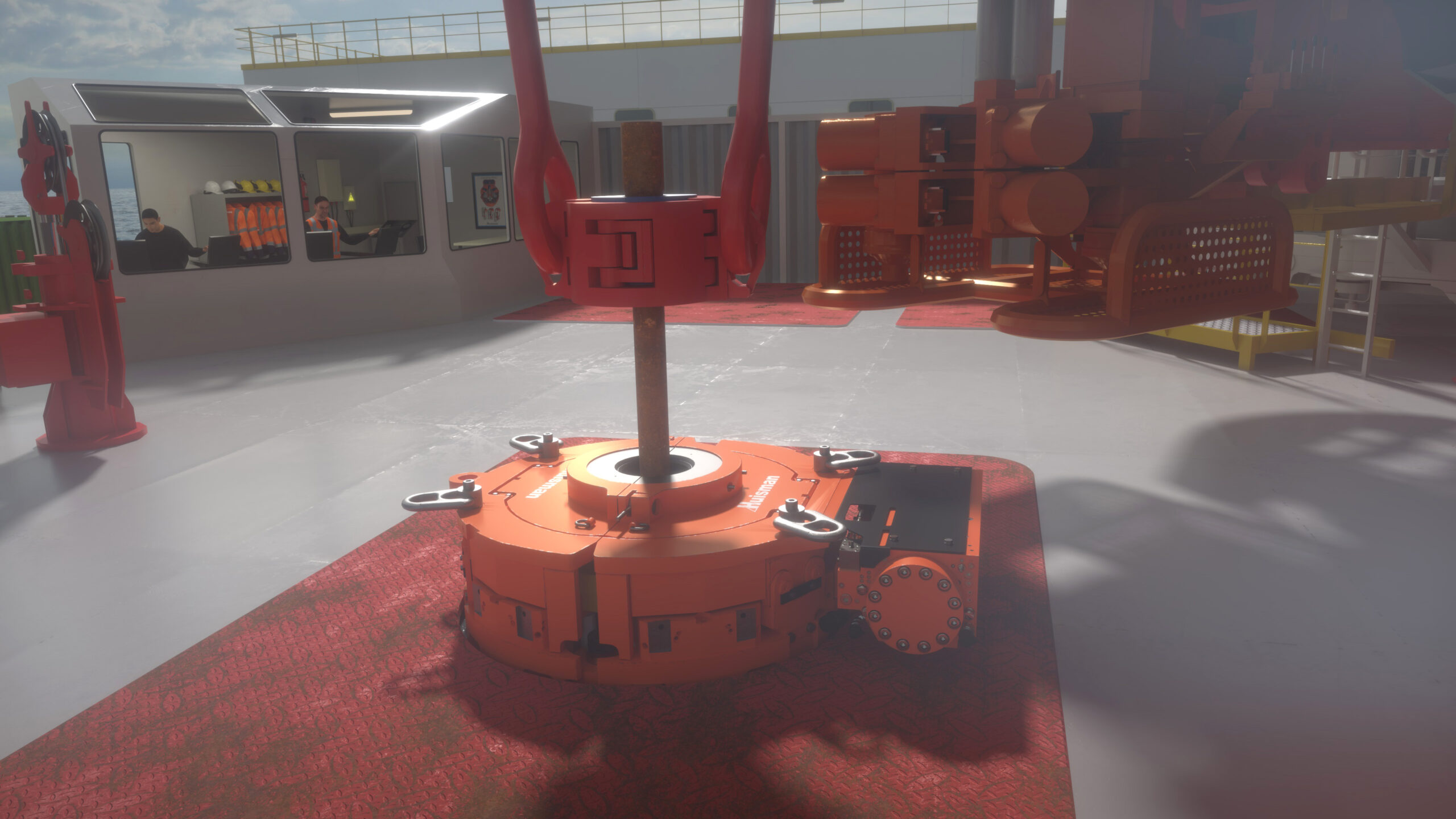
Huisman is set to deliver an AS605X Auto Slip system to Seadrill, enabling a more automated drill floor to reduce personnel exposure in the red zone while improving safety, efficiency and operational consistency.
The AS605X Auto Slip automates the handling of drill pipe slips, reducing the need for manual intervention during critical drilling operations. It enables faster, more consistent slip handling and supports smoother drill floor activity.
The technology is expected to reduce well construction interferences by up to 2.5 days per typical 60-day well, driven by the elimination of insert changes, uninterrupted passage of drilling tools, rapid opening and closing sequences, and the ability to safely close on pipe in rolling and pitching offshore conditions.
In addition, the system integrates with existing rig control systems, enabling straightforward implementation.
A key differentiator of the AS605X is Huisman’s patented roller-based clamping technology, which operates at the optimum point between pipe slipping and pipe crushing. This enables the system to handle extreme loads of up to 1,130 mt while maintaining the integrity of the tubulars.
The Auto Slip features a large stepless clamping range, allowing a complete drill string – including bottomhole assemblies, stabilizers and centralizers – to be handled without changing inserts. The system can clamp tubulars ranging from 5 in. to 9.5 in. and open up to 19 in., eliminating the need for manual intervention during critical drilling operations.
KOC set to advance digital, AI capabilities through Ahmadi Innovation Valley project
Several major oilfield service companies recently announced contract awards by Kuwait Oil Company (KOC) under the operator’s Ahmadi Innovation Valley (AIV) initiative. The project aims to establish an in-country research, development and digital innovation ecosystem. The ambition is to transform Kuwait’s energy sector by strengthening local capabilities and expanding knowledge transfer.
SLB was awarded a seven-year contract to evaluate, test and deploy advanced technologies across a range of operational and strategic priorities, including AI, Industrial Internet of Things applications, production optimization, reservoir technologies, water management and energy transition initiatives.
As part of the agreement, SLB plans to establish a dedicated AIV facility in Kuwait, with construction expected to begin in 2026 and opening planned for 2028.
Halliburton was also awarded a multiyear agreement and will support KOC through an upstream R&D center. Digital capabilities will be central to the program, through the application of data, scientific analysis and AI for the full field lifecycle.
Baker Hughes also announced it was awarded a contract as part of the AIV initiative, with a multiyear award focusing on scalable, fit-for-purpose technologies that optimize production and flow assurance. The company will deploy its portfolio of digital and AI automation solutions to help KOC increase recovery from existing wells, lower operating costs, reduce water production and minimize power consumption. A dedicated research and technology center in the country is part of the agreement.
PV Drilling to pilot process automation on 3 rigs, plans fleetwide adoption by 2030
Petrovietnam Drilling (PV Drilling) began rolling out NOV’s NOVOS automation platform across its offshore fleet, aiming to standardize operations and accelerate its digital transformation. The company is starting with deployment on three rigs: the PV Drilling VI, VIII and IX.
NOVOS operates as a high-level control layer that integrates with existing rig control systems such as Amphion and Cyberbase, coordinating the drilling process according to preset scenarios rather than controlling individual equipment in isolation. NOV has developed the platform since 2012, expanding it into a broader ecosystem that includes the KAIZEN AI optimization tool, DrillLink automated directional control, managed pressure drilling integration and the ATOM RTX rig floor mechanization system.
The company plans to validate NOVOS performance on the initial three rigs before expanding the platform fleetwide by 2030. PV Drilling is also pairing NOVOS with maintenance and rig asset management software to support predictive maintenance.
PV Drilling currently operates six jackup rigs and one deepwater rig, and is investing in an additional jackup, tentatively named PV Drilling X. The company plans to transport the new rig to Vietnam in October 2026 for recommissioning, technical certification and upgrades before it enters commercial service in Q2 2027.