Oil & Gas Markets
Another decline in exploration spend shows US E&Ps keeping focus on development
US E&Ps kept exploration a secondary priority while moderately boosting development spending in 2025, indicating their continued focus on existing asset bases and near-term production, according to a new EY analysis. The study looked at the 30 largest oil and gas companies based on 2025 end-of-year oil US oil and gas reserve estimates.
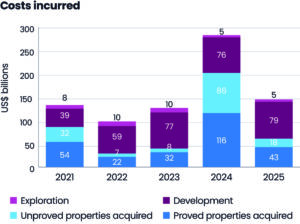
It showed that exploration spend by the 30 companies declined by 11% year over year to $4.8 billion, which represented just 3% of their total $144.3 billion in capital expenditures for the year. Development spend was up by 4% to $78.7 billion.
This underscores “a capital discipline framework centered on maximizing existing asset value, advancing DUC (drilled but uncompleted) inventories, and delivering near-term production growth rather than pursuing frontier expansion,” the report stated.
Scale players dominated development spending – led by ExxonMobil at $12.5 billion, then ConocoPhillips at $9.7 billion and Chevron at $8.5 billion. Exploration spending was highly concentrated, with Shell at $0.62 billion, ConocoPhillips at $0.61 billion and Devon Energy at $0.58 billion. Those three operators accounted for 38% of total US exploration outlays.
M&A spending
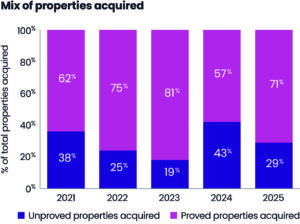
The analysis found a significant drop in M&A expenditures in 2025 – down by 70% to $60.7 billion from the previous year’s $202.5 billion. EY characterized this as a normalization of acquisition-driven outlays following the wave of upstream consolidation seen in 2024. In terms of the acquisition mix, there was a shift back toward proved properties in 2025, compared with unproved properties surging to 43% of deal value in the previous year. “The rebalancing reflects a US upstream M&A market moving beyond the 2023-2024 Permian megamerger cycle and into a post-consolidation phase,” the study said.
Reserves and production
For the 30 companies analyzed, their oil reserves declined modestly by less than 1% year over year in 2025. While that paints a broadly stable picture, EY noted an increasing need to replenish reserves over time.
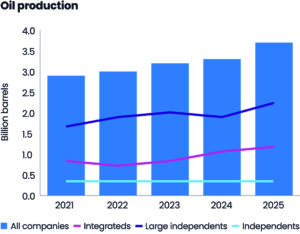
Meanwhile, oil production increased by 12% year over year in 2025. Production gains were concentrated among ExxonMobil (161 million barrels), Diamondback Energy (131 million barrels) and Chevron (126 million barrels). The study attributed these increases to each company’s respective acquisitions and subsequent integrations of Pioneer Natural Resources, Midland Basin assets and Hess, respectively.
On the natural gas side, end-of-year reserves for the studied companies increased by 14% year over year to 202.5 trillion cubic feet, reversing declines in 2023 and 2024. This rebound was consistent with a more supportive US natural gas market environment, as the Henry Hub benchmark averaged $3.62/MMBtu in 2025, up by 65% from the 2024 average.
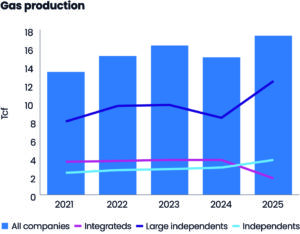
Gas production increased by 18% in 2025, with US marketed gas production reaching a record 118.5 billion cubic feet per day. The Appalachia, Permian and Haynesville accounted for the majority of the growth.
Revenue and cost
The 30 companies studied reported total revenues of $239.5 billion in 2025, representing a 7% increase. However, revenue per boe declined by 7%. EY noted that the mixed pricing environment in 2025 helps explain the divergence between higher overall revenues and lower revenue per boe: Crude oil prices fell materially during the year, while US natural gas prices increased from 2024’s record low.
The studied companies recognized a $7.2 billion, or 10%, increase in production costs year over year. But per-boe production costs fell by $0.43 per boe, or 4%, reflecting improved unit-cost absorption on higher volumes.