PETRONAS takes step-by-step, technology-focused approach to decarbonization of drilling
Tendering and procurement requirements, centralized electricity grids among next steps following technology implementation phase
By Stephen Whitfield, Senior Editor
As part of Malaysia’s pledge to achieve net zero greenhouse gas (GHG) emissions by 2050, the government announced its aim to reduce carbon intensity by 45% by 2030. Along with that ambition, Petronas is also aiming for net zero by 2050, as well as a a 25% reduction in GHG emissions for its groupwide activities by 2030 compared with 2019 levels.
Petronas’ initial plan to meet these targets centered on four main levers: zero routine flaring and venting; electrification; energy efficiency; and carbon capture and storage (CCS). While drilling operations were not initially included in the plan, the NOC spearheaded a strategic initiative (SI) in 2023 focused on decarbonizing Malaysia’s drilling industry.
“Petronas is a pretty unique national oil company, in that we play the part of the operator and the part of the regulator,” said Ariff Shazni Ibrahim, Staff Well Engineer at Petronas. “We see ourselves as the regulator, shaper and accelerator of the Malaysian upstream industry. This is driving us to be more proactive and collaborative. With that in mind, we came up with this initiative to drive accelerated decarbonization of wells. The drilling industry needs to support Petronas’ expedition with emissions, the target to reach net zero in 2050.”
Speaking at the 2025 IADC Advanced Rig Technology Conference in Reykjavik, Iceland, on 30 September, Mr Ibrahim outlined the origins of the SI, noting that it stemmed from a focus group representing companies across the oil and gas value chain. This included operators Shell and Hess (since acquired by Chevron); driller Velesto Energy; service company SLB; and Malaysia Petroleum Management (MPM), the upstream regulatory arm of Petronas that governs the country’s petroleum development.
The focus group, which was established by MPM in 2023, identified two deliverables: a GHG emission baseline and a decarbonization blueprint.
The group then drafted a five-year roadmap, with detailed targets that would guide industry players toward decarbonization. The goal stated that by 2027, Petronas and its partners would be on pace to achieve a 25% GHG reduction target by 2030, matching the target set by Petronas’ Pathway to Net Zero Carbon Emissions 2050.
The first phase involved defining the goals of each industry stakeholder in Malaysia. This involved members of the SI focus group discussing their companies’ respective GHG policies and working together on an initial baseline for rig-based operations.
The baseline was then rolled out in 2024 during the second phase. For this baseline, the SI focus group identified three GHG emission sources from its drilling activity: diesel combustion, flaring and fugitive emissions. The baseline established emission targets based the type of well activity and the type of rig used.
For jackups, semisubmersibles and tender-assisted rigs engaged in drilling and completions, that baseline was determined to be an average of 30 tonnes CO2e/day. For drillships inß drilling and completions, it is 90 tonnes CO2e/day. For hydraulic workover units engaged in workover operations of plug & abandonment, the baseline target is 18 tonnes CO2e/day.
In 2025, the group added emissions targets for vessels used in logistical activities, like transporting crews to offshore installations. The target for marine vessels is 27 tonnes CO2e/day, while helicopters have a target of 3 tonnes CO2e/day.
“When we started, we needed to take a look at how much we were producing and create goals that were as simple as possible,” Mr Ibrahim said. “We’re just looking at these averages for now, but we’re not overruling the possibility that we may look at these further.”
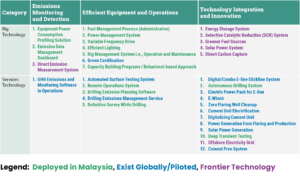
The blueprint also provides a list of possible solutions, identified by the SI focus group, to assist industry stakeholders in proactively planning their business activities around the GHG emissions reduction target. These solutions were divided into two categories (rig technologies and service company technologies) and then three subgroups (emissions monitoring and detection, efficient equipment and operations, technology integration and innovation).
The third phase of the timeline involved the implementation of the technologies listed in the blueprint and the embedding of GHG reduction targets in the governing standards of companies working in Malaysia. As part of this phase, the MPM is monitoring the progress of participating drilling contractors. Mr Ibrahim noted that several of the technologies identified had already been implemented in Malaysia even before the blueprint’s creation, and there is also ongoing implementation of technologies newer to the Malaysian market.
One example of technologies being deployed is energy-efficient lighting, which the SI focus group had estimated could lead to a 3% reduction in CO2 emissions from 2019 levels if implemented on all rigs in Malaysia. One drilling contractor had installed LED lighting on three rigs by September 2025, with plans to complete the transition to LED lighting on other rigs by year-end 2026. Another driller also plans to complete its transition to 100% LED lighting on its rigs by the end of this year.
SI focus group stakeholders are also reviewing the use of alternative fuel sources. One drilling contractor has already begun using excellium, an additive-rich fuel designed to minimize corrosion, on its rigs, while another has been using biodiesel on select rigs since 2022.
Another goal in the third phase is analyzing the challenges industry stakeholders are facing in deploying low-carbon systems. Mr Ibrahim noted that some of these systems were not without their challenges. For instance, retrofitting technologies like LED lighting onto a rig may disrupt existing rig functions and operations – in fact, one drilling contractor has put its LED installation plans on pause as it assesses potential issues with electrical harmonics.
As part of the fourth phase of the roadmap, the SI focus group aims to begin work on GHG reduction tendering and procurement requirements for Petronas contracts by the end of 2026. It is also aiming to begin feasibility studies on centralized electricity grids for both onshore and offshore rigs, as well as the use of floating solar panels to power rigs.
In the fifth phase, the focus group hopes to begin a pilot project on a centralized electricity grid for rigs. It is also aiming for 100% deployment of various low-carbon systems on rigs working in Malaysia, including power management systems and the application of energy-efficient electrical appliances. DC