2026 NOV Rig Census shows drilling markets diverging amid geopolitical disruption
On land, NAM strengthened while international trended lower; in offshore segment, jackup count fell while floaters were more resilient
By Tarjei “TJ” Myklebust and Karl Appleton, NOV
The 2026 NOV Rig Census captures a drilling industry adjusting to renewed geopolitical disruption. Expectations of lower oil prices and excess supply changed after the conflict in Iran restricted oil movements through the Strait of Hormuz, increased concerns over energy security and disrupted the Middle East – the world’s largest jackup market.
The effects were uneven. US and Canadian land activity strengthened despite continued contraction of their available fleets, while international land activity was slightly lower overall. Offshore utilization declined as jackup suspensions weighed on the market, but drillships and harsh-environment semis remained comparatively resilient.
These differences reinforce a broader shift toward technical capability, efficiency and disciplined fleet management. Consolidation is placing more rigs under the control of the largest contractors, while limited newbuilding and continued attrition are constraining supply. The outlook for 2027 will depend on the duration of the conflict, commodity prices and regional drilling requirements, with recovery likely to vary considerably across rig classes and markets.
Census highlights
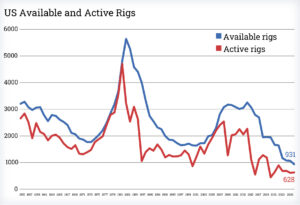
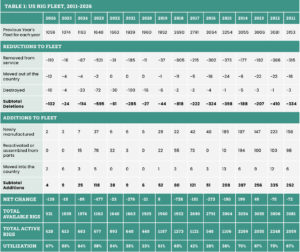
US available fleet (land and offshore) decreased by 128 rigs to 931, falling below 1,000 rigs for the first time in census history. Most of the decline resulted from onshore rigs being excluded under census rules following prolonged stacking. The offshore fleet declined by six units to 88, primarily as rigs relocated from the US Gulf to other regions.
US active rigs totaled 628, up from 613 in 2025. The increase in activity, combined with the substantial contraction of the available fleet, lifted utilization to approximately 67%, its highest level since 2014. US oil production reached record highs with a leaner and more efficient rig fleet.
US rig additions were limited to four units – two onshore newbuilds and two rigs relocated from other regions. This was the lowest number of additions recorded since at least 2008.
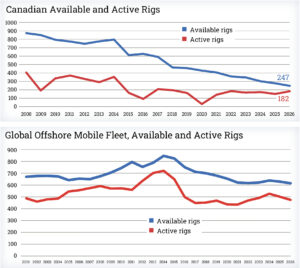
Canadian available fleet declined by 30 rigs to 247, while active rigs increased by 21% to 182. Eight onshore newbuilds entered the fleet, the highest annual total since 2016. Utilization rose from 54% to 74%, another high point, reflecting both increased activity and the continued removal of prolonged-stacked rigs.
Global mobile offshore drilling unit (MODU) fleet contracted by 14 units to 615 rigs, with no additions recorded since the previous census period. The active count fell from 502 to 475, while fleet utilization declined by 3% to 77%.
Jackup market: The war in Iran disrupted the Middle East, leading to rig suspensions and further pressure on utilization. Some affected units have begun returning to work, but a broader recovery remains on the horizon.
Floater market: Drillships and harsh-environment semis remained the strongest offshore segments. Brazil continued to lead drillship demand, while Norway supported a tight harsh-environment semi market.
International onshore market: Active rig count is slightly down year over year as the Middle East has not recovered to the same heights as this time last year despite a recent recovery under way in Saudi Arabia.
US fleet
The US available rig fleet totaled 931 in the 2026 census, down 128 rigs from the previous year and falling below 1,000 for the first time in census history. The land fleet accounted for 843 rigs, down from 965, while the offshore fleet declined from 94 to 88. Despite the smaller available fleet, US oil production reached another record, exceeding 13.9 million bbl/day in April 2026.
US rig additions
The US fleet gained four rigs, down from nine additions in the prior census and well below the recent five-year average of 39. These comprised two onshore newbuilds and a relocated onshore rig. The fourth addition was a jackup that moved from Mexico into the US Gulf.
The two newbuilds represented the lowest annual total recorded since at least 2008, continuing the longer-term slowdown in fleet expansion. Six of the past seven censuses have recorded single-digit newbuild additions, compared with an annual average of 35 from 2016 through 2019 and triple-digit annual additions before 2016.
US rig attrition
A total of 132 rigs were removed from the US available fleet in 2026, up sharply from 24 removals in the prior year. Out of those, 110 rigs were excluded under census rules after remaining stacked for a prolonged period, compared with 16 such removals in the previous census.
Of the remaining deletions, 10 rigs were scrapped, up from four last year. These comprised eight land rigs and two offshore jackups, ages 15 and 23 years. An additional 12 rigs relocated out of the US: seven land rigs moved to Canada, while four drillships and one inland barge left for international markets.
Canadian fleet
The total available Canadian rig fleet declined by 30 units to 247 rigs in the 2026 census. A total of 45 rigs were removed, including 44 units excluded under census rules due to prolonged inactivity and one rig that moved to the US. These removals were partly offset by 15 additions: eight newbuilds and seven rigs relocated from the US.
The available offshore fleet increased from four to five rigs and now comprises four platform rigs and one drill barge.
Global offshore mobile fleet
After declining slightly last year, the global MODU fleet contracted again in 2026. The available fleet totaled 615 rigs, down by 14 from 2025. No rigs have joined the fleet since the delivery of a drillship in April 2025, compared with six newbuild deliveries recorded in the previous census.
A total of 18 rigs were physically retired during the period: six drillships, four semisubmersibles and eight jackups. Four of the drillships had already been removed from the available fleet in previous censuses due to prolonged inactivity, meaning their subsequent scrapping did not affect this year’s total. The 14 other retirements, counted as deletions, comprised two drillships, four semisubmersibles and eight jackups.
The two drillships affecting the current count were delivered in 2009 and 2010. The four retired semisubmersibles averaged 23.3 years of age, ranging from 14 to 41 years, and included one harsh-environment unit. The eight retired jackups averaged 32 years, with ages ranging from 17 to 50 years.
Regionally, the Middle East remained the largest location for MODUs, although its share declined from 28.3% to 27.2%. The Far East’s share increased from 15.0% to 15.6%, while Northwest Europe rose from 9.0% to 9.4%. Southeast Asia and South America recorded the largest increases, with each accounting for 9.1% of the fleet, up from 8.2% and 8.4%, respectively.
US drilling activity
A total of 628 rigs were active during this year’s census window, up from 613 in 2025. Of these, 594 were onshore, compared with 576 last year, while onshore utilization increased from 60% to 70%. The offshore fleet had 34 active rigs, down from 37, with utilization unchanged at 39%.
The Permian Basin remained the most active region, with 270 of its 377 available rigs working during the census period. Although the active count declined from 278, utilization increased from 66% to 72% as the available fleet contracted from 424 rigs. The highest regional utilization was recorded in Ark-La-Tex, where 78% of the 74-rig fleet was active.
In the offshore segment, 16 drillships were active, down from 21, with utilization declining from 91% to 84%. The single available semisubmersible was active. Five jackups were active, resulting in an utilization of 56%, up from 44%.
Rigs rated to drill beyond 20,000 ft accounted for 62% of the available fleet and 67% of active rigs. A further 20% of available rigs and 21% of active rigs were rated between 16,000 and 19,999 ft, meaning that almost 90% of the active fleet was capable of drilling beyond 16,000 ft. Both depth categories recorded a 72% utilization. By comparison, the strongest-performing category below 16,000 ft – rigs rated between 6,000 and 9,999 ft – recorded a 53% utilization.
Canadian drilling activity
Canada had 182 active drilling rigs during the 2026 census period, up from 150 and the highest total since 2018, when 194 rigs were active. This fleet included four offshore platform rigs and 178 onshore rigs, compared with 147 onshore units a year earlier. Overall utilization increased from 54% to approximately 74%, its highest level since at least 2008. The increase reflected both the contraction of the available fleet and the higher number of rigs working during the census period.
Looking beyond the current increase in activity, recently completed export infrastructure could provide greater certainty for longer-term production and drilling plans. Two new pipelines – one transporting crude oil and the other supplying a liquefied natural gas (LNG) export facility – have expanded Canada’s access to overseas markets. Much of its capacity is supported by long-term shipper commitments, with oil transportation agreements lasting 15 to 20 years and LNG commitments potentially extending across a facility’s anticipated 25- to 40-year operating life. By providing more predictable transportation capacity and market access, these arrangements could support longer-term upstream investment.
International land rig activity
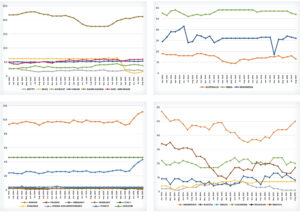
The active international count can be considered slightly down at 3,572, which includes estimates for the large Russian and Chinese fleets, and had a utilization of 79%. The regular May/June census endpoint was extended by an additional two months to capture any regional effects of the Middle East conflict since 28 February 2026.
Middle East: Active land rigs averaged 405 from May to June, compared with 426 in the previous census. While Saudi Arabia showed a marked recovery, Kuwait expanded through early 2026, then recently declined. Iraq saw the sharpest decline, likely due to security issues, reduced spending and data-reporting difficulties.
Europe: Land rig activity remained relatively steady, excluding Russia, while Turkey saw a recent surge that may align with domestic production objectives. The regional count fell from 97 last year to 94 in May 2026 before Turkey’s increase lifted it to 111 in August.
Asia Pacific: Not counting China, the active land rig count here averaged 113 from May to June, roughly level with 116 in last year’s census. Australia continued to recover as gas drilling ramped back up.
Latin America: Active land rigs averaged 101 from May to June, largely unchanged from 103 in the prior census. Argentina continued its pronounced recovery from late 2025.
Africa: There was an average of 101 active land rigs. Libya jumped from 18 to 28 rigs in June, although it is too early to say if this is a one-off count or the start of a trend. Meanwhile, Nigeria’s small onshore rig count of nine slowly but consistently expanded each month and hit 15 at the time of the census.
Global MODU activity
Active MODUs totaled 475 in the 2026 census, down 27 rigs from the previous year. Fleet utilization declined from 80% to 77%, reversing most of the gains recorded between 2022 and 2024. Drillship utilization remained unchanged at 79%, while semisubmersible utilization held at 76%. The overall decline was driven by jackups, whose utilization fell from 82% to 78%.
Drillship activity remained concentrated in the Golden Triangle. South America accounted for 42.3% of contracted drillships, followed by the US Gulf at 22.5% and West Africa at 12.7%. All three shares declined from the previous census, with the US Gulf recording the largest reduction as several units left the region. The Mediterranean/Black Sea recorded the largest increase, rising by 4.6% to 12.7%. Brazil accounted for most new contracting through blend-and-extend awards, while West African activity cooled from recent highs but remained above 2021 levels. The US Gulf continued to work down the white space. The dayrate gap between seventh- and sixth-generation drillships also widened.
The North Sea accounted for 38.2% of contracted semisubmersibles, up from 37.5% last year, driven almost entirely by Norwegian activity. The Far East held the second-largest share of semis at 23.6%, followed by South America at 20.0%.
The Middle East’s share of contracted jackups declined to 36.9%, from 38.3% last year and 42.7% two years earlier. The war in Iran led to further suspensions and prompted some units to relocate to the Asia Pacific. The Far East’s share of jackups increased from 16.7% to 17.2%, while Southeast Asia rose from 10.5% to 11.3%. The additional supply has begun to pressure utilization and dayrates in the Asia Pacific because demand has not kept pace. Mexico’s share fell from 8.4% to 5.6%.
US industry trends
The US drilling sector continued to consolidate in 2026, with the number of rig owners declining from 121 to 105. Of the available fleet, 30 rigs were owned by operators and 901 by contractors.
The Lower 48 strengthened during the first half of 2026. US land rig pricing also improved going into the census period, with the composite dayrate increasing for five consecutive months through July.
Technology upgrades remained an important focus for operators and contractors, with discussions now around going beyond the capabilities of the super-spec rigs and creating a new tier of rigs.
US forecast for next year
The duration of the conflict in Iran will be central to the 2027 outlook. Demand destruction could persist or intensify during a prolonged war, but inventories cannot provide protection indefinitely. If the conflict continues well into 2027, renewed supply pressure could sustain oil prices above $100/bbl. Conversely, a near-term resolution would allow the fundamentals anticipated in the previous census to reemerge, including excess supply and downward pressure on prices.
The disruption has placed greater emphasis on energy security. This could support investment in politically secure and diversified sources of supply.
For the US drilling market, higher prices and constrained production elsewhere support increased activity during the second half of 2026 and provide momentum entering 2027. Operators have indicated plans for further rig additions by year-end, and drilling programs are expected to increase in 2027 as companies seek to maintain – and potentially grow – production. Larger operators are initially emphasizing predictability, well economics and additional technology on existing rigs before materially expanding fleet requirements by providing longer contract terms. However, market volatility continues to encourage caution in medium- and long-term planning.
Natural gas provides another potential source of growth. Continued expansion of US data centers could increase electricity-sector gas demand and support additional gas-directed drilling.
Effective rig supply could constrain the recovery. Few idle units meet current operator requirements, with drawworks, horsepower and load capacity limiting the rigs that can return economically. Contractors have reported strong bidding activity and growing backlogs, but labor shortages could prevent some companies from supplying additional rigs if demand rises. Increasing insurance, fuel and labor costs are also pressuring profitability.
Offshore industry trends
The offshore outlook diverges by segment. Floater utilization is expected to strengthen in 2027 and 2028, while jackup recovery depends heavily on the Middle East. Suspended Saudi and Qatari rigs are returning, with further resumptions expected. However, a broader recovery will require restored regional drilling and production. Improving conditions at PEMEX in Mexico could also support contracting there.
The deepwater outlook is stronger. Brazil should remain the leading drillship market, while West African requirements through 2028 could absorb additional units. Longer-term US Gulf tenders beginning in 2027 also improve the outlook.
The semisubmersible market remains divided by region and capability. Norway’s production strategy supports a tight harsh-environment market, while policy, declining production and increased P&A work weigh on development drilling in the UK.
A major newbuilding cycle remains unlikely despite improving demand in selected segments. Before 2014, utilization near 85% often signaled new orders, but contractors, lenders and shipyards are now much more cautious.
There are also 25 offshore rigs under construction: six drillships, seven semisubmersibles and 12 jackups. Two jackups were ordered in 2025 with Middle Eastern NOC backing; most of the other 23 units were scheduled for delivery before 2017 and many require costly, time-consuming modernization. Only one drillship can compete internationally, limiting potential supply growth. Most remaining jackups are less desirable designs, while the stranded semi count has changed little in five years. Many units may never enter the drilling market and could instead be repurposed or remain undelivered.
Mega-mergers in 2026 increased the fleet share controlled by the 10 largest contractors, potentially strengthening pricing power and encouraging further high-grading and scrapping. More than 30% of marketed jackups are over 30 years old, and new construction will eventually be needed to maintain drilling capacity and replenish reserves over the medium to long term. DC
IHS Markit is the primary source for the global offshore fleet while Enverus has provided the source material for the US and Canadian onshore fleets. Information for the international land fleet was found using both Baker Hughes data and Spears information collected and analyzed by NOV personnel.
Click here to view the full version of the census featuring additional data.