Floater outlook optimistic while jackup market faces more unknowns
Tight supply and a more disciplined contractor base to drive additional recovery for floaters, while jackups wait on the Middle East

By Stephen Whitfield, Senior Editor
The global offshore rig market is heading into 2027 with little change in headline rig counts, but a clear divide is opening beneath the surface. The floating rig market has already turned the corner and is on track to recover further. And while the jackup market also has room to grow in the coming year, how much of that growth materializes will depend heavily on how the current conflict in the Middle East plays out, since jackup demand is concentrated there more than in any other region.
The utilization trends for floaters and jackups already point in different directions. By the end of this year, committed utilization (the utilization rate for rigs either contracted or committed for future work) is expected to reach 84% for semisubmersibles and 95% for drillships, according to the Westwood RigLogix database. Both are up from 2025 rates of 83% and 92%, respectively. Jackup utilization is trending the other way, expected to fall to 88% this year from 91% last year.
In terms of the committed offshore rig demand (the projected and active number of drilling rigs required globally), Westwood is forecasting barely any change from this year to next: from 387 to 392 for jackups, from 61 to 63 for semis and from 83 to 85 for drillships. The changes are more apparent when it comes to utilization rates. Drillship utilization is forecast to reach 97%, which would match the peak level it saw in 2023, and semis are forecast to reach 86%. Jackup utilization, however, is forecast to recover only to 89%, still five points below its 2023 high of 94%.
“We expect to see improvement, certainly, in utilization for drillships next year and similarly for the harsh-environment semisubs,” said Teresa Wilkie, Director – RigLogix at Westwood Global Energy Group.
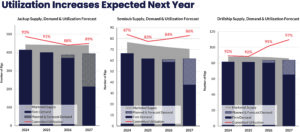
There’s less certainty for jackups, already evident in the fact that contract awards so far this year are only a fraction of last year’s total, while awards for drillships and semis have already exceeded 2025 levels. Westwood is also forecasting that roughly 50% of jackup demand for 2027 is still planed or forecast, rather than firm, compared with about 20% for floaters.
Whether more jackups end up landing a contract is largely a question of what will happen in the Middle East. Across 2025 and 2026, the region accounted for roughly 62,000 awarded rig days, nearly all of them jackups, and representing more jackup days than any other region.
There’s not a lack of potential. Looking forward, Westwood counts 44,872 outstanding jackup days for requirements starting before 31 December 2028. That represents the total cumulative volume of unawarded or uncontracted rig demand associated with upcoming jackup drilling programs, open tenders or ongoing direct negotiations that have not yet been formalized into active contracts.
Just in the Middle East alone, there are 18 outstanding jackup opportunities at the tender, pre-tender or direct negotiation stage. “There’s so much in tenders, pre-tenders and demand outstanding in the Middle East. It’s not so much the demand isn’t there. It’s just that we’ve seen a lot of the start dates pushed back,” Ms Wilkie said.
The jackup market’s uncertainty is not solely a Middle East story, however. India and Southeast Asia have both been slower than expected this year, which has also weighed on global utilization. “I think it’s going to be more of a challenge with the jackups,” she noted. “We need to see what happens in the Middle East and what operators choose to do in terms of the tenders there, but there are so many other areas to look at. I think it’s a little less clear how next year’s going to go.”
Floater supply keeps tightening
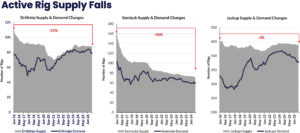
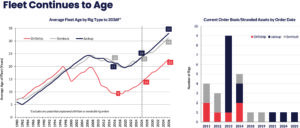
Supply constraints are driving market dynamics for floaters. Westwood’s data shows that the active drillship fleet decreased by 21% between January 2016 and August 2026, and the active semi fleet dropped by 56% in that same timespan. The floater fleet is also getting older. Excluding unplanned attrition, Westwood projects the average drillship age will rise from 14 years in 2026 to 23 by 2036, while semis will go from 25 to 31 years.
Ms Wilkie said she does not expect a new construction cycle anytime soon. Not only is global shipyard capacity constrained, but the economics also remain unfavorable. Westwood estimates a new drillship constructed today would cost around $1 billion, compared with about $600 million in the last cycle in the late 2000s and early 2010s. Current leading-edge drillship rates fall well short of the $500,000-$600,000, and the five- to 10-year terms, that supported the previous newbuild wave, she said.
Instead, the industry continues to lean toward investing in upgrades for existing rigs, with contractors adding automation, higher hookload capacities, MPD-ready packages and emissions-reduction technologies, among other improvements.
Another factor keeping the floater supply tight is continuing market consolidation. For instance, following the Transocean-Valaris merger, Westwood counts only eight managers of seventh- and eighth-generation drillships. Sixth-generation semis are held by 16 managers.
“We’re expecting stronger contractor discipline and tighter supply management, especially for drillships,” Ms Wilkie said.
The jackup fleet is also aging, estimated to reach an average age of 33 by 2036. However, the entrance of previously stranded or delayed newbuild jackups from 2021 to 2024 has helped to keep the global supply more steady – overall down by only 3% from early 2016 to mid-2026. There are also a few newbuilds under construction in the Middle East, including the Kingdom 3 and 4 jackups bound for Saudi Aramco as part of its 20-rig newbuild campaign.
Middle East
No region matters more to the jackup market than the Middle East, and none is harder to read right now. Westwood forecasts the region’s offshore rig count – all jackups – to stay flat year-to-year from 2026 to 2027 at 149 units. Utilization will also barely move, from 90% to 91%.
What will happen with Saudi Aramco is a huge part of the uncertainty, Ms Wilkie said. After the company issued a wave of jackup suspensions in 2024 and 2025, some of the released rigs found work in other markets and left. Aramco later issued a tender for nine rigs, but that was followed by the Iranian conflict starting in early 2026. While the tender stayed in place, the bid deadline was pushed out repeatedly, with bids finally coming in September.
“It’s taken so long for them to receive those tenders,” Ms Wilkie said. “But in the same week that we saw those bids come in, we’re now hearing that they could potentially suspend around 10 more rigs from their fleet. I don’t think anyone can quite understand what their strategy or plans are for the coming year.”
There have been other rig suspensions earlier in 2026, but those were tied more directly to the war, with rig crews being reduced in size or evacuated, not only in Saudi Arabia but also in Qatar and the UAE. Most of that has since normalized, she said.
There have also been some new contracts announced in September pointing more clearly in a positive direction. Arabian Drilling signed a four-year contract with Khafji Joint Operations (KJO) for the provision of four high-specification jackups to operate in the Divided Zone between Saudi Arabia and Kuwait. Additionally, Kuwait Oil Company received jackup bids – two from ADNOC Drilling, two from Arabian Drilling and two from ADES – on a tender launched back in January for a pair of jackups. Further tenders and pre-tenders are emerging from KJO and from ADNOC Drilling in the UAE.
While these movements are all positive and operators say it’s business as usual in the region, Ms Wilkie said the wider market can clearly see the effects of rig suspensions and project delays. Rigs freed up by suspensions, for example, have flowed into Southeast Asia and other regions, adding supply faster than demand has grown and weighing utilization down.
India
India is one market that could swing the jackup outlook for next year, even though it is showing only modest improvement right now. Westwood forecasts jackups there will move from 29 in 2026 to 31 in 2027, with utilization staying at 94% both years.
The market is still very much focused on older jackups, however. While ONGC has periodically signaled an interest in buying, building or upgrading its fleet, Ms Wilkie said, nothing has come to fruition. Meanwhile, the NOC has been slow to replace rigs that are coming off of hire, which has pushed the rig count lower over the past couple of years.
There are signs of momentum, though. Westwood is counting three outstanding jackup opportunities in India, along with two requirements each for drillships and semis. ONGC and Oil India have a history of issuing tenders, canceling them and retendering. This year, however, it has awarded contracts for two rigs from one tender, and another tender is in the market. Ms Wilkie noted that there will likely be more pressure on bids next year due to extra rig supplies from the Middle East.
West Africa
This is another market where jackup demand has picked up this year. Another small uptick is expected for next year, pushing the jackup count up by one to 21; utilization will stay at 90% for both years.
Nigeria has been the surprise here, where smaller indigenous companies have been moving ahead with substantial pieces of work, largely brownfield redevelopments of fields previously held by supermajors. “The smaller companies have taken over those fields, and they’re coming back in and doing a second phase of development or redevelopment, getting more of the resources out of the ground.”
West Africa is also the key region to watch for drillships. Although the region’s active floater count is forecast to go down by one unit, from 18 to 17, utilization is actually set to increase from 93% in 2026 to 100% in 2027. RigLogix data shows 12 outstanding drillship opportunities there with start dates between 2026 and 2028.
TotalEnergies is a focal point in West Africa, Ms Wilkie said. The company has tenders out for development drilling in Nigeria, along with tenders for three rigs in Namibia: one for appraisal drilling at Mopane and two for development drilling at Venus.
Other operators also have plans for Namibia. Shell is expected to return to the country with a rig, Rhino Resources is looking to operate there, and Chevron plans to take the Stena Forth drillship there from Egypt to drill a well this year.
In Ghana, Tullow Oil has firmed up a contract with Noble for the Noble Faye Kozack drillship for development work, Heritage Oil is expected to drill an exploration well, and Pecan Energy has a large field development that could move ahead within a few years.
In Côte d’Ivoire, Eni is planning a return, as is Murphy Oil, which made a major light oil discovery at the Bubale-1X exploration well in the deepwater Block CI-709 in June 2026.
In East Africa, where RigLogix is tracking two outstanding drillship opportunities, Mozambique is an area of interest. TotalEnergies’ and ExxonMobil’s development work there had stalled in 2021 after Islamic State-linked militant attacks near the island’s northeastern coast. Projects have begun advancing again recently with the unrest starting to clear up at the end of last year. The two operators each have one floater tender out currently – TotalEnergies’ tender has a 2027 start date, while ExxonMobil’s is for 2028.
“The situation in Mozambique has changed a lot recently, and the challenges behind development there have improved a lot. That’s the main thing driving interest there,” Ms Wilkie said.
The most speculative frontier in this region is Somalia, where TPAO is drilling a wildcat well with one of its own drillships. Ms Wilkie said it is the first deepwater exploration well ever drilled there, as well as TPAO’s first operated deepwater campaign outside of Turkey. With no existing infrastructure, a discovery would require heavy investment for further development.
North Sea
For the North Sea, Westwood forecasts a stable jackup market but no growth; it’s calling for the same active jackup count of 25 and the same 94% utilization rate for both 2026 and 2027.
The semi market, by contrast, is expected be sold out by next year, with the active count edging up from 23 to 25 and utilization moving from 98% to 100%. In October, the last harsh-environment rig without a contract in place, the Northern Ocean-owned Deepsea Mira, was contracted out to Shell for a campaign set to begin in April 2027.
For the UK market specifically, this shrinking supply had already been on the horizon for several years due to myriad fiscal and regulatory challenges.
“What we’ve been predicting for years has actually finally happened,” Ms Wilkie said. “There’s been so much scrapping of rigs because there’s not enough demand, that there are only about six semis left in the UK that are UK capable.” All six semis in the UK have work in place.
This supply scarcity is prompting some UK operators to look outside of the current active rig fleet as they consider future drilling programs. Ms Wilkie pointed to Serica Energy as one example of this trend. That company is preparing a multi-well drilling campaign in the UK North Sea scheduled to begin in the second half of 2027.
She noted that Serica has been talking to a Chinese shipyard that is still holding pre-2014 newbuilds that were not picked up following the 2014-2015 downturn. The Beacon Pacific and North Dragon harsh-environment semis are rumored to be the rigs under consideration, Ms Wilkie said, although no official statement has been made to this effect. DC