Momentum builds in Venezuela, but turning policy reform into real production won’t be easy
Rebuilding production will require a confluence of capital investment, rig and equipment availability, political and contractual certainty

By Stephen Whitfield, Senior Editor
Venezuela’s upstream sector is entering what may be its most consequential stretch in a long time. Sweeping legal reforms, a wave of new operator commitments and landmark deals by the new regime and Venezuela-based companies are combining to push the country’s production outlook.
However, Daniel Leppert, Head of Research for Latin America at Rystad Energy, says it remains to be seen whether the country can convert policy momentum into sustained output growth.
Rystad estimates Venezuela’s oil resource base to be approximately 300 billion barrels, one of the largest in the world. Much of that is concentrated onshore in the Orinoco Belt and near Lake Maracaibo. The country also holds notable offshore gas resources, including in the La Perla field and assets near Trinidad and Tobago.
“It’s hard not to be optimistic when you look at Venezuela from a below-ground potential perspective,” Mr Leppert said.
However, not all of the known oil is actually recoverable under current market conditions, he said. Rystad’s base-case analysis – built around a WTI price of $70/bbl and factoring in the heavy and extra-heavy quality of most Venezuelan crude – estimates the economic portion to be roughly 100 billion barrels.
Challenges to rebuilding a healthy E&P industry also remain around legal implementation, fiscal follow-through, rig availability and political durability. These tests will ultimately determine how much of the country’s potential gets realized, and how quickly.
A new legal framework reshapes the industry
Much of the renewed interest in Venezuela started with the interim government advancing an amended version of its Organic Hydrocarbons Law in January. The amended law was aimed at lowering royalty rates and corporate income taxes, changes designed to make the country’s oil resources more competitive against other global supplies. Many of Venezuela’s barrels carry breakeven costs above the $70/bbl threshold established under Rystad’s base-case scenario, Mr Leppert said, so these changes aimed at improving the economics of E&P projects are important.
The reform in Venezuela, combined with broader momentum across South America toward more market-friendly governments, has led to significant capital investment interest from what Rystad describes as the broadest pool of international operators and investors the country’s upstream sector has attracted in decades. Established players are expanding existing footholds, while an unusually wide range of new entrants are securing positions under the updated contractual framework established by the revised hydrocarbons law.
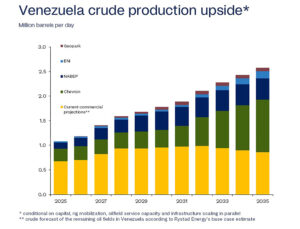
According to Rystad, the first phase of activity is expected to lean heavily on established international players. Chevron is projected to be the single largest contributor to Venezuela’s production growth through 2028. The company, which added the Carabobo-1 and Carabobo-2-Sur-A blocks to its Venezuelan portfolio this year, announced a $7 billion plan to scale up its joint ventures through 2031 with state-run PDVSA. It plans to double its oil production to roughly 600,000 bbl/day over that time span.
Repsol and Eni are also expected to be major contributors. Eni has taken exclusive operatorship of the Junin 5 block under a new 25-year production participation contract, while Repsol has regained operational control at Petroquiriquire. Additionally, Shell has re-entered the country through redevelopment agreements covering the Carito and Pirital fields. ExxonMobil is exploring a potential return to the country, and TotalEnergies has signed a memorandum of understanding with PDVSA covering new hydrocarbon opportunities.
Alongside these legacy operators, a new group of independents have entered the market, including regional player GeoPark, Texas-based Hunt Oil and Brazilian independent Fluxus Oil.
Rystad’s research indicates that international operators, as a group, could account for nearly two-thirds of the country’s forecast production increase through 2028. That growth is expected to come largely from expanding output at existing joint ventures rather than from new discoveries.
“Everyone wants to know what’s going to happen if things truly unlock and this becomes a more stable long-term market,” Mr Leppert said. “You want to be there. You want to have your assets ready and see how this really plays out.”
He framed the current phase of activity in Venezuela as being primarily focused on brownfield recovery – reactivating wells, performing workovers and stabilizing legacy assets – while operators simultaneously lay the groundwork for a second, longer-term wave of development tied to earlier discoveries. That second wave, he said, is more likely to impact post-2030 production.
Large investments needed
Rystad’s modeling illustrates just how much the country’s outlook has shifted over the past year. Before the US policy intervention at the beginning of 2026, Venezuela’s production had declined from the 3.1 million bbl/day it saw in 2010 to roughly 1.1 million bbl/day in 2025. That figure was originally expected to stay flat through 2028, but Rystad’s base case now forecasts production will reach 1.6 million bbl/day by 2028, 1.8 million bbl/day by 2030 and 2 million bbl/day by 2035. In an upside scenario built around a wave of new greenfield development over the next decade, production could climb to approximately 2.58 million bbl/day by 2035.
However, significant capital investment will be required to achieve any of that. Just to maintain a flat production would require $53 billion, and to reach the base case forecast would call for approximately $70 billion. A considerably larger sum would be needed to reach the upside scenario.
None of these capital investments will be made without more political certainty, Mr Leppert said. Not just in Venezuela but also in other Latin American countries, there is a track record of political transitions upending existing commercial contracts. Operators, he said, are acutely aware of that past.
For the current wave of deals to translate into durable investments, the country will need political stability, contractual certainty and clear fiscal terms, all reinforced by a government that has both international legitimacy and broad support from the domestic population.
A particularly notable data point in Rystad’s modeling is the contribution expected from the recently announced North American Blue Energy Partners (NABEP) agreement. On 31 August, the US Departments of State and Defense announced a deal between Venezuelan interim authorities and the US-backed NABEP on 100-year concessions for 17 oil fields that have combined proven reserves of about 65 billion barrels.
Since the announcement of the agreement, NABEP has floated a long-term funding plan in the neighborhood of $100 billion, although Rystad said it is treating this figure cautiously. It is still more of an aspirational funding target rather than committed long-term capital – the company has not disclosed a detailed financing structure.
Still, Mr Leppert pointed to this deal as a meaningful inflection point in the rebuilding of the country’s E&P industry. Rystad’s figures show that this deal could play a major role in boosting the country’s long-term production trajectory, potentially pushing it from the base case scenario of approximately 2 million bbl/day by 2035 up to 2.58 million bbl/day.
“We’re on an upward trajectory when you add NABEP to the other current commercial projections we’re seeing. The question is just how much do you see that annual growth rate go up? NABEP potentially paves the way for a more aggressive outlook,” he said.
The oilfield services gap
While political and fiscal risks are top of mind when it comes to attracting long-term investment to Venezuela, Mr Leppert noted physical operating capacity as an equally important but even more immediate challenge for the country. There is a clear bottleneck when it comes to infrastructure, he noted.
Looking at drilling rigs, for example, Baker Hughes counted just two active rigs operating in Venezuela as of August 2026. The Venezuelan Oil Ministry has targeted 93 active drilling rigs in the country by 2028 to support its production targets, while Rystad estimates the country would need to reach around 50 active rigs by 2028 and nearly 80 by 2030 to support its modeled production pathway.
Achieving those levels of rig activity would require a phased expansion involving reactivating domestic rigs, refurbishing idle equipment and importing additional rigs from international markets. This could create substantial opportunities for drilling contractors and oilfield service providers, although companies will have to balance equipment mobilization costs, contract duration requirements and their risk appetite before making significant commitments.
Momentum is already beginning to build on the oilfield services side though. SLB, for example, has roughly 15 rigs already positioned in the country that could be potentially brought back online within a year, according to Rystad. The process is moving faster than expected in terms of rebuilding local offices and increasing staffing, even if formal commitments remain limited for now. DC