Amid volatility, onshore growth to stay measured
While regions from NAM to Argentina to Venezuela are all expected to see higher drilling activity in 2027, operators will tread lightly

By Stephen Whitfield, Senior Editor
Heading into 2027, the global onshore drilling market is in a period of cautious growth. While oil prices are far above where operators had expected them to be a year ago, geopolitical conflicts and the constraints in the Strait of Hormuz have ratcheted up market volatility so much that few companies have been willing to significantly increase their drilling programs to take advantage of the recent higher prices.
Still, despite this temporary market shock brought on by the Middle East conflict, Michela Francisco, Onshore Analyst at Westwood Global Energy Group, said she believes the long-term fundamentals of the global onshore drilling market remain intact.
She has the same view on the long-term growth trajectory for the Middle East region. Not surprisingly, the war has had the biggest direct, immediate impact on this market, both in broader terms and in terms of rig disruptions. But so far the conflict is still being seen as more of a temporary shock to the market.
“We’re going to see a recovery,” she said. “Our base case is that, by next year, things will be back to normal in terms of the Strait of Hormuz. And if everything clears up, maybe by mid-2027, we’ll see a recovery. Based on the long-term goals of the operators, we will see that strong demand coming again.”
Globally, Westwood expects a nearly 11% increase in the average number of onshore rigs, moving from 4,021 in 2026 to 4,445 in 2031. The average number of wells drilled will rise 6%, from 45,806 in 2026 to 48,604 in 2031.
Some of that increase will come from North America, where drilling activity is expected to inch higher next year. Other markets like Argentina and Australia – where demand for high-specification rigs is already outstripping supply – are also expected to expand. The expansions, however, will all be measured, a reflection of the market’s overall cautious approach.
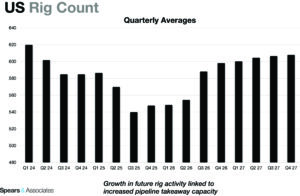
That caution can be clearly seen in the US Lower 48 this past year. Spears and Associates forecasts the average US Lower 48 rig count will end this year at 560, pretty much the same as the 561 average in 2025. In 2027, an 8% growth to 605 rigs is being forecast.
No big changes are expected in the number of wells drilled – 15,500 this year versus 15,650 next year – although the footage drilled is expected to grow more proportionally to the rig count as the trend for longer laterals and deeper wells continues. Spears forecasts operators will drill 257 million ft of hole by the end of 2026, with that figure growing by about 4% in 2027 to 267 million ft.
At the same time, US crude oil production is expected to average 13.8 million bbl/day in 2026, up 1.6% from the 13.6 million bbl/day in 2025, and rise a further 2.5% to 14.15 million bbl/day in 2027.
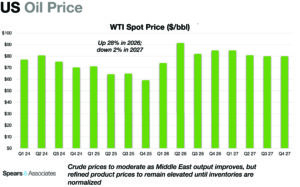
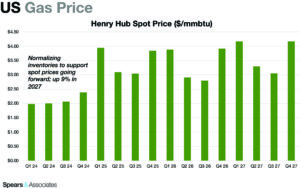
The measured growth in the rig count can be partly attributed to the volatile pricing environment, said John Spears, President of Spears and Associates. He expects little change in the WTI price next year, averaging $83/bbl in 2026 and $81/bbl in 2027. Henry Hub gas prices are forecast to average $3.30/mmBtu this year and rise modestly to $3.60/mmBtu next year. However, none of those are numbers that operators are actually using to plan their drilling programs, he said. A year ago, companies were assuming a 2026 oil price between $55 and $60. Today, many are planning activities around $70 for 2027, well below both the current spot price and his own forecast.
“When uncertainty increases, the tendency toward accepting risk declines, and I think that’s a factor in what we hear operators saying when they’re talking about their plans for next year,” Mr Spears said. “We don’t want to get out over the edge of our skis in terms of getting rigs busy under the presumption that these high prices will persist, and then all of a sudden prices end up lower than what we thought.”
North America
Lower 48 basin outlooks
The Permian Basin remains the biggest driver of growth in the US Lower 48, expected to account for all net increases in US crude production from 2026 to 2027. Spears and Associates expects the region to average 278 rigs in 2027, up roughly 10% from 255 rigs in 2026. Wells drilled are forecast to rise from about 6,400 in 2026 to about 6,900 in 2027. If realized, that 2027 forecast would still fall well short of the 7,500 wells drilled just two years ago – a gap Mr Spears attributes to the changing nature of Permian drilling rather than weak demand.
Footage drilled in the Permian is expected to grow faster than both rigs and wells – an increase of around 12%, from 123 million ft in 2026 to 137 million ft in 2027.
There has also been a continuing wave of E&P consolidation in the Permian in the past few years, exemplified this year by the completion of the Devon Energy and Coterra Energy $58 billion megadeal. However, that trend is starting to shift more from transformational consolidation to strategic optimization, Mr Spears said. Buyers are increasingly targeting assets that expand existing positions, improve operational efficiencies and extend high-quality drilling inventory, rather than pursuing scale alone. Contractors, too, are consolidating as they seek to strengthen their positions in the Permian, and Mr Spears pointed to Ensign’s acquisition of Citadel Drilling, completed in August 2026, as a prime example.
While more consolidation is likely in 2027, any deals made will likely not be “big transformative things” but more marginal, he added. “Right now, because the oil prices have been so up and down, how do you value a company? The buyer might presume that a company’s worth X amount of dollars because oil prices are currently at one level, and the seller might think it’s worth Y amount because it sees oil prices going somewhere else. We’re seeing a big spread that’s slowed down the pace of M&A work, but as the markets settle down, we’ll see the deals pop up. There’s always somebody willing to sell.”
Outside of the Permian, the Haynesville has proven to be one of the stronger stories in the Lower 48. Spears and Associates estimates the basin will average 51 rigs this year, up from 36 in 2025, with another gain of about 10% to 56 rigs in 2027.
That growth is not a response to natural gas prices, which have been flat. Instead, Mr Spears said much of it is being driven by excitement over the Western Haynesville, where companies are testing whether the play can work at current price levels. “It’s almost a proof-of-concept thing. Can we get these wells drilled? Can we get them completed? Can we do all of this so it fits in a $3.50 price environment? That’s attracted a lot of investment, which is divorced from a market that would be more responsive to the commodity price,” he said.
With the speculative nature of this activity, logistical plans in the basin are changing, as well. For example, while operators in the Haynesville have traditionally used in-basin frac sand, they’re now railing in sand from Wisconsin because local mines are stretched thin due to increased demand. This has added cost in an environment where diesel prices have roughly doubled in the past year.
Over in Appalachia, the Marcellus is not expected to see much movement for 2027. Spears and Associates forecasts an average of 26 rigs in the basin in both 2026 and 2027, while wells drilled is expected to decline from 900 in 2026 to 875 in 2027.
The constraint in the region is not geological but rather infrastructural. Mr Spears pointed to an increase in local opposition to data center projects in the Appalachian region, with Southern Pennsylvania and Northern Virginia sitting at the epicenter of data center sites. As public opposition slows the construction of data centers, the construction of the pipelines needed to move more gas out of the basin is slowing too, as it removes demand and economic justification for the cost of pipeline construction.
Mr Spears noted that he doesn’t expect public opposition to subside anytime soon, even despite the enthusiasm that local politicians have expressed for data centers. “If you could wave a magic wand, I think someone in Washington or the statehouses would have waved it by now,” he said. “The fact that they’re trying to wave it and nothing’s changing suggests it might not be a magic one.”
It could be another two to three years before rig activity picks up in the Marcellus, he added. That would give more time for local communities, regulators and developers to work through agreements that will eventually boost natural gas takeaway and consumption capacities.
Canada
Canada is expected to average 195 rigs and 5,600 wells drilled in 2026, compared with 200 rigs and 6,000 wells in 2027. As in recent years, Mr Spears said, the story in Canada is about pipelines and LNG. On 29 September, Shell took the final investment decision for the Phase 2 expansion of the LNG Canada export facility in Kitimat, British Columbia, a move the operator expects will double its LNG capacity in the country. However, he believes further midstream investments in pipelines and LNG need to come together before rig activity can move noticeably higher.
And while federal government approvals for pipeline projects have been somewhat more streamlined under Prime Minister Mark Carney compared with his predecessor, Justin Trudeau, progress on those projects remains slow, Mr Spears noted.
The more significant shift in Canada may be geopolitical, with tensions rising after US President Donald Trump signed an executive order in July imposing 50% tariffs on various Canadian exports. While Canadian producers have long been tied to the US market, the escalating trade war this year between the two countries has triggered a structural shift in LNG sales. In July – a week after the US tariffs order – Mr Carney announced a plan to sell 55% of Canada’s natural gas exports to countries other than the United States by the mid-2030s. That would be a significant change in export patterns, considering that non-US countries accounted for just 0.01% of Canada’s natural gas exports in 2024, the year before the opening of the country’s first LNG terminal.
The LNG Canada terminal gave the country an additional 14 million tonnes/year in export capacity, meaning the country now has more sale options for its crude products. Most of the exports going out of the LNG Canada terminal have been headed for Asian markets. Chinese and Indian refineries, for example, both have the ability to handle the heavy crude that Canada produces. On 1 October, Mr Carney announced plans to fast-track development of the Pacific Link oil pipeline running from Alberta to the Pacific Coast, following the Trans Mountain corridor. The pipeline would add approximately 1 million bbl/day in crude oil export capacity.
“Canada’s in an interesting position. So much of their oil and gas production has gone to the US, but as they add more capacity they’ll be able to keep themselves at arm’s length from the US,” Mr Spears said. “Those new terminals and the pipelines are going to give themselves a little bit more leeway from an export market standpoint, but I don’t think they’ll ever be able to truly divorce themselves from the US. They’re still selling crude at a significant discount to WTI just because of the distance between the markets. It’s just a fundamental reality they have to deal with. It may not grow, but it’s not going to shrink significantly.”
Focus on efficiency and capital discipline
Another continuing story in North America is the trend toward longer laterals and deeper wells, which means consumables such as drill pipe and bits are becoming more a function of footage drilled than of well count. U-turn wells, which Spears and Associates data show accounted for 2-4% of horizontal wells drilled last year and around 5% this year, are also becoming longer. “Operators used to drill 5,000 ft of lateral, turn around and drill back 5,000 ft in the opposite direction. Now they are talking about drilling 10,000 ft each way. It’s still just one well, but now you’re putting a lot more footage into a well, and it’s cost-effective on the drilling side to drill it in that fashion,” Mr Spears said.
Part of this shift is being driven by the desire to drill more cost effectively and partly by technological improvements, with drill bits and automation making it easier for operators to drill further than ever before. This places new demands on drilling rigs and equipment. “We’re looking at massive upgrades to the lifting capacity of the rigs that are needed to handle these lengths,” Mr Spears said. He added that operators have cited connection speed as one of their major bottlenecks, which is why automated tubular handling and robotics have become standard rig expectations.
Aside from commodity pricing volatility, Mr Spears also cited three other reasons why North American onshore is unlikely to see big jumps in drilling activity: capital discipline, inventory and cost. First, operators – especially the big public E&Ps – have adopted capital discipline as their default. Even with higher-than-expected oil prices this year, they’ve chosen to essentially keep flat rig counts; growth has only come from privately held operators.
This trend is expected to stay the same next year. Mr Spears estimates that operators are reinvesting about 50% of their free cash flow in 2026, with the rest going back to shareholders and balance sheets. This general steadfastness to capital discipline – even when oil prices were in the triple digits – is finally gaining recognition on Wall Street.
Inventory is another reason, as E&Ps don’t want to burn through their inventory of undrilled prospects too fast; this is the same driver that has kept the M&A market active. Mr Spears said there is already a growing gap between buyers and sellers this year, where sellers are valuing assets based on an oil price of around $90/bbl, while buyers are valuing them at $70/bbl. This has slowed the pace of M&A deals, especially the big and transformative ones.
And, finally, there are cost pressures. Diesel prices have roughly doubled from a year ago, leading to an incremental increase of nearly $1 million in fuel and trucking expenses for an average horizontal well. Using a conservative assumption for fuel prices, he said, operators should expect well costs to be about 10% higher in 2027 than in 2026. “Your budgets are going to have to go up that much just to hold activity flat, and that’s even before rig rates and pipe prices are considered,” he said.
Middle East
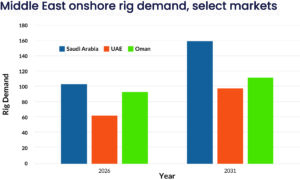
Heading into the final months of the year, the Middle East was still mired in volatility, with the ongoing war adding stress and tension to drilling operations in the region. In Saudi Arabia, for example, H&P had planned seven rig reactivations this year but reduced that number to five. Supply chain constraints are part of the reason for that change, along with higher fuel costs to power generators and sharply rising insurance premiums. While these issues are manageable in the short term, Ms Francisco at Westwood said they will become more challenging if the conflict continues unabated into 2027.
Saudi Arabia is also taking the softening in oil-centric drilling, rig contracting and CAPEX – due to the loss of some of its offtake infrastructure from Hormuz constraints – and filling the gap with more natural gas projects. This can be seen with Arabian Drilling’s awards to SLB for 19 gas rigs under lump-sum turnkey contracts in August and September. “That was an indication that most big GCC countries are led by those NOC targets. They’re looking to continue drilling and pushing toward those targets in this messy environment,” Ms Francisco said.
The UAE, like Saudi Arabia, has more than 1 million bbl/day in non-Hormuz offtake and has continued drilling despite the conflict. Ms Francisco said there have been “rumors” of a plan for the UAE to increase production to 6 million bbl/day by 2031. The country, which recently left OPEC, had already planned for an increased production of 5 million bbl/day by next year. Following ADNOC Gas’ sanctioning of Phases 2 and 3 of its Rich Gas Development project in August 2026, more rigs are likely to be needed to meet requirements beyond ADNOC Drilling’s own rig fleet. However, she noted these new additions would be made through ADNOC Drilling, not new contractors.
Oman has also been relatively better shielded from the Hormuz blockage, and activity has continued as normal. “Even in these months, they’ve been able to activate rigs. We are seeing active (well) construction in Oman,” Ms Francisco said.
Rig demand in the country, led by Petroleum Development Oman, will be driven by rigs between 1,500- and 3,000-hp as operators look to increase development and exploration drilling to arrest high decline rates in existing fields. By 2031, Westwood forecasts that Oman’s onshore rig count will grow to 111, from 93 rigs in 2026, and its demand for high-horsepower rigs will grow 32% in the same time period.
Kuwait, Iraq and Bahrain have been the harder-hit countries, where OPEC-reported production have all plummeted. Iraq has seen up to 80% of its active land rig fleet go inactive this year, although Ms Francisco said reactivations are slowly picking up, and TotalEnergies reestablished all rigs for its Gas Growth Integrated Project in September. Rigs in Bahrain and Kuwait that had been released or placed on standby are also gradually coming back, driven by the need to fulfill domestic production goals.
Kuwait still has a target of up to 4 million bbl/day of crude capacity, and contracts signed by SLDC, the ADNOC Drilling-SLB joint venture, reflect that ambition, Ms Francisco noted. In January, Kuwait Petroleum Corp had also awarded 24 rigs to six different drilling contractors.
South America
Argentina, already the continent’s brightest onshore E&P spot, saw more positive development in February, when the Argentine Executive Branch authorized extensive amendments to the regulatory framework of the country’s Large Investment Incentive Scheme (RIGI) for oil and gas projects.
RIGI was designed to provide stability for tax, customs and foreign exchange rules to oil and gas projects in the country. Qualifying projects will receive a 25% corporate income tax rate, down from the standard 35%. A proposed “Super RIGI” bill currently being considered would reduce this rate even further, to 15%. Additionally, foreign investors would be able to keep their export earnings from Argentine projects in US-based accounts, bypassing various capital controls. They would also receive complete exemption from import tariffs and duties for the capital goods, spare parts, components and supplies required for the construction of approved projects.
Among other things, the Executive Branch’s February decree extended the application deadline by a year to 8 July 2027. It also expanded the eligibility of new onshore upstream projects to include onshore oil projects, as long as they meet a minimum investment threshold of $600 million. According to Westwood, the RIGI has drawn applications totaling approximately $60 billion in proposed capital investment, accounting for more than 3,000 well commitments, since it was first announced in 2024.
From 2026 to 2031, Westwood expects the country to grow from 89 rigs and 1,149 wells to 107 rigs and 1,394 wells. Most of the rig demand will be for super-spec units capable of drilling complex and deep wells, with high-horsepower rig demand growing by 31% in the same time frame. Ms Francisco said this will likely require more rigs to be moved into the country, primarily from the US, although there is also potential for newbuild construction mandates.
Another high-interest country on the continent is Venezuela, where Westwood’s outlook is generally positive but still guarded. Since former President Nicolás Maduro was captured and ousted following US intervention at the beginning of 2026, significant changes have already been made to the country’s E&P framework. A series of deals and MOUs with supermajors and independents have also been signed, which could lift the country’s liquids production to 1.74 million bbl/day by 2031, about 50% higher than in 2026. Chevron, for example, announced in September a $7 billion plan to double oil production in Venezuela to 600,000 bbl/day by 2031.
In 2031, Westwood forecasts a 238% growth in rig demand in Venezuela, compared with 2026 levels. Operators are already exploring options to move rigs into the country, Ms Francisco noted, with six due by the end of this year. PDVSA has also mentioned plans to reactivate 250 rigs over the next 10 years, although she warned that number was highly optimistic as significant hurdles remain. They include regulatory stability, the return of subject matter experts who left during the production crash seen under Maduro’s government, infrastructure restoration, global supply chain tightness caused by the Middle East crisis and the ability of the electrical grid to support extra power needs from new infrastructure.
Especially when it comes to improving the country’s infrastructure and regulatory regime, real changes will likely not become apparent until the end of 2027 or 2028, she noted. Moreover, the economic viability of the country’s resources is also uncertain. “Strong production in the US, Guyana and Brazil could return the market to oversupply, and that raises the question of whether Venezuelan barrels are economic at a lower oil price,” she said.
Russia
Russia remains a complicated market to assess, particularly amid its ongoing war with Ukraine. Westwood forecasts a gradual activity decline in the country, indicated by a 7% drop in rig demand from 2026 to 2031. Onshore well spuds are expected to drop by 6%, compared with the hindcast (2020-2025), averaging 6,668 per year into 2031. In July, the International Energy Agency (IEA) projected the country’s oil production in 2026 and 2027 will be lower than previously expected, due to intensified Ukrainian drone attacks on Russia’s energy infrastructure. For 2026, the IEA oil supply forecast was cut by 85,000 bbl/day to 8.9 million, and the 2027 forecast was revised down by nearly twice this year’s downgrade, by 150,000 bbl/day to 8.8 million.
Drilling had already cooled considerably last year when oil prices were low; as a result, many of Russia’s smaller contractors went bust and people with technical expertise left the country, Ms Francisco said. Even with oil prices more elevated this year, activity has not been able to recover, mostly remaining just sufficient to maintain existing production. That will likely not change in the near to medium term, even if the conflict in Ukraine ended today, she said.
Asia and Australasia
China continues to account for a large share of global onshore activity, ranking second in terms of rig supply. Westwood expects rigs there to move from 978 in 2026 to 1,046 by 2031, and wells from 13,123 to 13,769.
Operators in China have already been drilling deeper for the past few years in search of shale gas reserves. The results of this work can be seen with the October 2026 announcement by CNPC that it had extracted more than 26 million tonnes (29.6 million tons) of oil and gas from formations buried deeper than 6,000 m (19,685 ft) beneath the Taklamakan Desert, located in the Tarim Basin in Xinjiang. It also announced that it had recovered rock cores from a depth of 8,080 m (26,509 ft) at the Zhentan-1 well near the edge of the desert.
Chinese companies have also focused on boosting production through enhanced oil recovery, and, to a lesser extent, exploring geothermal opportunities.
Rig-wise, the mix continues to move to higher-powered units, especially in places like the Sichuan Basin where deep exploration wells are being drilled. The share of low-horsepower rigs has been falling and will continue to fall, going from 50% in 2022 to 46% in 2026 to 43% by 2031. These units are mostly allocated to brownfield development drilling to maintain production in mature basins.
In India, Westwood expects onshore rig demand to increase from 134 in 2026 to 154 in 2031, up by 15%, with well spuds increasing by 11% from 637 to 708. Demand will be anchored by gas drilling as the government pushes for a larger gas share in the energy mix, development drilling in mature basins, and a national drive to boost exploration to close the gap between rising domestic consumption and production. Vedanta Oil & Gas’ planned $200 million FY 2027 investment in the Mangala field is one example.
ONGC is leading the exploration push, as most of its assets are mature. Success has been mixed, however. “Some discoveries are made here and there, but it hasn’t been anything material to really arrest the domestic demand, which is a big area of concern for them,” Ms Francisco said.
Over the past five years, ONGC and Oil India have both faced notable manufacturing and supply delays with major indigenous land rig construction contracts, awarded to MEIL and its subsidiary Drillmec India under the “Make in India” initiative. In 2021, MEIL secured a 47-rig contract from ONGC – 27 land rigs and 20 workover rigs – as well as a subsequent contract for five land rigs with Oil India. However, deliveries and commissioning schedules have experienced multi-year slippages and timeline revisions. While shipments and deployments are gradually catching up – Drillmec delivered the NG-1500-7 to ONGC’s Rajahmundry asset this July – the rollout remains delayed.
Australia is another market to note – even though it’s a smaller market in raw numbers, Westwood expects a 47% increase in average rig demand, growing from 16 rigs in 2026 to 24 rigs in 2031. Exploration and appraisal drilling in the Beetaloo and Surat basins is driving the demand growth, with several FIDs approved and appraisal wells being drilled.
There are few high-spec rigs in the country, so operators are primarily looking to the US fleet for growth, although they’re competing for the same rigs as operators in Argentina and the US. “Rigs are moving into the country with multiple years of work already in the pipeline,” Ms Francisco said. If ongoing exploration projects deliver positive drilling results, rig demand could expand even further. DC