McKinsey: AI is forcing a rethink of drilling contracts, from who owns the data to who gets the upside

By Stephen Whitfield, Senior Editor
At the 2026 IADC Contracts & Risk Management Conference in Houston on 6 October, Bill Ambrose, Partner at McKinsey & Company, asked the audience if they had used AI in the past 48 hours. Nearly every hand in the room went up. Two years ago, he said, only a fraction would have raised their hands. It was a simple observation indicative of a larger shift happening both in the drilling industry and society as a whole.
“AI is all around us right now,” Mr Ambrose said. “We’re all using it in our daily lives and even in our daily work, and it’s starting to proliferate out to the operations of companies.”
That shift into operations is what’s now raising contracting and risk questions the industry has yet to answer, he added. “Everybody’s in transition right now. We’re looking for enterprise-level benefit, and that’s a hard thing to figure out. You look at something like agentic AI, that’s been around now for at least a year, but we’re still very much in the early phases of thinking about how we can really rethink the way we do work. No one has been able to completely rethink all of their workflows across the entire organization. That’s just now starting.”
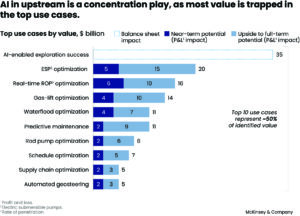
McKinsey’s research across more than 550 upstream oil and gas AI use cases points to a value opportunity of more than $230 billion per year. While a significant portion of that value centers on drilling and completions, the benefits are unevenly distributed among stakeholders. Under the typical dayrate contract, many of the efficiencies created by AI flows to operators, not drillers.
“This has always been the dilemma of drillers,” Mr Ambrose said. “Upstream oilfield services is a dayrate-, activity-based business, yet the whole point of AI is to reduce costs and improve time. If the goal is to reduce the time it takes to drill, that that reduces the revenue a driller gets on a per-well basis. And if you think about all the other activities that are time-based, you’re talking about a lot of margin that could be eroded.”
Despite that imbalance, drilling contractors are investing widely in AI to improve well operations, maintenance and power, safety, crew readiness and technical support. Examples of these investments include ROP optimizers, predictive drilling setpoints, mud-pump health models, BOP condition monitoring, proximity-warning systems and maintenance workflows.
Data ownership and the margin problem
Contracts and risk management will become a more apparent challenge as the industry continues to adopt AI, with data ownership issues already coming to the fore. Traditionally, operators own well programs, geology and downhole measurements, while drillers own rig sensor data, equipment condition records and billing information. Service companies and equipment manufacturers own their own data.
“It’s a mess,” Mr Ambrose said. “When you think about contracts and risk and what you’re going to do with data, we all have these ideas, but the questions are, where is the data coming from, and who owns it? When you’re trying to optimize downhole, you need the operator’s well plans, you need the rig’s data and you need the data from the service company’s downhole tools. They all have to come together.”
Utilizing AI requires stakeholders to answer some hard questions around data. For example, who owns the models that learn from the data? Can a party that has access to data use it to train models, and can those models then be used elsewhere? And if a data feed from another party falls short on quality, who bears responsibility when an AI agent produces bad information?
Negotiating those answers can be a slow process. Mr Ambrose said some McKinsey clients have spent nearly a year working out what they may do with a counterparty’s data. A contractor building a model might ask, for instance, whether it can combine training on an operator’s 1,000 wells with the 50,000 wells already in its own model. “Sometimes the answer is yes, sometimes it’s no,” he said.
Another challenge with AI is the economics of the dayrate model – reducing time on location often means reducing revenue for service providers like drilling contractors. McKinsey’s recent well delivery analysis, released in August 2026, shows AI can help operators reduce their well construction durations by 9-12%. The reduction represents what McKinsey estimates is the immediate efficiency upside available to an operator that transitions from standard practices to a fully optimized, AI-enabled drilling model.
In practice, operators that aggressively implement such transitions typically realize these compressed times over a 12- to 24-month deployment window as workflows are standardized across their active rig fleets. Efficiency gains would come from, for example, utilizing predictive analytics for real-time drilling adjustments, which can mitigate downhole hazards and optimize ROP. Another example is using AI-driven predictive maintenance to mitigate NPT by predicting catastrophic failures on equipment like top drives and mud pumps.
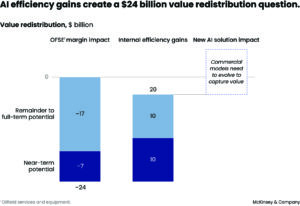
McKinsey estimates that full adoption of AI could erode approximately $24 billion in the valuation of oilfield service companies. The sector could recover roughly $20 billion of that by applying AI to its own cost structures, such as supply chain and back-office functions. For example, enhanced safety and uptime can help a drilling contractor protect revenue and strengthen customer retention, and they may lower equipment maintenance costs through predictive maintenance schedules. Addressing the $4 billion gap in lost valuation, however, would require addressing the commercial upside of those AI-enabled improvements – how they would manifest in performance bonuses, paid digital services and contract wins – and that is less certain.
Moreover, drillers also worry about a ratchet effect for any kind of performance-based contracts. “If I make the improvement on this well, the operator is going to change the bar. That could make the next performance incentive harder to earn and raise questions about whether the profit is sustainable.”
There’s also the cost side of AI. Mr Ambrose said AI providers are now charging what they have long wanted to charge for the tokens – the small fragments of data created when an AI breaks down text through a process – leading to substantial increases in the cost of AI over the past couple of years. This can further erode driller margins, especially in their implementation of AI and provision of ongoing support once those solutions are implemented, unless there is a change in incentive agreements.
Five questions for a new partnership model
McKinsey expects to see a future where tenders will split drillers into two categories: activity providers and performance partners, and only partners will be likely to share in AI’s upside. With that in mind, Mr Ambrose laid out five questions that all parties should address in a tender.
Define success: Success will largely mean cheaper wells, which means both sides must share something. Better utilization and safer wells can be shared benefits, he said, but there must be something in the tender that covers the cost of AI. The question is how will the industry reward lower total well cost while preserving safety, well quality and a sustainable contractor return after AI costs?
Make investment recoverable: Performance-based contracts are not new, but the targets keep tightening and each new level of performance is harder to reach. Contractors need to know how they will recover AI investment over several drilling programs or several years, not just during the drilling of the next well. What commercial commitments can protect that recovery before the next tender resets expectations?
Enable access without surrendering differentiation: For years, drilling contractors had sought to set themselves apart from competitors through rig equipment. Over time, that became more difficult, and performance became the differentiator. If AI is about maximizing performance, Mr Ambrose said, then operators building apps using a contractor’s rig data and then applying the learning to another rig belonging to a competing contractor becomes a real concern. Contractors should set expectations for what customers can and cannot take from their data. The reverse also applies. Contractors’ agreements with operators include confidentiality terms, and companies embedding operator data into their own tools should be sure that they know whether those tools can be taken elsewhere, he said.
Make performance evidence sufficient to earn payment: Parties should define performance upfront and agree on how it will be measured. The harder part is proving it, Mr Ambrose said. “How do you prove performance without showing all the inner workings of your models?” Those workings may be where the differentiation lies, and handing over too much could be giving away a competitive advantage.
Align authority with accountability: Mr Ambrose compared today’s AI decision support to cruise control. At some point, he said, drilling may become fully autonomous. The model making the decision may be the contractor’s, working from someone else’s data, with no human in the loop. “Where do you draw the line of risks and liabilities at that point?” he asked. Contracts will need to address which decisions AI may make, who can override them, and what changes to accountability, liability and compensation should accompany that authority. DC